
Last reviewed: October 10, 2026
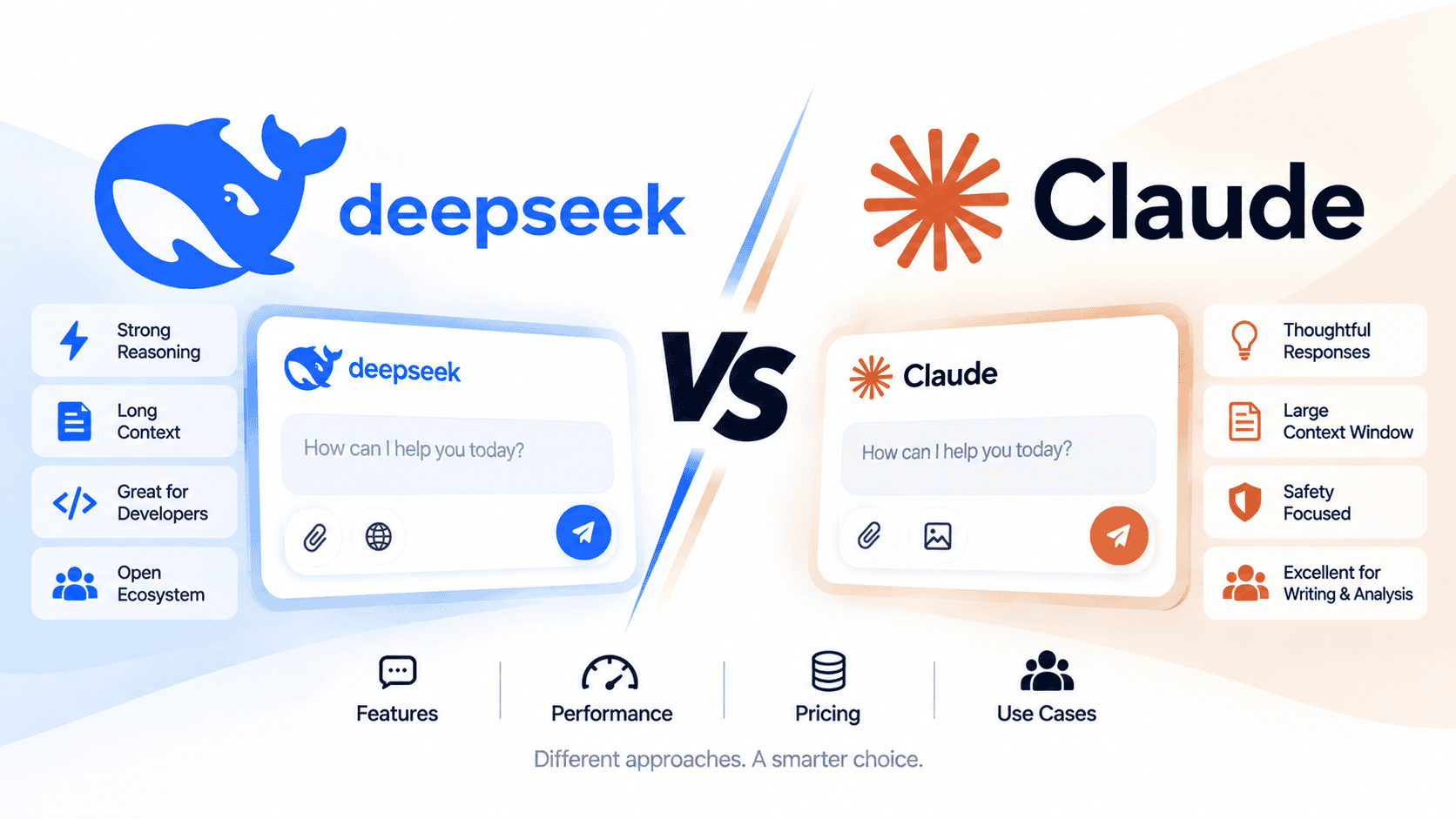
Quick answer: Claude is usually the stronger default for polished writing, structured business work, Claude Code, and enterprise workflows. DeepSeek is often more attractive for cost-sensitive API usage, OpenAI/Anthropic-compatible integrations, long-context experimentation, and high-volume technical tasks where you can test quality against your own workload.
The honest answer to DeepSeek vs Claude is not “one is better.” They are better at different jobs. Claude is a mature product ecosystem built around Claude.ai, Claude Code, Claude API, Team, Enterprise, and cloud deployment options. DeepSeek is a lower-cost model/API option with very aggressive token pricing, a 1M-token context window in its current API models, and compatibility layers that make it easier to plug into OpenAI-style or Anthropic-style workflows.
This comparison is based on official documentation, public pricing pages, and product information checked on the review date. Prices, model names, limits, and privacy terms can change, so always confirm the official pages before making a production decision.
| Use case | Better starting point | Why |
|---|---|---|
| Everyday writing, planning, research, and polished answers | Claude | Claude generally offers a more refined assistant experience, stronger product polish, and better fit for non-technical daily work. |
| Low-cost API calls at scale | DeepSeek | DeepSeek’s listed API prices are much lower than Claude Sonnet and Opus for many token-heavy workloads, although Claude Haiku can still be competitive for lightweight tasks. |
| Agentic software development | Claude Code | Claude Code is a dedicated coding product that works in the terminal, IDEs, GitHub, Slack, and Claude’s app ecosystem. |
| Custom developer integrations | Depends | DeepSeek is attractive if API cost and OpenAI/Anthropic compatibility matter most. Claude is stronger if you need mature tools, cloud options, and enterprise controls. |
| Privacy-sensitive commercial work | Claude commercial plans, after review | Anthropic publishes detailed commercial data-use and retention controls. DeepSeek should be reviewed carefully against your organization’s privacy and jurisdiction requirements. |
| Long-context technical analysis | Depends | Both currently document 1M-token context in their current model lineups, but quality, latency, and cost must be tested on real tasks. |
DeepSeek vs Claude at a glance
Before comparing quality, it is important to define what is being compared. “DeepSeek” can mean the public chat app, the hosted DeepSeek API, or DeepSeek’s released model artifacts. “Claude” can mean Claude.ai, Claude API, Claude Code, Claude for Teams, Claude Enterprise, or Claude through cloud platforms.
| Category | DeepSeek | Claude |
|---|---|---|
| Current API model names checked | deepseek-flash and deepseek-v4-pro | Claude Fable 5.1, Claude Opus 5.5, Claude Sonnet 5.5, Claude Haiku 5.5 |
| API format | OpenAI-compatible and Anthropic-compatible base URLs | Native Claude API, Claude SDKs, and cloud platform availability |
| Context window | DeepSeek API docs list 1M context length for the current models | Anthropic’s model overview lists 1M context for the current Claude lineup |
| Max output | DeepSeek docs list a maximum output of 384K tokens | Anthropic lists 128K max output for the current Claude lineup |
| Pricing style | Peak/off-peak pricing, cache-hit/cache-miss input pricing, and separate output pricing | Per-model input/output token pricing, prompt caching, batch discounts, and data residency pricing |
| Coding product | DeepSeek API can be connected to some agent/coding tools, including Anthropic-format compatibility | Claude Code is a dedicated coding agent product from Anthropic |
| Best overall fit | Cost-sensitive API workloads, technical experimentation, long-context API work, custom integrations | Writing quality, coding workflows, business use, enterprise controls, polished app experience |
The main difference: DeepSeek is a cost-focused model/API play; Claude is a product ecosystem
DeepSeek is most compelling when you are comparing raw model access, API economics, and integration flexibility. Its official API documentation says the DeepSeek API is compatible with OpenAI and Anthropic API formats, using https://api.deepseek.com for OpenAI-style access and https://api.deepseek.com/anthropic for Anthropic-style access. That makes DeepSeek attractive for teams that want to test an alternative backend without rewriting every integration.
Claude is more than a model endpoint. It includes Claude.ai for everyday use, Claude Code for software development, Claude API for developers, Team and Enterprise plans, cloud platform options, workspace controls, usage analytics, and detailed data-handling documentation. That makes Claude stronger when the buying decision includes workflow, admin controls, trust, support, and repeatability rather than token price alone.
For that reason, the right comparison is not “DeepSeek brand vs Claude brand.” A better question is: Which system produces the best result for your exact task, at an acceptable cost, with the privacy and operational controls you need?
Model lineup and technical specs
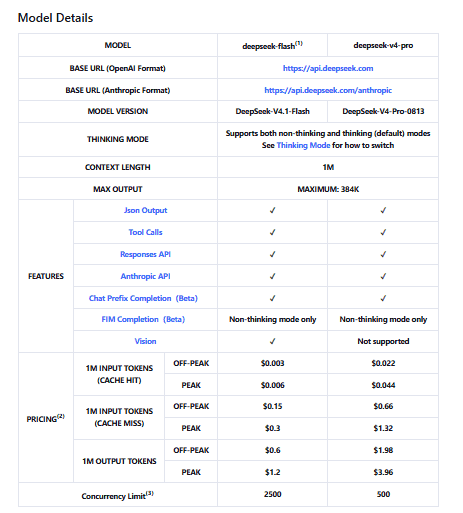
As of this review, DeepSeek’s official pricing page lists two main API model names: deepseek-flash, served by DeepSeek-V4.1-Flash (current hosted version: DeepSeek-V4.1-Flash-1017), and deepseek-v4-pro, served by DeepSeek-V4-Pro-0813. The same page lists 1M context length, 384K maximum output, thinking mode support, JSON output, tool calls, Responses API support, Anthropic API support, and other developer features. It also notes that some legacy model names are still accepted but are served by the newer Flash model and billed at the Flash price.
Anthropic’s current Claude model overview lists Claude Fable 5.1, Claude Opus 5.5, Claude Sonnet 5.5, and Claude Haiku 5.5 as the main current lineup. The same official page describes all current Claude models as supporting text and image input, text output, multilingual capabilities, vision, and tool use, with 1M context and 128K max output.
| Model area | DeepSeek | Claude |
|---|---|---|
| Fast/general model | deepseek-flash | Claude Sonnet 5.5 or Claude Haiku 5.5, depending on complexity |
| Higher-capability model | deepseek-v4-pro | Claude Opus 5.5 or Claude Fable 5.1 for more demanding work |
| Long context | 1M context listed in DeepSeek API docs | 1M context listed for current Claude models |
| Maximum output | 384K listed in DeepSeek API docs | 128K listed in Claude model overview |
| Vision | DeepSeek docs list Vision support for Flash and not for V4 Pro | Claude’s current model overview lists image input and vision support across current models |
| Tool use | Tool calls are listed in DeepSeek docs | Tool use is listed across current Claude models |
The practical takeaway: do not compare DeepSeek’s cheapest model to Claude’s most expensive model and call the result final. Compare the specific model you would actually use for the job.
Pricing: is DeepSeek cheaper than Claude?
For many API workloads, yes, DeepSeek can be much cheaper than Claude Sonnet or Claude Opus on raw token pricing. But “cheaper” needs context. You must specify the model, input tokens, output tokens, cache hits, cache misses, peak or off-peak timing, batch processing, and the cost per successful result.
DeepSeek’s official pricing page uses peak and off-peak rates, and separates input cache hits from cache misses. On the review date, DeepSeek Flash listed peak pricing of $0.30 per 1M cache-miss input tokens and $1.20 per 1M output tokens, with lower off-peak rates. DeepSeek V4 Pro listed peak pricing of $1.32 per 1M cache-miss input tokens and $3.96 per 1M output tokens, also with lower off-peak rates.
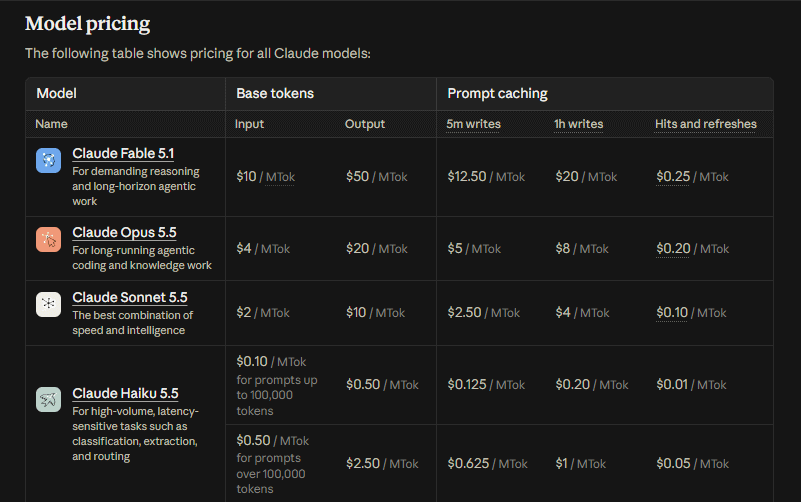
Anthropic’s official pricing page lists Claude Sonnet 5.5 at $2 per 1M input tokens and $10 per 1M output tokens, Claude Opus 5.5 at $4 per 1M input tokens and $20 per 1M output tokens, and Claude Fable 5.1 at $10 per 1M input tokens and $50 per 1M output tokens. Claude Haiku 5.5 starts at $0.10 per 1M input tokens and $0.50 per 1M output tokens for prompts up to 100,000 tokens, with higher pricing for longer prompts.
| Example API workload | Estimated listed cost | Important caveat |
|---|---|---|
| DeepSeek Flash, peak, 1M cache-miss input + 1M output | $1.50 | Peak pricing example. Off-peak and cache-hit input can be lower. |
| DeepSeek V4 Pro, peak, 1M cache-miss input + 1M output | $5.28 | Higher than Flash, but still below Claude Sonnet/Opus in this simple token example. |
| Claude Sonnet 5.5, 1M input + 1M output | $12.00 | Prompt caching and batch processing can reduce cost. |
| Claude Opus 5.5, 1M input + 1M output | $24.00 | Use only when quality gain justifies the higher cost. |
| Claude Haiku 5.5, 1M input + 1M output for short-prompt requests | $0.60 | Haiku can be cheaper than DeepSeek Flash for some lightweight workloads, but it is not the same quality class. |
This is why the best pricing question is not “Which provider is cheaper?” It is: Which model completes this task reliably with the fewest retries, smallest output, acceptable latency, and lowest total cost?
Coding: DeepSeek API vs Claude Code
For coding, the comparison depends on whether you mean model output or the complete development workflow.
DeepSeek can be a strong choice for code generation, technical reasoning, debugging prompts, algorithmic tasks, and high-volume coding assistance where API cost matters. It is especially interesting for teams that already have their own coding agent, evaluation harness, or internal developer tooling and simply need a cheaper model backend to test.
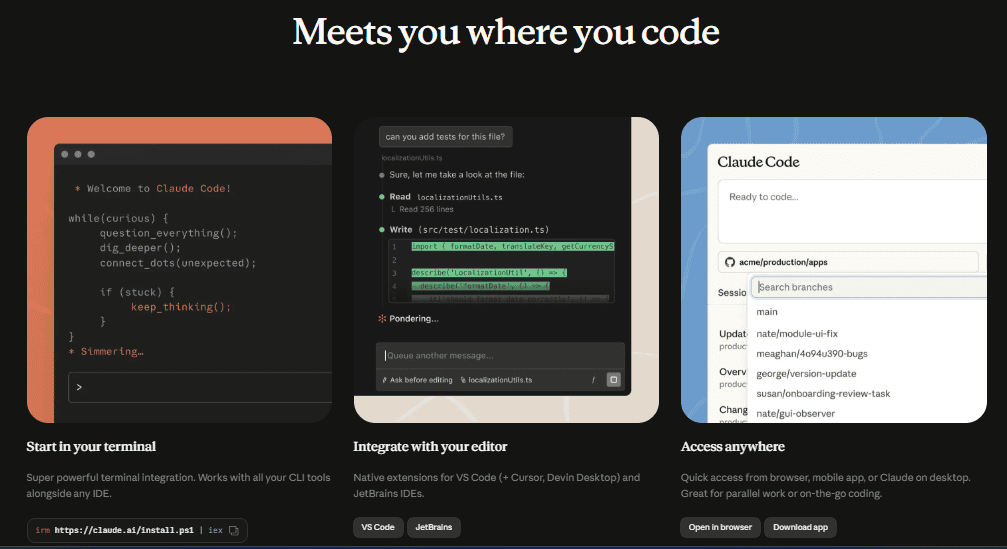
Claude is stronger if the job is not just “write code,” but “work inside a real codebase.” Claude Code is designed for tasks such as bug fixes, tests, multi-file refactors, repo understanding, command-line workflows, IDE usage, GitHub workflows, and long-running development sessions. Anthropic describes Claude Code as available across terminal, IDE, Slack, web, and other surfaces, with Pro, Max, Team, Enterprise, and Console access paths.
| Coding need | Choose DeepSeek if… | Choose Claude if… |
|---|---|---|
| Cheap repeated code generation | You run many prompts and can evaluate outputs automatically. | You need higher reliability and fewer manual retries. |
| Repository-scale work | You already have your own agent tooling around the model. | You want Claude Code to inspect files, run commands, plan changes, and work in your existing dev environment. |
| Algorithmic coding tasks | You care about cost and can test accuracy with unit tests. | You need clearer explanations, reviewability, and safer step-by-step changes. |
| Enterprise software teams | You have strict cost targets and can manage integration and security yourself. | You need admin controls, usage tracking, workspace management, and established commercial terms. |
Do not compare DeepSeek chat with Claude Code as if they are the same product. A fair comparison would be DeepSeek API inside your chosen coding agent versus Claude Code in the same type of workflow.
API and developer experience
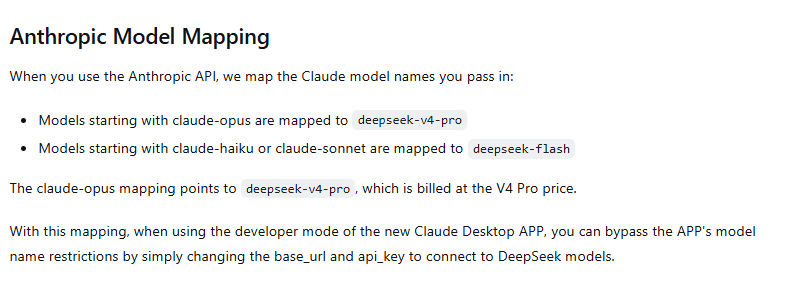
DeepSeek’s strongest developer advantage is compatibility. The official docs say the DeepSeek API can be accessed through OpenAI-compatible and Anthropic-compatible formats. DeepSeek also documents how Claude-style model names are mapped when using its Anthropic API compatibility layer: Claude Opus-style names map to deepseek-v4-pro, while Claude Sonnet and Haiku-style names map to deepseek-flash. That is useful for testing, but it also means you must be careful: passing a Claude model name to DeepSeek does not call the real Claude model.
Claude’s developer advantage is depth of ecosystem. Anthropic offers official model documentation, pricing documentation, SDKs, Claude Code, prompt caching, batch processing, tool use, cloud platform options, data residency pricing, and detailed controls for commercial customers. This matters when a model is part of a production system instead of an isolated experiment.
DeepSeek is easier to test as a backend swap
If your app already uses an OpenAI-style SDK or an Anthropic-style SDK, DeepSeek may be relatively easy to test by changing the base URL, API key, and model name. That can reduce migration friction and help you benchmark cost, latency, and answer quality quickly.
Claude is stronger as a managed development platform
If your team needs predictable commercial terms, model documentation, security controls, team administration, coding-agent workflows, and cloud deployment choices, Claude usually has the stronger platform story.
Writing, research, and everyday productivity
For general writing, planning, summarization, careful editing, document drafting, and business communication, Claude is usually the safer recommendation. Its answers tend to be structured, readable, and easier to adapt into polished documents. Claude’s product ecosystem also supports projects, files, web, desktop, mobile, and business plans, which makes it more convenient for non-developers.
DeepSeek can still be useful for writing and research, especially if cost matters or you need very long context in API workflows. However, for a user who wants one polished assistant for daily thinking, writing, and professional work, Claude is usually easier to recommend.
The best approach for serious work is to test both on your own examples. Give each system the same source material, instructions, and quality checklist. Then compare factual accuracy, structure, tone, hallucination rate, edit time, and cost.
Long-context work
Both DeepSeek and Claude now document 1M-token context in their current model information. But a large context window does not automatically mean better results. Long-context quality depends on retrieval accuracy, attention to earlier details, instruction following, latency, output length, and cost.
Choose DeepSeek for long-context work when the priority is lower-cost processing of large inputs and you can validate the output with your own checks. Choose Claude when the priority is careful synthesis, professional writing, codebase understanding, or enterprise workflow controls.
Privacy, data handling, and enterprise use
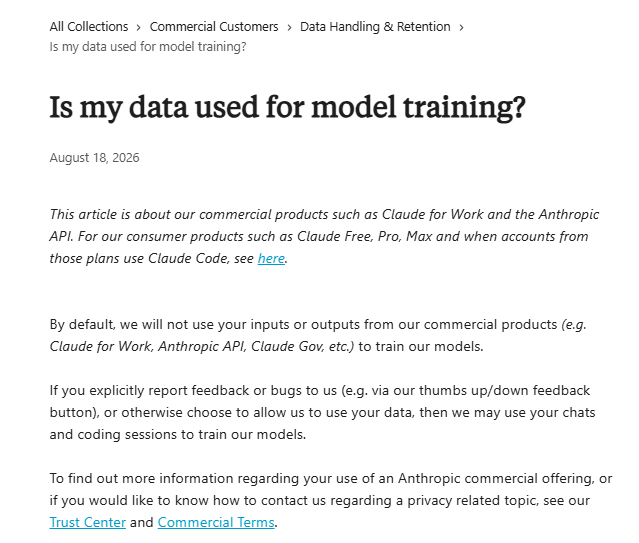
For privacy-sensitive work, Claude currently has a clearer public documentation trail. Anthropic’s commercial privacy documentation says that, by default, Anthropic does not use inputs or outputs from commercial products such as Claude for Work and the Anthropic API to train models. Claude Code documentation also distinguishes consumer use from commercial use, explains training preferences, and describes retention periods and zero-data-retention availability for qualified accounts.
That does not mean every Claude plan is automatically safe for every sensitive use case. Consumer, Pro, Max, Team, Enterprise, API, cloud provider, and Claude Code sessions can have different terms and controls. You should review the exact plan and data flow before pasting confidential data, source code, customer records, medical data, legal material, or regulated business information.
For DeepSeek, review the official DeepSeek Privacy Policy, API terms, data location, retention language, and enterprise options before using it with sensitive or regulated data. If your organization has strict data residency, procurement, or compliance rules, do not treat low API price as the deciding factor.
| Privacy question | Why it matters | What to check |
|---|---|---|
| Will prompts or outputs be used for training? | This affects sensitive business, legal, and code data. | Check the exact plan, API terms, and opt-in/opt-out settings. |
| How long is data retained? | Retention affects breach exposure and compliance. | Check standard retention, feedback retention, safety review retention, and deletion terms. |
| Where is inference processed? | Some businesses require data residency or regional routing. | Check global, US-only, cloud-provider, or enterprise deployment options. |
| Who can access logs? | Human review policies matter for confidential information. | Check security review, abuse monitoring, support access, and audit controls. |
| Can you get zero data retention? | Important for high-sensitivity workloads. | Check eligibility, contract terms, and model exceptions. |
When to choose DeepSeek
Choose DeepSeek if your main priority is API cost, compatibility, and technical experimentation.
- You need a lower-cost API for high-volume workloads.
- You already have your own evaluation system and can measure output quality.
- You want OpenAI-compatible or Anthropic-compatible API access.
- You are building internal tools where model swapping is part of the architecture.
- You need long-context API processing and can validate the results.
- You are comfortable reviewing privacy, hosting, and compliance terms yourself.
- You do not need Claude Code’s integrated product workflow.
DeepSeek is not automatically the best choice just because the token price is low. It is best when lower cost still produces acceptable task completion quality.
When to choose Claude
Choose Claude if your main priority is quality, workflow, coding-product maturity, or business controls.
- You want a polished assistant for writing, planning, research, and analysis.
- You want Claude Code for real codebase work, not just isolated code generation.
- You need Team or Enterprise features, admin controls, usage analytics, or commercial data terms.
- You need strong tool-use workflows and reliable developer documentation.
- You prefer a managed product over building your own AI workflow layer.
- You are working with sensitive business data and need clearer commercial documentation.
- You can justify higher token costs with fewer retries, better output quality, or faster human review.
Claude is not automatically the best choice for every workload. If you are processing millions of tokens at scale, Claude’s higher-tier models can become expensive unless the quality gain reduces total retries, review time, or operational risk.
Testing checklist before choosing
If you are choosing between DeepSeek and Claude for a real project, run a small evaluation instead of relying on generic benchmark claims.
- Pick 20 to 50 real tasks from your actual workflow: coding issues, customer replies, document summaries, extraction tasks, or reasoning questions.
- Use the exact models you would deploy, not the cheapest model from one provider and the strongest model from the other.
- Measure task success, not just answer length or style.
- Track retries, because a cheaper model that needs three attempts may not be cheaper in practice.
- Track review time, especially for writing, legal, support, and code review tasks.
- Record input tokens, output tokens, cache behavior, and latency.
- Test privacy controls, including data retention, deletion, training settings, and enterprise requirements.
- Check integration effort, including SDK compatibility, rate limits, monitoring, logging, and failover.
- Calculate cost per accepted answer, not only cost per token.
Common mistakes in DeepSeek vs Claude comparisons
- Calling DeepSeek “cheapest” without conditions. You must specify model, cache, peak/off-peak timing, input/output mix, and task success rate.
- Comparing Claude Code to the DeepSeek chat app. Claude Code is a coding agent product; the fair comparison is Claude Code versus a DeepSeek-powered coding agent setup.
- Using old model names. Model lineups change quickly. Always verify current model IDs from official docs.
- Ignoring Claude Haiku. Claude Haiku can be very low cost for lightweight tasks, so not every Claude workload is expensive.
- Trusting benchmark screenshots without methodology. Benchmarks vary by prompt, model version, tool use, evaluator, and date.
- Ignoring privacy terms. API price does not replace data-governance review.
- Assuming long context equals better reasoning. Long context helps only if the model uses the right information accurately.
Final verdict: DeepSeek vs Claude
Choose DeepSeek if you are a developer or technical team optimizing for API cost, compatibility, large-context experiments, and high-volume workloads where you can test quality with your own evaluation pipeline.
Choose Claude if you want a polished AI assistant, stronger writing experience, Claude Code, business-friendly product features, commercial data documentation, and a more complete workflow around the model.
For most everyday users, Claude is the easier recommendation. For cost-sensitive API teams, DeepSeek deserves serious testing. For software teams, Claude Code is the stronger out-of-the-box product, while DeepSeek can be compelling if you already have your own coding-agent infrastructure and want to reduce model cost.
The best answer is not “DeepSeek wins” or “Claude wins.” The best answer is: test both on your real workload, compare total cost per accepted result, and choose the system that gives you the best balance of quality, cost, privacy, and workflow fit.
FAQ
Is DeepSeek better than Claude?
DeepSeek can be better for low-cost API usage, compatible integrations, and high-volume technical workloads. Claude is usually better for polished writing, everyday productivity, Claude Code, and enterprise workflows. Neither is universally better.
Is Claude better than DeepSeek for coding?
Claude is usually better if you mean full coding workflows through Claude Code. DeepSeek can still be strong for code generation and technical prompts, especially when cost matters and you have tests or evaluation tools to verify the output.
Which is cheaper, DeepSeek or Claude?
DeepSeek is often cheaper than Claude Sonnet and Claude Opus on raw API token pricing. However, Claude Haiku can be very cheap for lightweight tasks, and Claude’s prompt caching and batch processing can reduce costs. Always compare the exact models and workload.
Can DeepSeek use the Anthropic API format?
Yes. DeepSeek documents an Anthropic-compatible API base URL. However, using an Anthropic-style model name through DeepSeek does not call the real Claude model; DeepSeek maps those names to its own models.
Is DeepSeek better than Claude Code?
Not as a direct product comparison. Claude Code is a dedicated coding agent product. DeepSeek is better compared as a model backend that could power coding tools. If you want an integrated coding workflow, Claude Code is the stronger out-of-the-box choice.
Which is better for business use?
Claude is usually the safer starting point for business use because Anthropic provides detailed commercial product, team, enterprise, data-use, and retention documentation. DeepSeek may still be attractive for cost-sensitive business APIs, but it needs careful privacy, legal, and security review before sensitive use.
Which is better for privacy-sensitive work?
For privacy-sensitive work, review the exact plan and terms. Anthropic publishes detailed commercial data-use and retention documentation, including differences between consumer and commercial usage. For DeepSeek, review the official privacy policy, API terms, data location, and enterprise options before using sensitive data.
Should developers test both?
Yes. Developers should test DeepSeek and Claude on real tasks, measure accepted outputs, retries, latency, token use, cache behavior, and review time. The best model is the one that solves your actual workload at the best total cost and acceptable risk.