

DeepSeek R1 is DeepSeek’s first-generation reasoning model, released in January 2025. It became important because it showed strong reasoning performance, was released with open weights and a technical report, and helped push wider interest in reinforcement-learning-based reasoning models.
However, DeepSeek R1 is now an older legacy model by current DeepSeek standards. The old API name deepseek-reasoner originally referred to R1, but it later changed meaning across newer DeepSeek releases and was eventually scheduled for discontinuation during the move to V4 models. New API users should not assume deepseek-reasoner still means the original R1 model.
Documentation checked: October 4, 2026. This article is based on official DeepSeek release notes, the DeepSeek API change log, the DeepSeek-R1 model card, and the R1 paper. No live API request, local deployment, or benchmark test was performed.
DeepSeek R1 quick facts
| Item | Current explanation |
|---|---|
| Original release | January 20, 2025 |
| Model type | First-generation reasoning model from DeepSeek |
| Original API name | deepseek-reasoner at launch |
| Current API status | Do not assume deepseek-reasoner still means R1; use the current DeepSeek model table for hosted API work |
| Main open-weight model | deepseek-ai/DeepSeek-R1 on Hugging Face |
| Related model | DeepSeek-R1-Zero, an earlier RL-only reasoning experiment |
| R1 model size | 671B total parameters, 37B activated parameters, 128K context in the official model card |
| Distilled models | Six dense checkpoints based on Qwen and Llama families |
| License | The model card lists the code repository and model weights under the MIT License, with additional base-model license notes for distilled models |
Why DeepSeek R1 mattered in 2025
The official DeepSeek-R1 release page introduced R1 as an open reasoning model with performance positioned as comparable to OpenAI-o1 on reasoning tasks. DeepSeek also released the model and technical report under an open-weight framing, with the code and models described as MIT licensed.
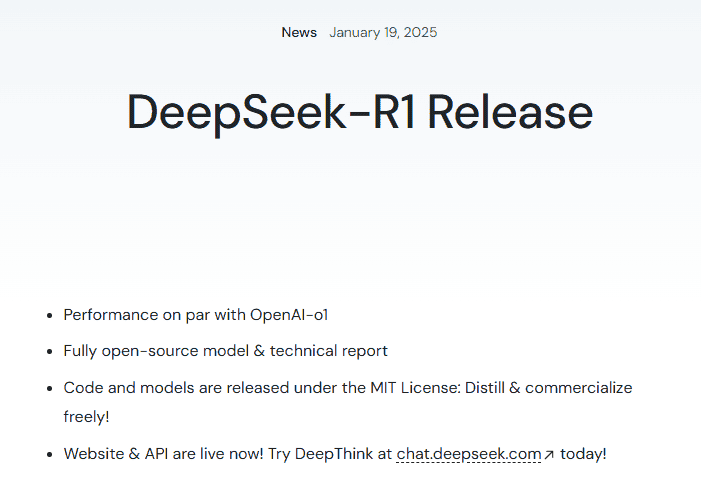
R1 mattered because it focused directly on reasoning tasks: mathematics, coding, logic, STEM-style problems, and complex multi-step problem solving. The official DeepSeek-R1 model card says DeepSeek-R1 was designed to address problems in R1-Zero while improving reasoning performance through cold-start data and reinforcement-learning stages.
That historical importance should not be confused with current default API usage. R1 was a major 2025 model release, but DeepSeek’s API and model lineup have moved through later V3, V4, and V4.1 releases since then.
DeepSeek R1 timeline: from release to legacy status
| Date | What happened | Why it matters now |
|---|---|---|
| January 20, 2025 | DeepSeek released DeepSeek-R1. The release page said API users could access it with model=deepseek-reasoner. | This explains why old tutorials use deepseek-reasoner for R1. |
| January 22, 2025 | The DeepSeek-R1 paper was submitted to arXiv. | The paper is the primary source for the RL and reasoning-method discussion. |
| May 28, 2025 | DeepSeek-R1-0528 was released. DeepSeek described improved benchmark performance, reduced hallucinations, and JSON output/function calling support. | R1 had a later upgrade; not every R1 reference means the original January release. |
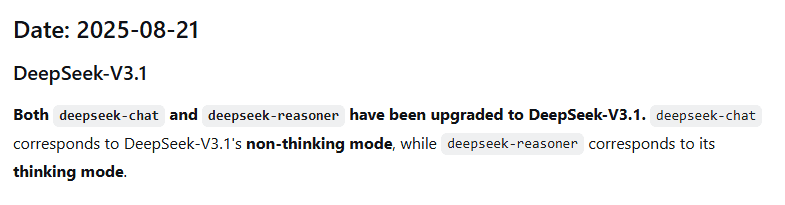
| August 2025 | The API change log says deepseek-chat and deepseek-reasoner were upgraded to DeepSeek V3.1, with deepseek-reasoner corresponding to the thinking mode. | At this point, deepseek-reasoner no longer meant the original R1 model. |
| September 2025 | The same aliases were upgraded again to V3.1-Terminus. | Old model-name assumptions became increasingly unsafe. |
| April 2026 | DeepSeek’s V4 update scheduled the legacy deepseek-chat and deepseek-reasoner names for discontinuation and temporarily mapped them to V4 Flash modes. | For current API work, use the current model table instead of old R1-era names. |
The key lesson is simple: DeepSeek R1 still exists as an open-weight historical model release, but the old hosted API alias is not a stable current way to get the original R1 model.
DeepSeek-R1-Zero vs DeepSeek-R1
The DeepSeek-R1 model card distinguishes two important releases: DeepSeek-R1-Zero and DeepSeek-R1.
DeepSeek-R1-Zero was trained with large-scale reinforcement learning without supervised fine-tuning as a preliminary step. It demonstrated interesting reasoning behaviors such as self-verification and long reasoning traces, but the model card says it suffered from problems including endless repetition, poor readability, and language mixing.
DeepSeek-R1 added cold-start data before reinforcement learning to improve readability and reasoning performance. That makes R1 the more practical model in the original R1 family, while R1-Zero remains important as an experimental proof point for RL-driven reasoning behavior.
What changed with DeepSeek-R1-0528?
DeepSeek-R1-0528 was a later update to the R1 line. DeepSeek described it as improving benchmark performance, enhancing front-end capabilities, reducing hallucinations, and supporting JSON output and function calling.
The API note for R1-0528 said there was no change to API usage at that time. That made sense in May 2025, when deepseek-reasoner still represented the R1 line. It should not be read as a permanent 2026 instruction to use deepseek-reasoner for R1 today.
For current hosted API work, always check the latest DeepSeek API change log and the current Models & Pricing page.
Is deepseek-reasoner still DeepSeek R1?
No, not as a safe current assumption. At R1 launch, deepseek-reasoner was the hosted API name for DeepSeek-R1. The API change log later shows that the same name was upgraded to R1-0528, then to V3.1 thinking mode, then to V3.1-Terminus thinking mode, then scheduled for discontinuation with the V4 transition.
If you have old code like this:
{
  "model": "deepseek-reasoner"
}
treat it as old R1-era code. Do not assume it still calls the original R1 model. Update the integration according to the current official model table and the current Thinking Mode documentation.
DeepSeek has not documented a current hosted API model ID such as deepseek-r1 in the current model table. Do not invent one. If you specifically need R1, use the open-weight model resources or a provider that explicitly serves DeepSeek-R1, and verify that provider’s own model name, pricing, and terms.
DeepSeek R1 is not the same as current Thinking Mode
DeepSeek R1 was a specific model release. Thinking Mode is a current API behavior or control that lets supported newer DeepSeek models produce reasoning before their final answer.
That distinction prevents a common misunderstanding:
- DeepSeek R1 was a historical reasoning model.
- Current DeepSeek models can support thinking without being R1.
- Enabling Thinking Mode on a newer model does not recreate the exact R1 model.
- Old tutorials that say “use
deepseek-reasoner” may now be outdated.
For new hosted API projects, use the currently documented model IDs and thinking controls. For the original R1 model, use the open-weight resources or a host that explicitly serves that model.
Open weights, distilled models, and license
The official DeepSeek-R1 model card lists both DeepSeek-R1-Zero and DeepSeek-R1 as 671B-total-parameter, 37B-activated-parameter models with 128K context. It also says DeepSeek released six distilled dense models based on Qwen and Llama families.
| Model group | What it contains | Practical note |
|---|---|---|
| Full R1 models | DeepSeek-R1-Zero and DeepSeek-R1 | Very large MoE models; open weights do not mean easy local deployment. |
| Qwen distills | 1.5B, 7B, 14B, and 32B dense models | More practical for many local experiments; check base-model license details. |
| Llama distills | 8B and 70B dense models | Check the relevant Llama license terms in addition to DeepSeek’s notes. |
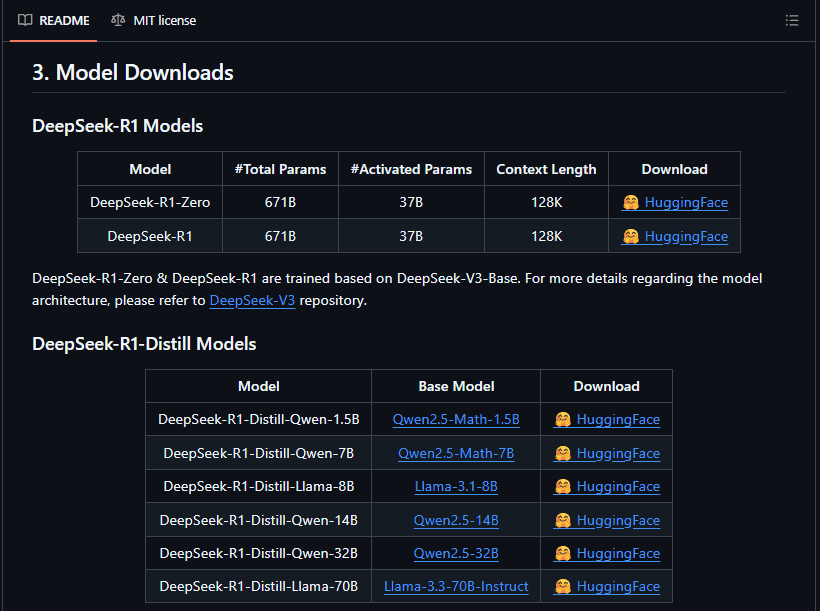
The model card says the code repository and model weights are licensed under the MIT License and supports commercial use, modifications, and derivative works. It also notes that the distilled Qwen and Llama models are derived from their respective base model families, so you should check the relevant base-model licenses before commercial or redistributed use.
Open weights do not automatically mean the training data is open, that training can be fully reproduced, or that running the model locally is simple.
Can you run DeepSeek R1 locally?
You can use the DeepSeek-R1 open-weight resources, but “running R1 locally” can mean very different things depending on which checkpoint you choose.
The full DeepSeek-R1 model is extremely large. The model card points readers to DeepSeek-V3 resources for running full R1 locally and notes that Hugging Face Transformers was not directly supported for the full R1 model in that section. By contrast, the R1-Distill models can be used more like Qwen or Llama models, and the model card gives examples using vLLM and SGLang for a distilled Qwen-32B checkpoint.
Do not assume a consumer laptop can run the full R1 model. If your goal is local experimentation, the distilled checkpoints are usually the more realistic starting point. Even then, hardware, quantization, inference engine, context length, and licensing all matter.
R1 usage recommendations are not current API rules
The DeepSeek-R1 model card includes usage recommendations for the R1 series. It recommends a temperature range of 0.5–0.7, with 0.6 recommended, to reduce repetition or incoherent output. It also recommends putting instructions in the user prompt rather than adding a system prompt, and asking the model to reason step by step for mathematical problems.
Those are R1-series model-card recommendations. Do not apply them automatically to every current DeepSeek model or every hosted API workflow. Modern DeepSeek API models have their own Thinking Mode controls, reasoning effort settings, and format-specific behavior.
The model card also mentions forcing the model to start with <think> in some R1-series cases to avoid a thinking-pattern bypass. That is a local/open-weight R1-series note, not a general instruction for current DeepSeek API models.
How to read R1 benchmarks today
R1 benchmark tables are useful historical evidence, especially for math, code, and reasoning. The model card reports results such as AIME, MATH-500, GPQA Diamond, LiveCodeBench, Codeforces, SWE Verified, and distilled-model evaluations. It also documents important evaluation settings, including maximum generation length and sampling parameters for benchmark runs.
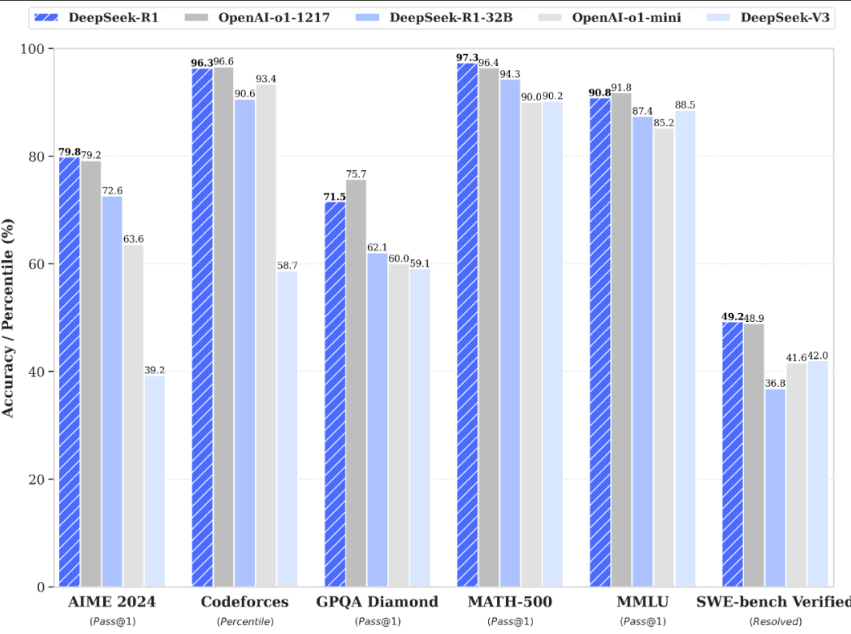
Do not use those 2025 results to claim that R1 is the strongest model today. The correct interpretation is narrower: R1 was highly competitive when it was released and had a major effect on the open-weight reasoning-model landscape. For current deployment decisions, compare it against current DeepSeek models and the specific provider or local inference route you plan to use.
Should developers use R1 or a current DeepSeek model?
For new hosted API work, start from the current DeepSeek model table rather than old R1 tutorials. Current API models expose modern model IDs, longer context, current Thinking Mode controls, Tool Calls, JSON Output, Responses API, Anthropic API, and—in the case of Flash—Vision support.
R1 still makes sense when you specifically need:
- the historical R1 open-weight model for research;
- one of the R1-Distill checkpoints for local or smaller-scale experiments;
- compatibility with an existing R1-specific evaluation setup;
- a provider that explicitly serves DeepSeek-R1 or R1-0528 and documents its own terms.
R1 is not useless. It is simply no longer the default current hosted DeepSeek API route.
Migration checklist for old R1-era code
If you maintain old examples, agents, or scripts that were written around the R1 launch, check these items before using them today:
- Do not assume
deepseek-reasonerstill means the original DeepSeek-R1 model. - Check the current DeepSeek API change log for what legacy names currently mean.
- Use the current Models & Pricing page for active hosted API model IDs.
- Use current Thinking Mode controls for reasoning on supported modern models.
- Do not copy old launch pricing into current budgeting.
- Do not apply R1-specific prompt recommendations to every newer DeepSeek model.
- If you need R1 specifically, choose the Hugging Face/GitHub open-weight path or a provider that explicitly says it serves DeepSeek-R1.
- Check the license of distilled models and their base models before redistribution or commercial deployment.
Common DeepSeek R1 misunderstandings
| Misunderstanding | What is actually safer to say |
|---|---|
| “DeepSeek R1 is the current DeepSeek API model.” | R1 is a historically important reasoning model. Current API work should use the current model table. |
“deepseek-reasoner still means R1.” | It meant R1 at launch, but later changed meaning and was scheduled for discontinuation in the V4 transition. |
| “R1 and Thinking Mode are the same thing.” | R1 is a model. Thinking Mode is a current behavior/control available on supported newer models. |
| “DeepSeek-R1-Zero and DeepSeek-R1 are identical.” | R1-Zero was the RL-only preliminary model; R1 added cold-start data to improve readability and performance. |
| “All R1 distilled models have identical license terms.” | They are based on Qwen and Llama families; check each base-model license and DeepSeek’s model-card notes. |
| “Open weights mean I can easily run the full R1 model locally.” | Full R1 is extremely large. Distilled models are more practical for many local experiments. |
| “R1 benchmark tables prove it is still best today.” | They show historical performance in documented settings. Compare against current models for present-day decisions. |
Official resources
- DeepSeek-R1 release page
- DeepSeek API change log
- DeepSeek-R1-0528 release page
- DeepSeek-R1 model card on Hugging Face
- DeepSeek-R1 GitHub repository
- DeepSeek-R1 paper on arXiv
- Current DeepSeek Models & Pricing
- Current DeepSeek Thinking Mode guide
FAQ
What is DeepSeek R1?
DeepSeek R1 is DeepSeek’s first-generation reasoning model, released in January 2025. It focused on math, coding, and reasoning tasks and was released with open weights and a technical report.
Is DeepSeek R1 old?
Yes. DeepSeek R1 is old by current DeepSeek standards. It remains important historically and as an open-weight model, but it should not be treated as the default current hosted API model.
Is deepseek-reasoner still DeepSeek R1?
Not as a safe current assumption. deepseek-reasoner referred to R1 at launch, but the API change log later shows the alias moved through R1-0528 and newer DeepSeek thinking-mode models before being scheduled for discontinuation during the V4 transition.
What is DeepSeek-R1-Zero?
DeepSeek-R1-Zero was an earlier reasoning model trained with large-scale reinforcement learning without supervised fine-tuning as a preliminary step. It showed strong reasoning behaviors but also had repetition, readability, and language-mixing problems.
What is DeepSeek-R1-0528?
DeepSeek-R1-0528 was a May 2025 update to the R1 line. DeepSeek described it as improving benchmark performance, reducing hallucinations, and supporting JSON output and function calling. It is part of R1’s historical lifecycle, not necessarily the current hosted API model.
Is DeepSeek R1 open source?
The DeepSeek-R1 model card says the code repository and model weights are licensed under the MIT License. The distilled Qwen and Llama models also have base-model license considerations that should be checked separately.
Should I use R1 or a newer DeepSeek model?
Use current DeepSeek API models for new hosted API work unless you specifically need the R1 open weights, an R1-distilled checkpoint, or a provider that explicitly serves R1. Use the current Thinking Mode guide for reasoning behavior on newer models.