
DeepSeek can be reasonable for low-risk, non-sensitive tasks, but it should not be treated as automatically safe for confidential, regulated, proprietary, or highly personal data. The right answer depends on how you use it: hosted chat, mobile app, API, a third-party provider, or a local/open-weight deployment all have different risks.
According to DeepSeek’s official Privacy Policy, its hosted services may collect prompts, uploaded files, photos, voice inputs, feedback, chat history, account data, device and network data, IP address, approximate location, cookies, and payment/order information for paid platform services. The policy also says the personal data it collects is directly collected, processed, and stored in the People’s Republic of China.
Documentation checked: October 4, 2026. This article is an informational safety and privacy guide, not legal advice, not a security audit, and not a certification that DeepSeek is safe or unsafe for every use case.
Quick answer: when is DeepSeek lower risk or higher risk?
The table below is an editorial risk guide, not an official rating. No AI tool is zero-risk.
| Use case | Risk level | Why | Safer approach |
|---|---|---|---|
| Asking about public information | Lower | You are not sharing private data, but answers can still be wrong. | Use it for learning or drafting, then verify important facts. |
| Writing or editing non-sensitive text | Lower to medium | The text is sent to a hosted service if you use chat or API. | Remove personal, client, and confidential details first. |
| Coding with public examples | Lower to medium | Code output can contain bugs or insecure patterns. | Use non-confidential snippets and test generated code. |
| Pasting proprietary source code | High | It may expose trade secrets, internal architecture, secrets, or vulnerabilities. | Use only approved company workflows; redact secrets and private code. |
| Uploading personal documents | High | Uploaded files are included in the categories of Inputs DeepSeek may collect. | Avoid uploading identity, financial, health, legal, or private documents unless approved. |
| Uploading work documents | High | Internal files may contain confidential, regulated, or customer data. | Follow company policy; classify and redact data before use. |
| Using customer data | High | You may have legal, contractual, or compliance obligations. | Use only approved systems and confirm disclosure, consent, and processing rules. |
| Medical, legal, or financial decisions | High | DeepSeek’s Terms say outputs may contain errors and are not professional advice. | Use qualified professionals and human review; do not rely on output alone. |
| API integration in a product | Medium to high | Developers must protect API keys, disclose personal-data rules, and validate outputs. | Keep keys server-side, redact logs, validate outputs, and review Open Platform Terms. |
| Local/open-weight deployment | Variable | Prompts may stay on your infrastructure, but you inherit security, logging, licensing, and operations risk. | Secure the environment, control access, review licenses, and monitor usage. |
| Third-party DeepSeek provider | Variable | The provider may have different logging, privacy, model version, and terms. | Check the provider’s privacy policy, terms, model route, and data location. |
What “safe” means for DeepSeek
“Safe” can mean several different things. A good safety decision should separate these layers:
- Privacy safety: what happens to prompts, files, account data, chat history, and logs.
- Security safety: whether your account, API keys, app source, and deployment route are protected.
- Output safety: whether answers are accurate, complete, and appropriate for the task.
- Workplace safety: whether your company allows the tool for the type of data you want to use.
- Regulatory safety: whether your jurisdiction, sector, or organization has rules about the service.
- Local deployment safety: whether self-hosting is secured, logged, monitored, licensed, and maintained correctly.
DeepSeek is not simply “safe” or “unsafe.” It is lower risk for general, non-sensitive tasks and higher risk when prompts or uploads include sensitive personal data, confidential work, regulated records, proprietary code, secrets, or information that affects real people.
What data does DeepSeek collect?
DeepSeek’s Privacy Policy says it collects personal data in three ways: data users provide, data automatically collected, and data from other sources. Depending on how you use the service, this may include:
| Data category | Examples from DeepSeek’s policy | What it means for users |
|---|---|---|
| Account data | Email address, phone number, password, date of birth where applicable, username where applicable. | Use a strong password and avoid sharing account credentials. |
| User input | Text input, voice input, prompts, uploaded files, photos, feedback, chat history, and other content provided to the model and services. | Do not submit sensitive or confidential data unless you are authorized and understand the risk. |
| Device and network data | Device model, operating system, IP address, device identifiers, system language, diagnostic and performance logs. | Usage may be linked to device and network information. |
| Location data | Approximate location based on IP address. | The policy says DeepSeek will not obtain precise geolocation by other means without explicit consent. |
| Cookies and similar technologies | Cookies for security and to understand service use. | Cookie controls may depend on law and settings. |
| Payment data | Payment order and transaction data for paid open platform services. | API/platform billing has separate account and payment implications. |
| Third-party login data | Data from third-party login services such as Apple or Google where available, such as access tokens. | Third-party sign-in adds another account and privacy layer. |
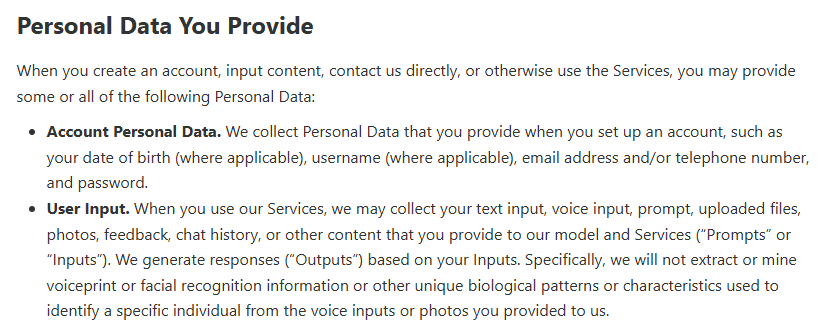
DeepSeek’s privacy policy identifies the user inputs its hosted services may collect.The same policy says DeepSeek’s services are not designed or intended to process sensitive personal data, and users should not provide sensitive personal data to the services. That includes data such as health information, children’s data, precise geolocation, genetic or biometric data, and other sensitive categories listed in the policy.
Where is DeepSeek data stored?
DeepSeek’s Privacy Policy says the personal data it collects from users may be stored on a server outside the country where the user lives. It also says: to provide the services, DeepSeek directly collects, processes, and stores personal data in the People’s Republic of China.
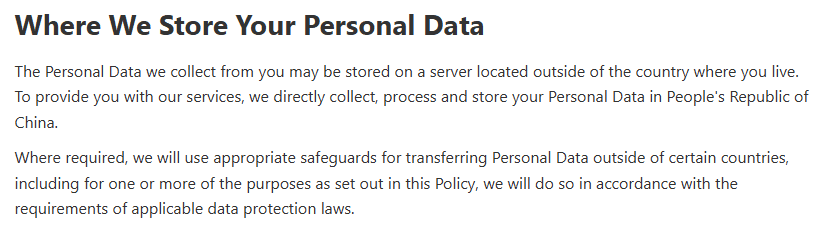
DeepSeek’s policy states that personal data is processed and stored in China.This does not automatically mean every use is illegal or unsafe. It does mean users and organizations should consider cross-border transfer, data residency, internal policy, vendor review, and applicable law before using DeepSeek for workplace, customer, confidential, or regulated data.
If your employer, school, client, or regulator has rules about where data may be processed, do not use the hosted DeepSeek chat, app, or API until that route has been approved.
Does DeepSeek use prompts for training?
DeepSeek’s Privacy Policy says it uses personal data to improve and develop services and to train and improve its technology, including machine learning models and algorithms. The policy also lists a right to opt out of using personal data for training models or optimizing technologies, depending on where the user lives and subject to applicable legal exceptions.
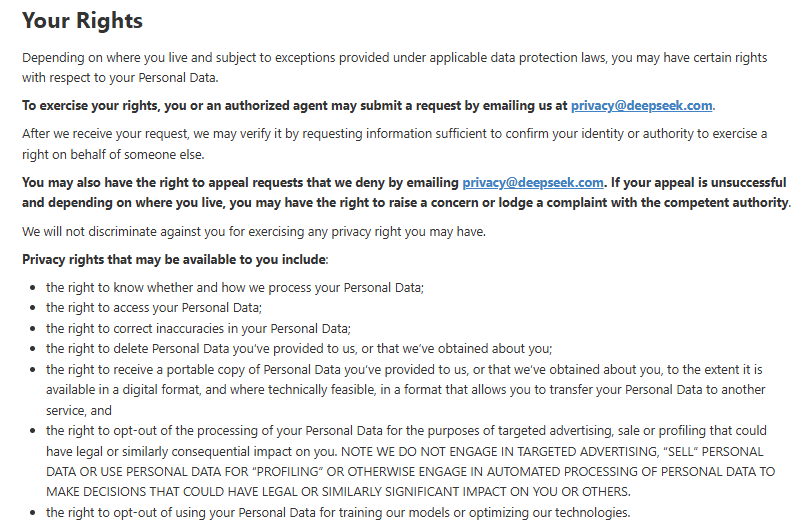
Training opt-out rights depend on applicable law and the exceptions described in DeepSeek’s policy.Do not overread this. An opt-out right does not necessarily mean previously submitted data is deleted from every system, and it does not automatically answer every API, enterprise, or third-party provider scenario. Check the current privacy policy, account settings, and applicable platform terms for the exact route you use.
If training or retention terms matter to you, do not paste sensitive data first and ask later. Review the policy and get approval before using the tool with sensitive information.
Is DeepSeek Chat safe?
DeepSeek Chat can be useful for general questions, writing, learning, summarizing public information, and experimenting with non-sensitive ideas. It is not a private notebook by default. Prompts, uploaded files, photos, voice inputs, and chat history are included in the categories of user input DeepSeek may collect under its Privacy Policy.
Use hosted chat more safely by following these rules:
- Do not enter passwords, API keys, private keys, or credentials.
- Do not upload identity documents, medical records, legal files, tax records, or private financial documents.
- Do not paste customer records, employee records, confidential contracts, or NDA-covered material.
- Redact names, addresses, phone numbers, account numbers, and internal identifiers when possible.
- Verify important answers before using them.
- Use the official DeepSeek website or official download page; avoid unofficial app mirrors.
Is the DeepSeek app safe?
The safest way to install the app is through the official DeepSeek download route or official app-store listing linked by DeepSeek. Unofficial APK mirrors, repackaged installers, or “modified” clients add malware and credential-theft risk.
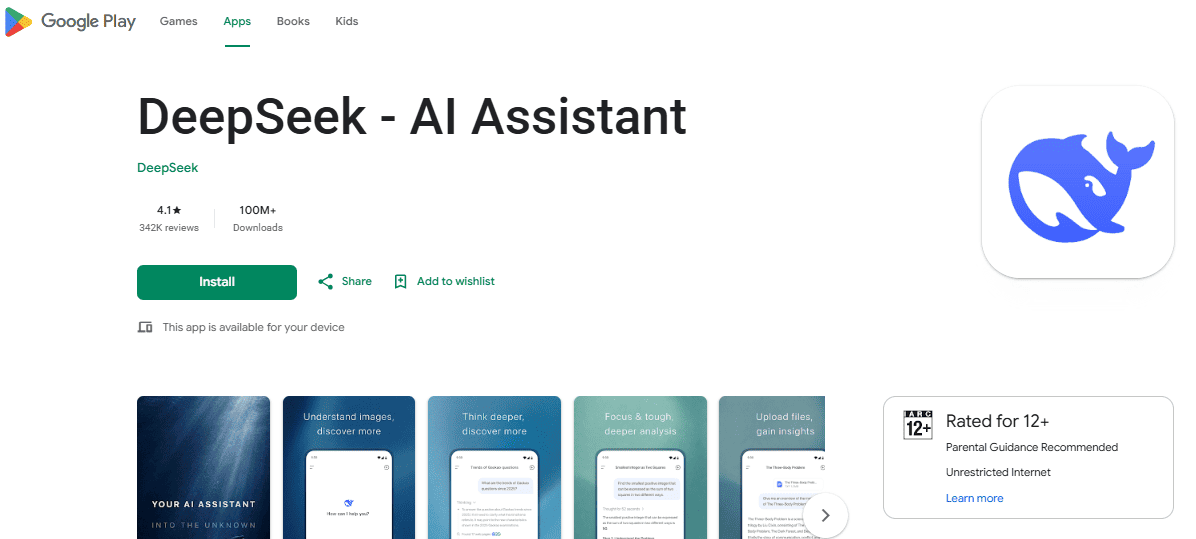
Check the app title and publisher before installing DeepSeek from Google Play.App safety is not only about malware. It also includes what you type into the app, what files you upload, whether you share conversation links, and whether your organization allows the tool. Treat the mobile app as a hosted service unless you are using a separately verified local deployment.
Is DeepSeek safe for work?
DeepSeek may be acceptable for some work tasks and inappropriate for others. The answer depends on your employer’s policy, data classification, client commitments, and regulatory obligations.
| Work task | Safer or riskier? | Guidance |
|---|---|---|
| Brainstorming public topics | Lower risk | Keep prompts general and non-confidential. |
| Rewriting non-confidential text | Lower to medium risk | Remove names, private details, and internal identifiers. |
| Summarizing public documents | Lower risk | Verify output against the original source. |
| Internal strategy or roadmaps | High risk | Use only if company policy explicitly allows it. |
| Client/customer data | High risk | Requires legal, privacy, and contractual review. |
| HR, hiring, credit, insurance, education, housing, or legal decisions | High risk | Use human review and approved systems only. |
| Regulated data | High risk | Do not use without formal approval and compliance review. |
When in doubt, do not paste the data. Ask your organization which AI tools and data categories are approved.
Is DeepSeek safe for coding?
DeepSeek can be useful for learning programming concepts, debugging non-sensitive snippets, explaining public code, writing examples, and reviewing open-source-style patterns. The risk increases when you paste private repositories, proprietary code, credentials, environment files, infrastructure details, unpublished vulnerabilities, or customer data.
For safer coding use:
- Use small, non-confidential snippets.
- Remove API keys, passwords, tokens, hostnames, and internal URLs.
- Do not paste full private repositories into hosted chat unless approved.
- Run tests before using generated code.
- Review for security issues, licensing issues, and hidden assumptions.
- Do not use generated code blindly in production.
Is DeepSeek API safe for developers?
DeepSeek API safety is shared between DeepSeek and the developer using the API. DeepSeek’s Open Platform Terms say API users can integrate DeepSeek model capabilities into downstream systems for internal or external end users. Those terms also place responsibilities on developers.
Key developer responsibilities include:
- Protect API keys. The Open Platform Terms say an API key is a necessary credential and should not be shared, publicly disclosed, or exposed in browser or other client-side code.
- Inform end users. If you build an application for the public, you may need to disclose your personal-information processing rules and obtain consent or another legal basis where required.
- Use technical and organizational safeguards. Developers are responsible for protecting their systems, networks, information, and data.
- Validate outputs. The Open Platform Terms say outputs may contain errors or omissions and are for reference only.
- Do not use unreviewed output for professional or high-impact decisions. Medical, legal, financial, and other professional uses require caution and human review.
For public apps, keep the DeepSeek API key server-side. Do not place it in browser JavaScript, a mobile app bundle, a WordPress custom HTML block, a public GitHub repository, screenshots, logs, or support forums.
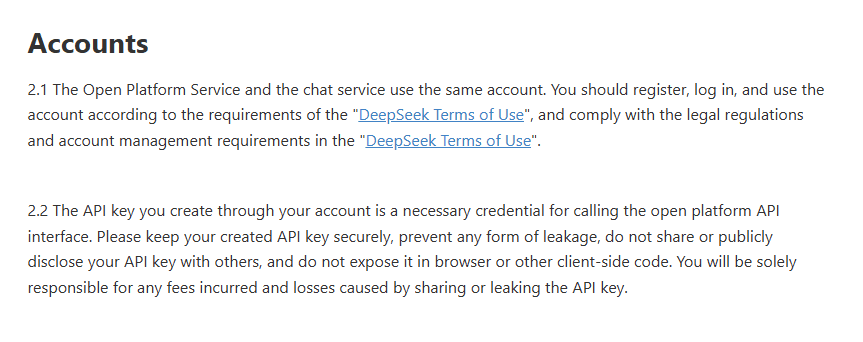
DeepSeek’s platform terms require API keys to remain confidential and out of client-side code.Is local DeepSeek safer than hosted DeepSeek?
Local or self-hosted DeepSeek models can reduce the need to send prompts to a hosted DeepSeek service. That can be useful for privacy-sensitive workflows. But local deployment is not automatically safe.
When you run open-weight models locally, you become responsible for:
- server and network security;
- user access control;
- prompt and output logging;
- model updates;
- license review;
- monitoring for misuse;
- output validation;
- data retention and deletion policies.
Open weights do not guarantee output accuracy, security, privacy compliance, or safe behavior. They only change the deployment and control model. Review the exact model card on DeepSeek’s Hugging Face organization or DeepSeek’s GitHub organization before using a local model.
Third-party DeepSeek providers have different risks
DeepSeek models may be available through the official DeepSeek API, cloud providers, gateways, IDE tools, local apps, model hubs, fine-tunes, or quantized versions. Each route can have different privacy rules, logging behavior, data location, model version, safety filters, pricing, terms of service, and rate limits.
Do not assume a third-party provider follows DeepSeek’s official privacy policy or terms. Check the provider you actually use. A route can be powered by a DeepSeek model and still have separate data-handling rules.
Can you trust DeepSeek’s answers?
DeepSeek’s official Terms of Use say outputs may contain errors or omissions, are for reference only, and should not be treated as professional advice. The terms specifically mention medical, legal, financial, and other professional issues as areas where users should consult professionals and make decisions under professional guidance.
The Terms also say that if outputs are used for purposes that could have a legal or material impact on natural persons, such as credit, education, employment, housing, insurance, legal, medical, or other important decisions, those outputs should undergo human review.
Use DeepSeek output as a draft, assistant, or research starting point—not as a final authority. For important answers:
- verify facts against primary sources;
- check dates and citations;
- test code before using it;
- ask a qualified professional for medical, legal, financial, or regulated decisions;
- use human review for decisions affecting people’s rights, money, employment, health, housing, education, insurance, or legal status.
Regulatory and government scrutiny
DeepSeek has received regulatory and government scrutiny in some jurisdictions. This context matters for organizations, but it should be described carefully and by date.
- In January 2025, Italy’s data protection authority announced an immediate limitation on processing Italian users’ data in connection with DeepSeek, citing data-protection concerns. The authority’s press release is available from the Garante Privacy.
- Reuters reported in February 2025 that South Korea’s data protection authority suspended new downloads of the DeepSeek app locally while privacy-law improvements were addressed.
- Reuters later reported in April 2025 that South Korea’s agency said DeepSeek had transferred user information and prompts to Beijing Volcano Engine Technology without consent, and also reported that the app became available again after changes and recommendations were at least partly reflected.
These were jurisdiction-specific and date-specific actions. They do not mean DeepSeek is banned everywhere, and they do not prove that every use is illegal or unsafe. They do show why privacy, data location, workplace policy, and regulatory review matter before using DeepSeek with sensitive data.
What you should not share with DeepSeek
These rules apply to any hosted AI service, not only DeepSeek. Avoid sharing:
- passwords;
- API keys, private keys, tokens, and credentials;
- customer records;
- confidential contracts;
- unpublished business plans;
- proprietary source code;
- trade secrets;
- medical records;
- legal case files;
- financial account data;
- identity documents;
- children’s data;
- sensitive personal data;
- regulated data;
- confidential workplace files;
- personal addresses, phone numbers, or private contact details unless absolutely necessary and approved.
Safe-use checklist for individuals
- Use DeepSeek first for low-risk public or non-sensitive tasks.
- Do not enter sensitive personal data.
- Do not upload confidential files just to test the tool.
- Use the official website or official download route.
- Check privacy settings and any available opt-out options.
- Verify important answers against reliable sources.
- Avoid sharing conversation links that contain personal data.
- Do not rely on outputs for medical, legal, financial, or high-impact decisions without professional review.
Safe-use checklist for workplaces
- Confirm whether DeepSeek is approved by company policy.
- Classify data before employees paste or upload it.
- Block or restrict use with customer data, regulated data, source code, and confidential files unless approved.
- Review DeepSeek’s privacy policy, data storage location, and terms.
- Decide whether hosted chat, API, third-party hosting, or local deployment is acceptable.
- Train employees on what not to paste into AI tools.
- Use logging and redaction rules for approved AI workflows.
- Require human review for high-impact outputs.
- Review regulatory and client requirements before using DeepSeek with sensitive data.
Safe-use checklist for developers
- Keep DeepSeek API keys server-side.
- Do not expose keys in browser code, mobile binaries, screenshots, GitHub, logs, or support messages.
- Redact prompts and outputs before logging them.
- Disclose AI use and personal-data processing rules to end users where required.
- Validate model outputs before writing to a database, executing a tool, or making user-facing decisions.
- Separate development, staging, and production credentials.
- Review DeepSeek’s Open Platform Terms.
- Monitor misuse, abuse, prompt injection, and unexpected output behavior.
Is DeepSeek safe for students or children?
DeepSeek’s Privacy Policy says its services are not aimed at children and that it does not knowingly process personal data from children. Students should not enter school IDs, private addresses, phone numbers, family information, identity documents, or private school records. Parents, teachers, and schools should supervise use and follow school policy.
Students should also verify outputs. AI answers can sound confident and still be wrong.
Common misconceptions about DeepSeek safety
| Misconception | More accurate answer |
|---|---|
| “DeepSeek is completely safe.” | No hosted AI service should be treated as zero-risk. Safety depends on use case, data, route, and policy. |
| “DeepSeek is completely unsafe.” | That is too broad. Low-risk public or non-sensitive use is different from uploading regulated or confidential data. |
| “If I use the API, privacy is the developer’s problem only.” | DeepSeek has provider responsibilities, but developers also have responsibilities for disclosures, safeguards, API keys, and outputs. |
| “Local DeepSeek is automatically safer.” | Local deployment can reduce third-party data transfer, but it creates infrastructure, logging, access-control, and maintenance risk. |
| “If an answer has search, it is always accurate.” | DeepSeek’s terms still warn that AI-generated content can be inaccurate. Search does not remove the need to verify. |
| “Government scrutiny means ordinary use is illegal everywhere.” | No. Regulatory actions are jurisdiction-specific and date-specific. Check your own location and organization policy. |
Bottom line: should you use DeepSeek?
Use DeepSeek for low-risk tasks where you can tolerate and verify imperfect output: brainstorming, learning, drafting non-sensitive text, explaining public code, summarizing public information, or experimenting with non-confidential ideas.
Be cautious or avoid hosted DeepSeek for confidential work, personal documents, customer records, regulated data, proprietary source code, secrets, credentials, and high-impact decisions unless your organization has approved the workflow and reviewed the relevant policy, terms, data location, and compliance implications.
For developers and organizations, the safer approach is not a blanket yes or no. It is a controlled workflow: choose the right deployment route, minimize data, protect keys, redact logs, validate outputs, and require human review where the stakes are high.
FAQ
Is DeepSeek safe to use?
DeepSeek can be reasonable for low-risk, non-sensitive tasks, but it should not be treated as automatically safe for confidential, regulated, proprietary, or highly personal data. The risk depends on whether you use hosted chat, API, a third-party provider, or local deployment.
What data does DeepSeek collect?
DeepSeek’s Privacy Policy says it may collect account data, prompts, text input, voice input, uploaded files, photos, feedback, chat history, device and network data, IP address, approximate location, cookies, and payment/order data for paid platform services.
Does DeepSeek store data in China?
DeepSeek’s Privacy Policy says the personal data it collects may be stored outside the user’s country and that, to provide the services, DeepSeek directly collects, processes, and stores personal data in the People’s Republic of China.
Does DeepSeek use prompts for training?
The Privacy Policy says DeepSeek uses personal data to improve and develop services and to train and improve its technology. It also lists a right to opt out of using personal data for training models or optimizing technologies, subject to applicable law and exceptions.
Is DeepSeek safe for work?
It depends on the work. Brainstorming public topics or rewriting non-confidential text is lower risk. Using customer data, proprietary code, legal files, medical records, financial data, HR data, or regulated data requires company approval and compliance review.
Is DeepSeek safe for coding?
It can be useful for learning and non-sensitive snippets. Do not paste proprietary repositories, credentials, environment files, private infrastructure details, or unpublished vulnerabilities into hosted chat or API unless your organization has approved that workflow. Review and test generated code.
Is local DeepSeek safer than hosted DeepSeek?
Local deployment can reduce the need to send prompts to a hosted provider, but it is not automatically safer. You become responsible for infrastructure security, access control, logging, updates, license review, misuse prevention, and output validation.
Is DeepSeek safe for medical, legal, or financial advice?
Do not rely on DeepSeek output as professional advice. DeepSeek’s Terms say outputs may contain errors or omissions and should not be treated as medical, legal, financial, or other professional advice. Consult qualified professionals for those decisions.
Is DeepSeek banned anywhere?
DeepSeek has faced regulatory or government restrictions in some jurisdictions at specific times, such as Italy’s January 2025 data-protection action and South Korea’s 2025 app-download suspension and later reopening. These actions are date-specific and jurisdiction-specific; they do not mean DeepSeek is banned everywhere.