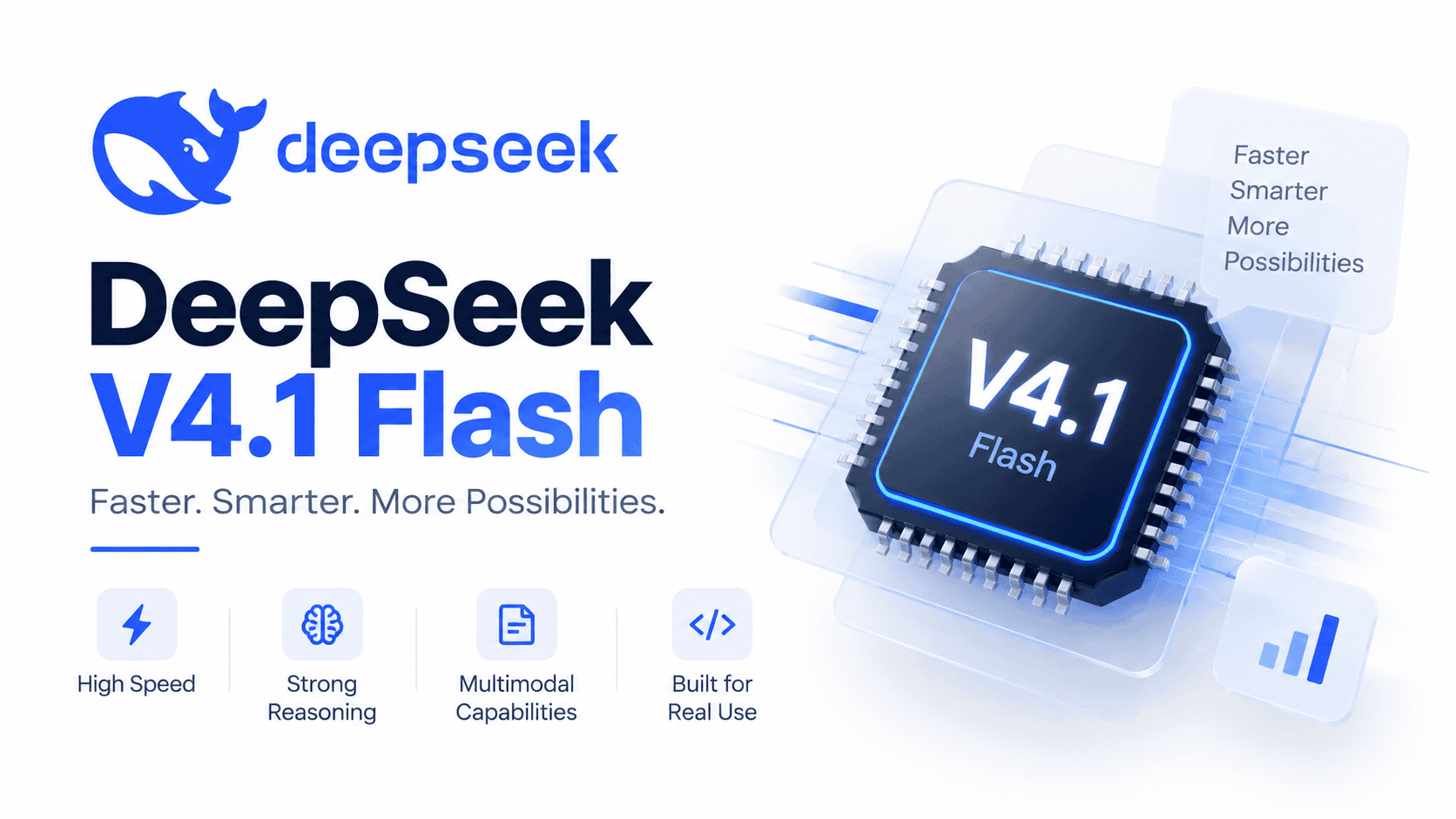

DeepSeek V4.1 Flash is DeepSeek’s current Flash model release, available through the official API as deepseek-flash. It is designed as a faster, lower-cost, multimodal model for text, image understanding, long-context work, and agent workflows.
The name matters. DeepSeek-V4.1-Flash is the original release or model name. The current hosted version is DeepSeek-V4.1-Flash-1017, updated on October 17, 2026, with the API calling method and pricing unchanged. deepseek-flash is the API model ID to use in new code. Do not assume that deepseek-v4.1-flash is the correct API name unless the current official docs later expose that exact ID.
Documentation checked: October 4, 2026. Hosted Flash version rechecked: October 19, 2026. This article is based on official DeepSeek documentation and the DeepSeek V4.1 Flash model card. No live API request, local deployment, benchmark test, or private evaluation was performed.
DeepSeek V4.1 Flash quick facts
| Item | Current information |
|---|---|
| Release date | September 10, 2026 |
| Release name | DeepSeek-V4.1-Flash |
| API model ID | deepseek-flash |
| Legacy names | deepseek-v4-flash and deepseek-v4-flash-vision-exp are compatibility names currently routed to V4.1 Flash. |
| Model type | Multimodal Mixture-of-Experts model for image-text-to-text and text generation tasks. |
| Context length | 1 million tokens in the official model table. |
| Maximum output | 384K tokens in the official model table. |
| Vision support | Supported by deepseek-flash. |
| Open weights | Available on Hugging Face. |
| License | The Hugging Face model card lists the repository and model weights under the MIT License. |
DeepSeek’s official change log describes V4.1 Flash as the smallest model in a new architecture family, with native multimodal visual understanding, faster inference, higher throughput, and a design intended to scale to larger models.
Use deepseek-flash in the API
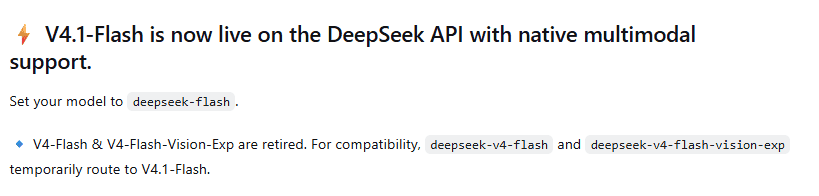
The most important developer detail is the model name. DeepSeek’s release notes say: set your model to deepseek-flash to call the latest V4.1 Flash model.
Older snippets may still use deepseek-v4-flash or deepseek-v4-flash-vision-exp. DeepSeek says those previous-generation models have been retired, and those legacy names are temporarily routed to V4.1 Flash for compatibility. New projects should use deepseek-flash directly.
Here is a minimal cURL request for the official OpenAI-compatible Chat Completions endpoint. Running it sends a real API request and can consume DeepSeek API balance.
curl https://api.deepseek.com/chat/completions \
  -H "Authorization: Bearer ${DEEPSEEK_API_KEY:?Set DEEPSEEK_API_KEY first}" \
  -H "Content-Type: application/json" \
  --data '{
    "model": "deepseek-flash",
    "messages": [
      {
        "role": "user",
        "content": "Explain what DeepSeek V4.1 Flash is in one sentence."
      }
    ],
    "max_tokens": 256,
    "stream": false
  }'
If you use an SDK, give the SDK the base URL https://api.deepseek.com, not the full /chat/completions endpoint. The SDK method appends the endpoint path.
What changed from V4 Flash and Vision Exp?
DeepSeek V4.1 Flash replaces the earlier V4 Flash and V4 Flash Vision Exp API models for current Flash usage. The practical changes are:
- One current Flash model ID: use
deepseek-flashinstead of creating new code around older V4 Flash names. - Native multimodal support: V4.1 Flash includes visual understanding instead of relying on a separate experimental Vision Exp model.
- New architecture family: DeepSeek describes V4.1 Flash as the smallest model in a new architecture family.
- Lower API pricing: DeepSeek says the V4.1 Flash release reduced API prices for this model.
- Compatibility routing: legacy names still work for now, but they route to the new model rather than preserving the retired underlying models.
This means an old tutorial can be partly correct and still misleading. The request shape may look similar, while the recommended model name, pricing, vision behavior, and model behind the alias have changed.
Core capabilities
For API users, DeepSeek V4.1 Flash is more than a basic text model. The current model table and related guides connect deepseek-flash with the following capabilities:
| Capability | Current status for deepseek-flash | What to check |
|---|---|---|
| Text generation | Supported | Use Chat Completions or Responses API depending on your integration. |
| Thinking Mode | Supported | Check the Thinking Mode guide for effort controls and response fields. |
| Vision | Supported | Use the Vision guide for image formats, limits, and content blocks. |
| Tool Calls | Supported | The application executes the tool; validate arguments before using them. |
| JSON Output | Supported | Use response_format in Chat Completions or text.format in Responses API. |
| Responses API | Supported | Do not mix Responses input/output parsing with Chat Completions parsing. |
| Anthropic API format | Supported | Use DeepSeek’s Anthropic-compatible endpoint only for Anthropic-format clients. |
| Open weights | Available | Review the model card and license before self-hosting. |
Feature support is surface-specific. A capability documented for the official API should not automatically be assumed for a third-party gateway, a local runner, the consumer app, or another provider’s hosted route.
Vision means image understanding, not image generation
DeepSeek V4.1 Flash supports native multimodal visual understanding. In practice, this means the model can receive image input together with text and return text output, such as an image description, screenshot explanation, chart interpretation, or answer to a question about visible content.
This is not the same as image generation. Do not describe deepseek-flash as an image generator unless a current official DeepSeek source documents image generation for the specific surface you are using.
Another important distinction: the current official model table lists Vision support for deepseek-flash, while deepseek-v4-pro is not listed as supporting Vision. Do not assume that all V4-family models accept images.
Context length and output limits
The current DeepSeek model table lists deepseek-flash with a 1M-token context window and a 384K-token maximum output.
These two numbers mean different things:
- Context length is the amount of input information the model can consider in a request.
- Maximum output is the upper bound for generated output in a response.
- Reasoning effort controls how much inference work the model applies in thinking mode; it is not the same as context length.
- Context caching can reduce the cost of repeated input prefixes, but it does not increase the context window.
A 1M context window does not mean the model remembers all previous sessions. Stateless API formats still require the application to send the context the model needs for the current request.
Thinking Mode and reasoning effort
DeepSeek V4.1 Flash supports both thinking and non-thinking behavior through API controls. DeepSeek’s Thinking Mode documentation currently describes effort levels such as low, high, and max.
Use these controls according to task complexity:
- Non-thinking or low effort: simple extraction, rewriting, short classification, or routine formatting.
- High effort: everyday reasoning, coding help, debugging, and agent workflows.
- Max effort: difficult multi-step reasoning where extra inference is worth the time and token budget.
Higher effort is not automatically better for every task. It can add generated reasoning and may affect latency or token usage. Visible reasoning should not be treated as proof that the final answer is correct.
DeepSeek V4.1 Flash pricing and limits
The current official pricing page should be the final source before budgeting. As of this documentation check, deepseek-flash pricing is separated into cached input, uncached input, and output tokens. Peak rates are double off-peak rates.
Token category for deepseek-flash | Off-peak | Peak |
|---|---|---|
| Cached input | $0.003 per 1M tokens | $0.006 per 1M tokens |
| Uncached input | $0.15 per 1M tokens | $0.30 per 1M tokens |
| Output | $0.60 per 1M tokens | $1.20 per 1M tokens |
Peak periods are currently 01:00–04:00 UTC and 06:00–10:00 UTC, Monday through Friday, excluding Chinese public holidays. All other periods are off-peak, including weekends and Chinese public holidays.
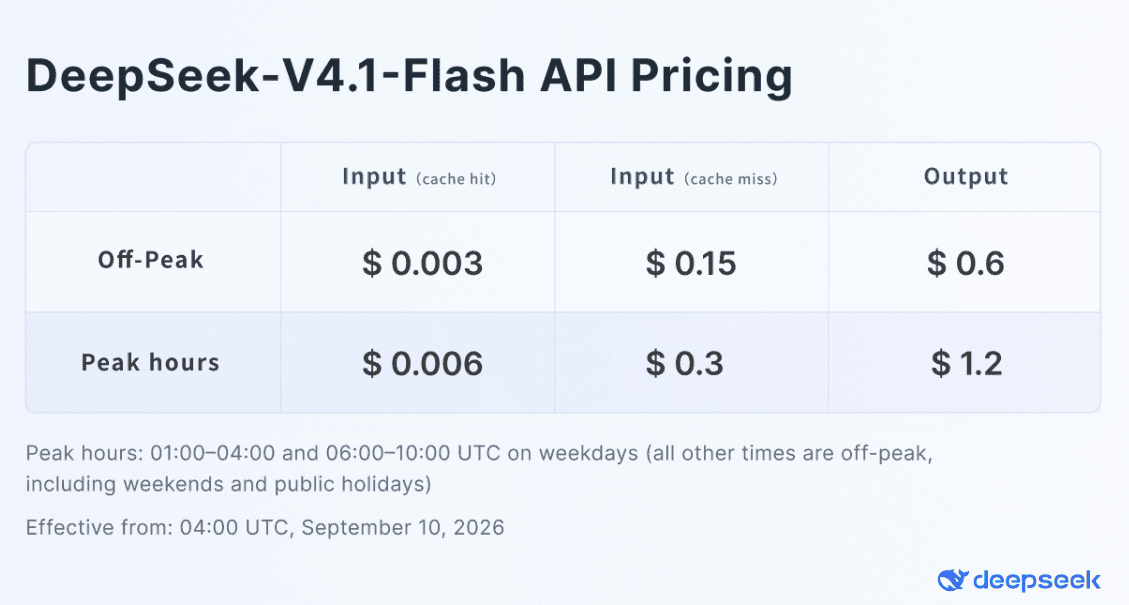
Do not translate those rates into a universal “cost per request.” A request’s cost depends on text input, image input where used, cache hits and misses, output length, reasoning behavior, tool loops, and whether the request occurs during peak or off-peak pricing.
DeepSeek’s public rate-limit documentation currently lists deepseek-flash at 2,500 concurrent connections per account. That is an account-level concurrency limit, not a separate quota for every API key.
DeepSeek V4.1 Flash vs DeepSeek V4 Pro
Use this comparison to avoid assuming both V4-family models behave the same way.
| Item | deepseek-flash | deepseek-v4-pro |
|---|---|---|
| Current model version | DeepSeek-V4.1-Flash-1017 | DeepSeek-V4-Pro-0813 |
| Context length | 1M | 1M |
| Maximum output | 384K | 384K |
| Vision support | Supported | Not listed as supported in the current model table |
| Thinking Mode | Supported | Supported |
| Tool Calls | Supported | Supported |
| Responses API | Supported | Supported |
| Anthropic API | Supported | Supported |
| Public account-level concurrency | 2,500 concurrent connections | 500 concurrent connections |
DeepSeek’s September 10 release page originally said V4 Pro would be phased out and routed to V4.1 Flash. The current API change log later says DeepSeek decided to continue providing API services for DeepSeek V4 Pro after September 14, 2026, with billing unchanged. When pages disagree, use the newer API change log and the current model table for implementation decisions.
Do not assume V4 Pro is automatically better for every coding or agent workload, and do not assume Flash is always sufficient. Use current documentation and your own task-specific evaluation.
Architecture in practical terms
DeepSeek describes V4.1 Flash as a 552B-parameter Mixture-of-Experts model with a new Causal Encoder–Decoder architecture. The official release says the architecture activates about 8B parameters for input and 16B for output.
For developers, the practical point is not the name of every architecture component. The important idea is that DeepSeek designed the model to reduce the cost of processing large inputs and long-context agent workloads. The release says the new KV cache needs one quarter of the HBM and one eighth of the SSD storage of the previous generation.
The Hugging Face model card describes the technical design in more detail, including Causal Encoder–Decoder structure, KV-cache compression, and attention optimizations. These details help explain why DeepSeek positions the model for input-heavy agents and long-context workflows, but they do not guarantee that every real-world workload will improve.
How to read the benchmark claims
The September 10 release entry in DeepSeek’s official change log reports benchmark numbers for the original V4.1 Flash, including GPQA Diamond 90.9, Codeforces rating 3471, Terminal-Bench 2.1 score 90.6, DeepSWE v1.1 score 74.2, and several agent and vision-related evaluations. It also notes that one HLE figure was tested only on the pure-text subset of the HLE benchmark set.
These benchmarks are useful signals, but they should not be turned into a blanket claim that the model is best for every task. Benchmark outcomes depend on the evaluation harness, task mix, reasoning settings, tool availability, prompt format, and whether the result is from the hosted API, the model card, or a self-hosted setup.
Use the numbers as a starting point for evaluation, then test your own workload: coding agents, repository analysis, extraction, vision tasks, RAG, tool calls, or latency-sensitive chat may behave differently.
Open weights and MIT license
DeepSeek V4.1 Flash is available as an open-weight model on Hugging Face. The model card lists the task type as image-text-to-text and identifies the license as MIT. It also says the repository and model weights are licensed under the MIT License.
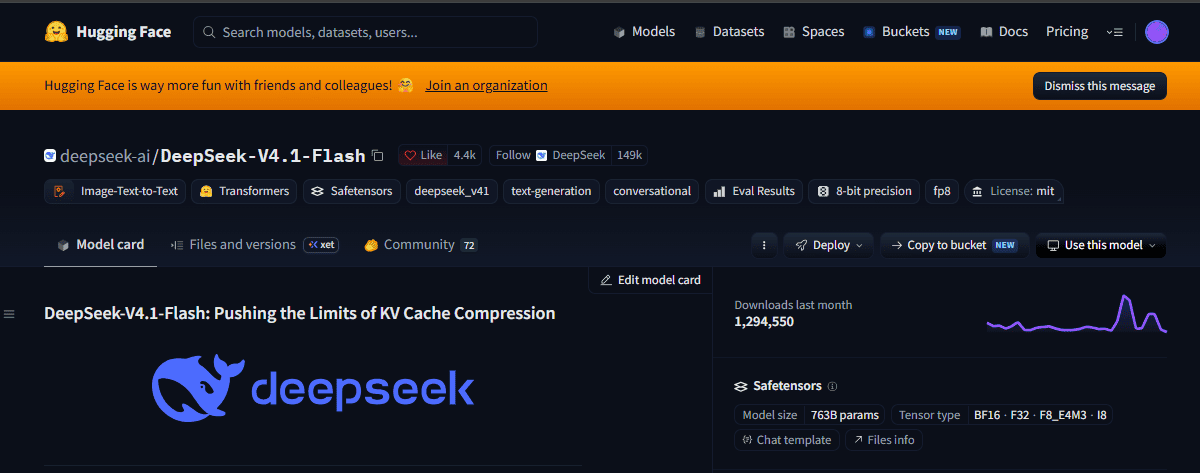
Open weights are not the same as a fully reproducible training release. They do not automatically mean that all training data, training infrastructure, or every detail required to reproduce the original training run is available.
Self-hosting is also different from using the official API. The model card includes examples for tools such as Transformers, vLLM, SGLang, Docker Model Runner, and quantized local-app workflows, but running a large multimodal MoE model still requires substantial hardware, engineering, storage, monitoring, and security planning. Do not assume local deployment will be cheaper or easier than the hosted API without testing your own workload.
Who should consider DeepSeek V4.1 Flash?
DeepSeek V4.1 Flash is a strong candidate to evaluate when you need:
- coding agents or coding assistants;
- long-context repository or document analysis;
- tool-using workflows;
- image understanding with text output;
- OpenAI-compatible or Anthropic-compatible integrations;
- cost-sensitive API workloads where cache-hit behavior matters;
- experiments with open weights or local inference infrastructure.
Evaluate carefully for high-stakes domains, safety-critical code changes, specialized OCR, medical or legal analysis, or cases where you need a capability that is documented only for V4 Pro, another model, or another provider.
Migration checklist for developers
If you are updating older DeepSeek code or following an older tutorial, check these items before shipping:
- Use
deepseek-flashfor new V4.1 Flash API calls. - Replace new uses of
deepseek-v4-flashwithdeepseek-flash. - Replace new uses of
deepseek-v4-flash-vision-expwithdeepseek-flashfor current vision work. - Do not build new code around
deepseek-chatordeepseek-reasonerunless current docs for your use case require those names. - Check whether your workflow needs thinking enabled, disabled, or a specific reasoning effort level.
- Check image input syntax if you migrated from text-only code.
- Recalculate cost using cached input, uncached input, output, and peak/off-peak timing.
- Keep Chat Completions, Responses API, and Anthropic API request shapes separate.
- Check account-level concurrency if you scale agent or batch traffic.
Common mistakes and fixes
| Symptom or assumption | Likely issue | What to do |
|---|---|---|
deepseek-v4.1-flash does not work as a model name | The release name was used as the API model ID. | Use deepseek-flash unless current docs later expose another ID. |
| Old Vision Exp tutorials still appear in search | deepseek-v4-flash-vision-exp was an experimental older model name. | Use deepseek-flash for current Flash vision work. |
Image input fails with deepseek-v4-pro | The current model table lists Vision for Flash, not Pro. | Use deepseek-flash for image understanding. |
| The app expects image generation | Vision support means image understanding, not image creation. | Use the model for image-to-text tasks unless DeepSeek documents image generation elsewhere. |
| Costs differ from an old estimate | Pricing changed with V4.1 Flash and depends on cache/peak rules. | Check the current official pricing table before budgeting. |
| A third-party route behaves differently | Another provider may expose a different wrapper, price, or capability set. | Check that provider’s docs instead of assuming official DeepSeek API behavior. |
| Local deployment is harder than expected | Open weights do not remove infrastructure requirements. | Review the model card, inference instructions, hardware needs, and operational costs. |
Official resources
Use official sources for current facts, because model names, pricing, and API behavior can change.
- DeepSeek V4.1 Flash release page
- DeepSeek V4.1 Flash API announcement
- DeepSeek API change log
- DeepSeek models and pricing
- DeepSeek Vision guide
- DeepSeek Thinking Mode guide
- DeepSeek Tool Calls guide
- DeepSeek Responses API guide
- DeepSeek V4.1 Flash model card on Hugging Face
FAQ
Is DeepSeek V4.1 Flash the same as deepseek-flash?
DeepSeek V4.1 Flash is the release/model name. deepseek-flash is the current official API model ID used to call it.
Should I use deepseek-v4-flash-vision-exp?
No for new code. DeepSeek says deepseek-v4-flash-vision-exp is a legacy compatibility name that temporarily routes to V4.1 Flash. Use deepseek-flash for current vision-capable Flash work.
Does DeepSeek V4.1 Flash support images?
Yes. DeepSeek describes V4.1 Flash as having native multimodal visual understanding, and the current model table lists Vision support for deepseek-flash. This means image understanding with text output, not image generation.
Is DeepSeek V4.1 Flash open source?
The model weights are available on Hugging Face, and the model card lists the repository and model weights under the MIT License. Open weights do not automatically mean the training data or every detail needed to reproduce training is available.
Can I run DeepSeek V4.1 Flash locally?
The Hugging Face model card provides links and examples for local and server-based inference routes, but running a large multimodal MoE model requires serious hardware and operational planning. Do not assume local deployment is cheaper or easier than the hosted API without testing your workload.
Is DeepSeek V4.1 Flash better than V4 Pro?
Not universally. DeepSeek reports strong V4.1 Flash benchmark results and positions it for efficient long-context and agent workloads, while V4 Pro remains a separate API model in the current documentation. Choose based on current capabilities, cost, vision needs, and your own evaluation.