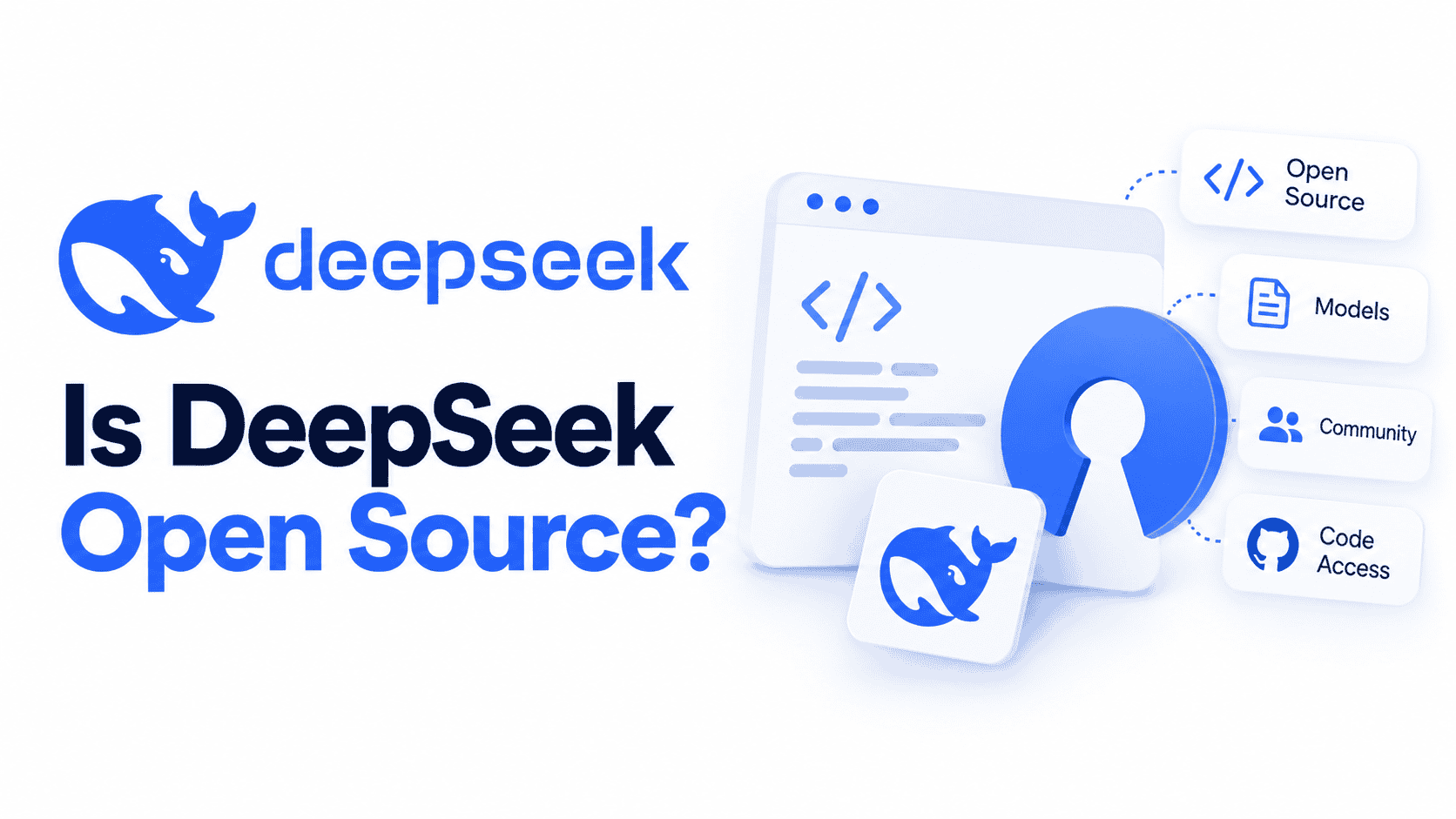

DeepSeek is partly open, but the precise answer depends on what you mean by “DeepSeek.” DeepSeek publishes many model repositories and downloadable model weights, and several official model cards or repositories list permissive licenses such as MIT. But the hosted DeepSeek Chat service and the hosted DeepSeek API are not automatically open source simply because some model weights are public.
The safest answer is: DeepSeek has open-weight and open-repository releases, but “DeepSeek” as a whole should not be described as fully open source without qualification. A model with public weights is not automatically “Open Source AI” under stricter definitions unless the required data information, code, parameters, and license terms are available for that exact model or system.
Documentation checked: October 4, 2026. This article is an informational guide, not legal advice. Always check the exact model card, repository, license file, and provider terms for the DeepSeek model or service you plan to use.
Quick answer: what is open and what is not?
| DeepSeek component | Is it open source? | Practical answer |
|---|---|---|
| DeepSeek model weights | Often open-weight, model by model | Many official DeepSeek models are available on Hugging Face or GitHub. Check each model card and license. |
| DeepSeek GitHub repositories | Some are open-source repositories | Repositories may include code, inference resources, papers, license files, or model references. The license can differ by repository. |
| DeepSeek Chat | Not proven open source | The hosted chat website is a service. Public model weights do not mean the full chat product source code is public. |
| DeepSeek API | Not an open-source codebase | The API is a hosted developer service. API access is not the same as source-code access. |
| Training data | Not automatically open | Model cards and papers may describe training at a high level, but public weights do not automatically mean the full training data is available. |
| Third-party DeepSeek endpoints | Depends on the provider | A gateway, cloud provider, local app, or quantized model may have its own terms, license notes, limits, and privacy rules. |
Open source, open weights, and Open Source AI are not the same
The phrase “open source” can mean different things in AI discussions. For DeepSeek, the distinction matters.
| Term | Plain-English meaning | Why it matters for DeepSeek |
|---|---|---|
| Open source software | Source code is available under an open-source license that permits use, modification, and redistribution under stated terms. | A GitHub repository can be open source even if the hosted service built around it is not. |
| Open weights | The learned model parameters are downloadable or publicly accessible. | DeepSeek publishes many model weights, but weights alone do not prove that training data or the full training pipeline is open. |
| Open model | A loose phrase that can mean open weights, open architecture details, or broader access. | Always check what the model card actually provides. |
| Open Source AI | Under the Open Source Initiative definition, the system must provide freedoms to use, study, modify, and share, with access to the preferred form for modification. | OSI’s definition requires more than public parameters; it includes data information, code, and parameters. |
| Hosted API | A service endpoint operated by a provider. | Calling an API does not give you the provider’s source code or training pipeline. |
The Open Source Initiative’s Open Source AI Definition says the preferred form for making modifications to machine-learning systems includes sufficiently detailed data information, complete code used to train and run the system, and model parameters. It also says that “Open Source models” and “Open Source weights” must include the data information and code used to derive those parameters. That is stricter than simply publishing a downloadable checkpoint.
What DeepSeek makes public
DeepSeek publishes official resources through its GitHub organization and Hugging Face organization. These resources can include model cards, downloadable weights, inference notes, technical reports, evaluation notes, and license files.
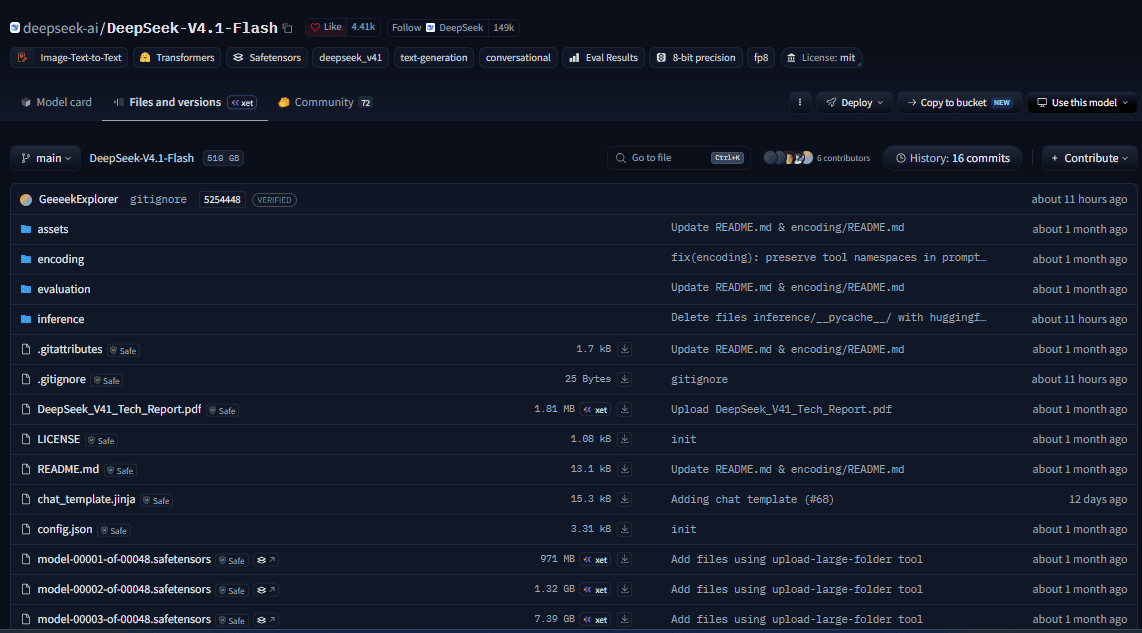
That public release pattern is valuable for researchers and developers. It does not mean that every DeepSeek internal system is public. Unless an official source says otherwise, do not assume DeepSeek has published the source code for the hosted chat website, the hosted API backend, the full training pipeline, or the complete training data behind every model.
Model-by-model license and openness check
DeepSeek releases should be checked model by model. The table below summarizes major official resources, but it is still only a starting point. Read the exact model card and license file before using a model in a product, redistribution workflow, or regulated setting.
| Model or component | Official source | Weights public? | License / caveat |
|---|---|---|---|
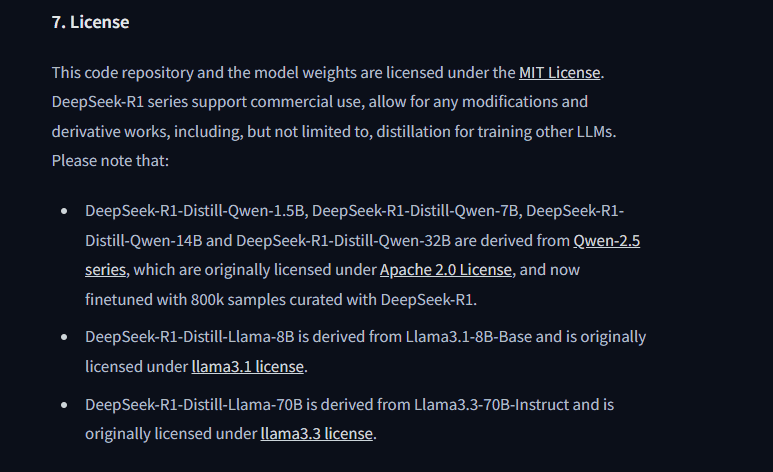
| DeepSeek-R1 and DeepSeek-R1-Zero | GitHub and Hugging Face | Yes | The model card says the code repository and model weights are under MIT and that the R1 series supports commercial use, modifications, and derivatives. Distilled models have base-model caveats. |
| R1-Distill-Qwen models | DeepSeek-R1 model card | Yes | DeepSeek says these distills are derived from Qwen 2.5 models originally under Apache 2.0. Check both DeepSeek notes and the relevant Qwen license. |
| R1-Distill-Llama models | DeepSeek-R1 model card | Yes | DeepSeek says the Llama distills derive from Llama 3.1 or Llama 3.3 models. Check the relevant Llama license terms. |
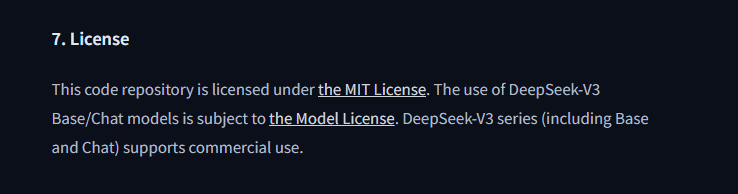
| DeepSeek-V3 | Hugging Face and GitHub | Yes | The V3 card says the code repository is MIT, while use of V3 Base/Chat models is subject to a model license; it also says the V3 series supports commercial use. |
| DeepSeek-V3-0324 | Hugging Face | Yes | The model card displays License: mit. Still check the model card and files for the exact version you use. |
| DeepSeek-V3.1 | Hugging Face | Yes | The model card lists License: mit and says the repository and model weights are under MIT. |
| DeepSeek-V3.2 | Hugging Face | Yes | The model card lists License: mit and says the repository and model weights are under MIT. |
| DeepSeek-V4.1-Flash | Hugging Face | Yes | The model card lists License: mit and says the repository and model weights are licensed under MIT. |
| DeepSeek-V4-Pro-0813 | Hugging Face | Yes | The model card says the repository and model weights are licensed under MIT. |
| DeepSeek Chat | Official chat service | Not applicable | This is a hosted service. Public weights for some models do not make the full chat product source code public. |
| DeepSeek API | Official API docs | Not applicable | This is a hosted developer service. API terms, pricing, limits, and privacy rules are separate from model-weight licenses. |
What the MIT license means—and what it does not mean
Several DeepSeek model cards list MIT or say the repository and model weights are licensed under MIT. The MIT License is a permissive license that commonly allows use, copying, modification, merging, publishing, distribution, sublicensing, and selling copies, provided the copyright and permission notice are included. It also includes warranty and liability disclaimers.
But MIT on a repository or model card does not automatically prove all of the following:
- that the full training data is public;
- that the full training pipeline is released;
- that every distilled model has no base-model license obligations;
- that a third-party hosted route has the same terms;
- that a deployment is suitable for regulated or sensitive use;
- that self-hosting will be simple or low-cost.
For commercial, regulated, redistributed, or high-risk use, review the exact license file and provider terms. If the decision is legally important, consult qualified counsel.
Does DeepSeek meet the Open Source AI definition?
It depends on the exact model and the standard you apply. DeepSeek’s public model weights and permissive licenses are meaningful forms of openness. They are especially useful for research, local inference experiments, fine-tuning workflows, and independent evaluation.
However, the Open Source Initiative’s Open Source AI Definition is stricter than “weights are downloadable.” It says an Open Source AI system should provide access to the preferred form for modification, including data information, code, and parameters. It also says open-source models and weights must include the data information and code used to derive the parameters.
Therefore, it is more accurate to say:
- Many DeepSeek models are open-weight releases.
- Some DeepSeek repositories and weights are under permissive licenses such as MIT.
- Not every DeepSeek service or system should be called fully open source without checking the exact code, data information, parameters, and license terms.
Is DeepSeek Chat open source?
DeepSeek Chat is a hosted consumer service. It may use DeepSeek models, and some DeepSeek model weights are public, but that does not make the full chat website, service backend, moderation system, account system, or product infrastructure open source.
If your question is “Can I inspect and modify the full source code of the official DeepSeek Chat product?” public model weights are not enough to answer yes. Use the official chat as a hosted service and evaluate it through its own terms and privacy policy.
Is the DeepSeek API open source?
The DeepSeek API is a hosted developer platform. API access lets your application send requests to DeepSeek’s servers; it does not give you the source code for the API backend or the full production stack.
The API’s model names, pricing, rate limits, error handling, and platform terms are separate from the license of downloadable model weights. If you use the hosted API, check the DeepSeek API documentation and the relevant platform terms. If you self-host model weights, check the model card, license, and your deployment environment.
Can you use DeepSeek commercially?
There is no single answer for every DeepSeek model, route, and use case. For example, the DeepSeek-R1 model card says the R1 repository and model weights are MIT licensed and that the R1 series supports commercial use, modifications, derivatives, and distillation. It also warns that distilled Qwen and Llama models are based on their respective base model families, so those base licenses must be checked too.
Use this rule:
- For official model weights: check the exact Hugging Face or GitHub model card and license file.
- For distills: check DeepSeek’s notes and the base model license.
- For the hosted API: check DeepSeek’s API terms and current pricing.
- For third-party providers: check that provider’s terms, pricing, and privacy policy.
- For commercial or regulated deployments: document the exact model, version, source, license, and provider terms you relied on.
Can you self-host DeepSeek?
Open weights make self-hosting possible in principle for many DeepSeek releases, but they do not make it easy for every model. Full DeepSeek models can be extremely large. Self-hosting may require specialized GPUs, inference frameworks, quantization, serving infrastructure, monitoring, security controls, and ongoing maintenance.
Official model cards often include local inference notes, but those notes are not the same as a guarantee that your hardware, application, or compliance requirements are covered. Community quantizations, adapters, fine-tunes, and local-app packages may also have different behavior and different licensing details from the official model card.
Training data, training code, and reproducibility
Downloading model weights is not the same as reproducing a model from scratch. Full reproducibility usually requires detailed training data information, preprocessing steps, training code, hyperparameters, tokenizer details, infrastructure details, intermediate checkpoints, and evaluation setup.
DeepSeek technical reports and model cards can describe model architecture, training approach, inference recommendations, or benchmark methods. But unless an exact source provides full training data information and full training code for a specific release, do not claim that the model is fully reproducible under a strict Open Source AI standard.
Official models vs third-party versions
When people say “DeepSeek model,” they may mean different things:
- an official DeepSeek Hugging Face model card;
- an official DeepSeek GitHub repository;
- a community quantization;
- a fine-tune or adapter;
- a hosted endpoint from a third-party provider;
- a local app package;
- the hosted DeepSeek API.
These can differ in model version, license, safety settings, context length, quantization, capabilities, pricing, logging, and terms of service. Do not transfer an official DeepSeek model-card license statement to an unofficial fine-tune, gateway, or quantized package without checking that source directly.
Common misconceptions
| Misconception | More accurate answer |
|---|---|
| “DeepSeek is open source, so the chat website source code is public.” | No. Public model weights do not prove that the hosted chat product source code is public. |
| “MIT weights mean the training data is open.” | No. A permissive license on weights does not automatically release the full training dataset. |
| “Open weights mean I can reproduce training.” | Not by themselves. Reproducibility needs data information, training code, settings, and infrastructure details. |
| “All DeepSeek models have the same license.” | No. Check each model card, repository, and base-model license for distills. |
| “If a model is on Hugging Face, it is automatically open source.” | No. Hugging Face is a hosting platform. The model’s actual license and files determine the terms. |
| “The API is open source because some weights are public.” | No. A hosted API is a service. Model-weight licensing and API service terms are separate. |
| “Self-hosting is automatically cheaper than the API.” | Not necessarily. Hardware, serving, engineering, monitoring, and maintenance can be expensive. |
| “Distilled models have no base-model license concerns.” | Not safe. R1 distilled models based on Qwen or Llama require checking the relevant base-model terms. |
Developer checklist before using a DeepSeek model
Before building with a DeepSeek model, document the exact source and terms you rely on.
- Identify the exact model or repository name.
- Open the official model card on DeepSeek’s Hugging Face or GitHub organization.
- Read the license file, not only the model title.
- Check whether weights are actually available.
- Check whether training data information and training code are available if strict Open Source AI compliance matters to you.
- Check base-model licenses for distilled models.
- Check DeepSeek API terms if you use the hosted API.
- Check third-party provider terms if you do not use official DeepSeek hosting.
- Record the model version, source URL, license, and date checked.
- Ask qualified legal or compliance reviewers before commercial, redistributed, regulated, or high-risk deployment.
Privacy and safety: open weights do not automatically mean private
Running a model locally can change data-handling implications because prompts may stay within your own infrastructure. But that depends on how you deploy the model, where logs are stored, who has access, and which third-party tools are involved.
Using the hosted DeepSeek Chat or DeepSeek API sends data to a service provider. Using a third-party inference provider sends data to that provider. Open weights and hosted services have different privacy, security, and compliance considerations. For sensitive work, follow your organization’s approved-tool policy and the terms of the provider you actually use.
FAQ
Is DeepSeek open source?
Partly. DeepSeek publishes many model weights and repositories publicly, and several official releases use permissive licenses such as MIT. But the hosted DeepSeek Chat and API services are not automatically open source, and open weights are not the same as full Open Source AI under strict definitions.
Is DeepSeek open weights?
Yes for many official models. DeepSeek publishes major model weights through official Hugging Face and GitHub pages. Check the exact model card for the checkpoint you plan to use.
Are DeepSeek models under MIT license?
Several major DeepSeek model cards list MIT or say the repository and model weights are under MIT, including DeepSeek-R1, DeepSeek-V4.1-Flash, and DeepSeek-V4-Pro-0813. Some releases have additional caveats, such as base-model license considerations for R1 distilled models. Check each exact model card.
Is DeepSeek Chat open source?
The official chat product is a hosted service. Public model weights do not mean the full chat product source code, backend, or account system is open source.
Is the DeepSeek API open source?
No, not in the sense of a public source-code release for the hosted API backend. The API is a developer service. Its terms, pricing, limits, and privacy rules are separate from model-weight licenses.
Can I use DeepSeek commercially?
Possibly, depending on the exact model, license, base-model terms, and hosting route. Some DeepSeek model cards explicitly mention commercial use, but you should verify the exact source and consult appropriate legal or compliance advice for serious deployments.
Does open weights mean the training data is open?
No. Open weights provide model parameters. They do not automatically provide full training data, complete data-processing code, or a fully reproducible training pipeline.
Does Hugging Face mean a model is open source?
No. Hugging Face hosts many kinds of models with different licenses. Always read the model card and license for the exact repository.