
DeepSeek is a strong choice when you prioritize low API cost, current open weights, or control over deployment. Grok is a strong choice when you need live web and X research, voice, or image and video creation in its consumer product. For developers, compare DeepSeek’s inference rates with Grok’s managed search and agent tools, then check the billing terms of the account you will use.
There is no defensible universal winner for coding or difficult reasoning without testing both systems on the same tasks. Grok 4.7 offers a more integrated agent and tool ecosystem, while DeepSeek-V4.1-Flash emphasizes lower inference costs, a larger documented API context than Grok 4.7, and greater deployment control. The right choice depends on whether you are comparing the consumer assistants, the APIs, or models you can run yourself.
Updated: October 16, 2026, for DeepSeek API web search and Grok subscription/API billing. The API token-rate comparison below was last checked on October 11, 2026. Model names, prices, plan limits, tools, and privacy practices can change. This is a documentation-based comparison, not a private hands-on benchmark.
Independent-site disclosure: Deep-AI.chat is an independent editorial guide. It is not owned, operated, sponsored, authorized, or endorsed by DeepSeek, Grok, SpaceXAI LLC, SpaceXSI, X Corp., or their current operators.
DeepSeek vs Grok: quick verdict
| Use case | Better fit | Why |
|---|---|---|
| Live news and web research | Grok | Its consumer product documents live web and X search with citations. |
| Researching activity on X | Grok | It has a first-party X search integration instead of relying only on general web results. |
| Image, video, and voice creation | Grok | Grok provides dedicated consumer features and APIs for images, video, and voice. |
| Lower published text API rates | DeepSeek | DeepSeek-V4.1-Flash has substantially lower published token prices for a comparable text workload. |
| Larger context in the models compared | DeepSeek | deepseek-flash documents a one-million-token context window; Grok 4.7 documents 500K. |
| Managed agent tools | Grok | Its Responses API includes managed web search, X search, code execution, file search, RAG, and remote MCP tools. |
| Current open weights and self-hosting | DeepSeek | DeepSeek-V4.1-Flash publishes MIT-licensed weights; the current Grok 4.7 flagship is offered as a hosted model. |
| Everyday free chat | Either | DeepSeek presents its assistant as free, while Grok provides a free plan with documented limits. |
| Coding and complex reasoning | Depends | Model quality varies by repository, language, tool access, reasoning settings, and evaluation method. |
| Confidential organizational work | Neither consumer app by default | Use an approved business plan, API agreement, or controlled self-hosted deployment after reviewing data handling. |
Grok’s official product page documents live web and X search, voice, images, video, file analysis, vision, memory, and multi-agent features. DeepSeek’s current API documentation emphasizes lower-cost text and vision inference, tool calls, structured output, Responses API support, Anthropic compatibility, and a one-million-token context window.
What exactly are we comparing?
“DeepSeek vs Grok” can describe three different comparisons. Mixing them produces misleading conclusions:
| Comparison layer | DeepSeek | Grok |
|---|---|---|
| Consumer assistant | DeepSeek web chat and its iOS or Android app | Grok.com, Grok mobile apps, and Grok inside X |
| Hosted API | deepseek-flash and deepseek-v4-pro | grok-4.7 plus separate Imagine and Voice APIs |
| Local or self-hosted deployment | Current and historical open-weight DeepSeek checkpoints | Historical Grok-1 open weights, not the current Grok 4.7 flagship |
The exact models used by consumer products are not always disclosed as clearly as API model IDs. DeepSeek’s official download page says its app uses the company’s current flagship model without naming an API ID. Grok’s current plan comparison advertises its latest models on Premium and higher tiers, but that does not establish that every free interaction uses the same model and settings. This article therefore compares consumer products by documented features and compares APIs using explicit model IDs.
The main API feature comparison below uses deepseek-flash, currently listed as DeepSeek-V4.1-Flash-1017, against grok-4.7. DeepSeek also continues to list deepseek-v4-pro as DeepSeek-V4-Pro-0813 in its current model and pricing table. Pro remains a separate text-model option with its own prices; the table does not list Vision support for Pro.
DeepSeek’s September 10 launch announcement described a planned phase-out and redirection of Pro requests to Flash. However, the maintained API change log explicitly says V4 Pro API service continues after September 14, 2026, with billing unchanged. This comparison follows the current change log and model table, so it does not describe Pro as discontinued or automatically replaced by Flash.
Which is better for everyday use?
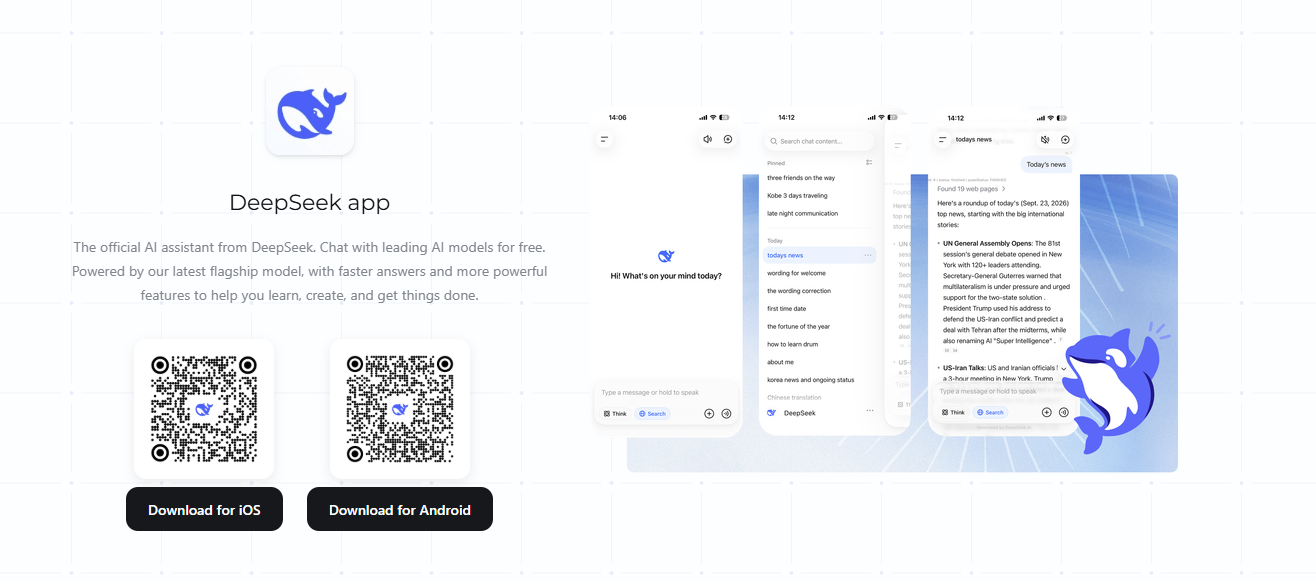
DeepSeek is a straightforward choice when you mainly need conversational help with writing, explanations, problem-solving, code, photos, and uploaded files without buying a consumer subscription. Its official web and mobile assistant is presented as free, although “free” should not be interpreted as a promise of unlimited messages, permanent availability, or identical limits in every region.
Grok covers a broader range of tasks inside one consumer product. Its documented feature set includes live web and X search, source citations, voice conversations, image and video generation, image editing, file and PDF analysis, vision, memory across chats, custom instructions, canvas-style writing, and multi-agent research.
Practical decision: choose DeepSeek when you want a free general assistant and do not need an extensive media or live-search suite. Choose Grok when web research, current X activity, voice, or media creation is central to your workflow.
Which is better for current news and research?
Grok has the clearer advantage for time-sensitive research. The standalone Grok product documents live web search, direct X search, primary-source citations, and follow-up research. This can be especially useful for breaking news, public reactions, product launches, market discussions, and topics developing on X.
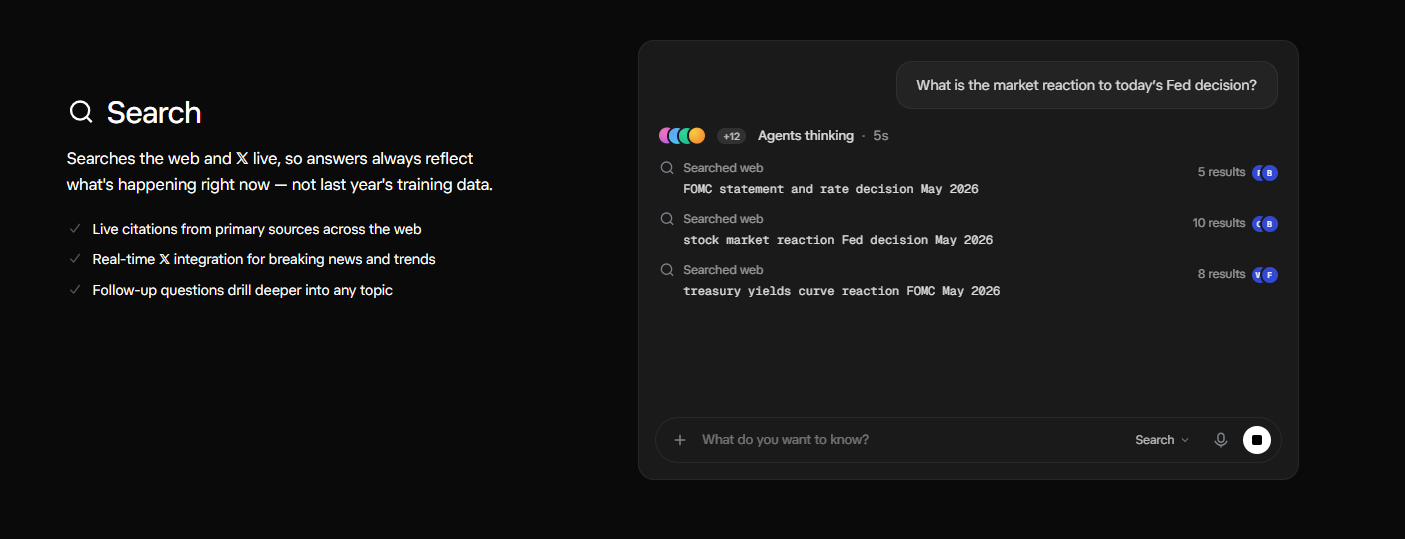
This advantage comes from tools surrounding the model, not from the base model automatically knowing everything happening now. Grok’s own API documentation warns that Grok 4.7 does not know current events unless search tools are enabled. Developers can add first-party web_search and x_search through the Responses API, with separate tool charges.
DeepSeek supports tool and function calling for application-managed retrieval. It also provides server-side web_search in the Responses API with deepseek-v4-pro; the tool is ignored with deepseek-flash. Separate Search and Fetch endpoints can retrieve structured results or page content. Grok’s documented first-party X search remains a distinct feature. With either provider, cite retrieved sources rather than treating model memory as live information.
Verdict: Grok is convenient for combined web and X research. DeepSeek V4 Pro also offers managed web search through Responses, so developers do not need to build a search backend merely to use that supported tool. Flash requires a separate retrieval route, and neither model should be assumed to provide Grok’s first-party X search.
Which is better for coding and software development?
A documentation-only comparison does not support declaring one universal coding winner. Grok’s provider describes Grok 4.7 as its flagship for coding and knowledge work, while DeepSeek positions V4.1-Flash as a more capable, efficient, vision-enabled model for agentic workloads. Those are provider claims produced under different evaluation settings, not a shared independent test.
Choose Grok for a managed agent toolchain
Grok’s API ecosystem is more turnkey when an agent must search the web or X, run Python code in a managed sandbox, search attached files, query document collections, call remote MCP servers, or continue stateful work through the Responses API. Grok Build and Grok Bot provide additional agent and coding environments around the same broader platform.
Choose DeepSeek for cost, long context, and deployment control
DeepSeek is attractive when you already operate your own tools and retrieval system. Its API supports tool calls, JSON output, Responses API, streaming, and both OpenAI- and Anthropic-style endpoints. DeepSeek-V4.1-Flash also publishes current weights under an MIT license, allowing qualified teams to inspect and host the model in their own infrastructure.
For a real engineering decision, test both on the same repository and use the same tools, documented and comparable reasoning settings, acceptance tests, time budget, and retry policy. Measure whether the code builds, passes tests, respects existing architecture, avoids security regressions, and solves the assigned issue—not whether the explanation merely sounds convincing.
Which is better for reasoning and mathematics?
Both current APIs support adjustable reasoning behavior. DeepSeek’s documented models support thinking and non-thinking modes, with thinking enabled by default. Grok 4.7 also offers configurable reasoning effort. Longer reasoning can increase latency and token use, so the most expensive or verbose mode is not automatically the best choice for every task.
Provider benchmark tables cannot establish a clean DeepSeek-vs-Grok winner because the companies report different benchmark sets, harnesses, effort levels, and tool configurations. A fair comparison would require identical problems, equivalent reasoning modes, multiple runs, hidden reference answers, and mechanical grading where possible.
Verdict: documentation alone does not establish an overall reasoning winner. Test for a repeatable advantage on your own workload. For simple tasks, lower reasoning effort; DeepSeek also documents disabling thinking mode. Grok 4.7 documents low, medium, high, and xhigh effort, with high as the default. Do not assume the two APIs expose identical controls.
Images, video, voice, and file analysis
| Capability | DeepSeek | Grok |
|---|---|---|
| Understand images | Supported by deepseek-flash and the current mobile app | Supported in the consumer product and API |
| Analyze screenshots and diagrams | Yes, through vision-capable workflows | Yes |
| Upload files | Available in the consumer app; API support depends on the endpoint and file type | Consumer file and PDF analysis plus Files and Collections APIs |
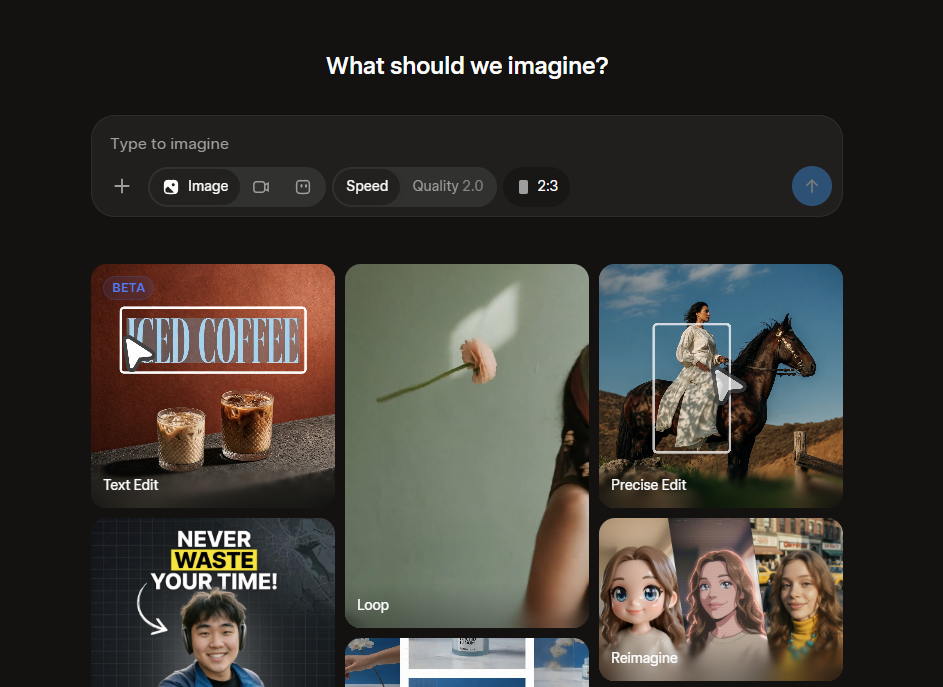
| Generate images | No comparable first-party generation API is documented in the current model table | Yes, through Grok Imagine and its API |
| Edit images | Not documented as a comparable current first-party API | Yes |
| Generate video | Not documented as a current first-party API | Yes, with dedicated video models |
| Voice conversations and voice API | No comparable dedicated voice suite is listed in the current API documentation | Consumer voice plus speech-to-speech, speech-to-text, and text-to-speech APIs |
DeepSeek-V4.1-Flash has native visual understanding, and the current iOS release history documents unified vision capabilities and improved photo and file uploads. This makes it useful for reading screenshots, describing images, and extracting information from visual inputs. Vision is not the same as image generation.
Grok is the stronger choice when the output itself must be an image, edited image, video, or voice conversation. Its consumer product combines these modes in one interface, while its developer platform exposes separate Imagine and Voice APIs with usage-based pricing.
DeepSeek vs Grok consumer pricing
| Product or plan | Published monthly price | What to know |
|---|---|---|
| DeepSeek assistant | Free | Official chat and mobile app; access limits can still apply. |
| Grok Free | $0 | Limited chat and agent usage. |
| Plus | $8 | Entry paid tier with shared eligible AI usage. |
| Premium | $30 | A larger allowance and access to the latest Grok models. |
| Super | $100 | A larger allowance and priority model access. |
| Ultra | $200 | The highest listed individual usage tier. |
| Teams | From $30 per seat | Tiered seats, shared administration, and centralized billing. |
| Enterprise | Custom pricing | Contract-specific features, limits, and support. |
These are published USD monthly list prices checked on October 14, 2026, using the current pricing page and The X Subscription plan documentation. Applicable taxes and fees are extra. Confirm the plan, billing period, and final checkout price shown to your account.
Does a Grok subscription include API usage?
Paid X Subscription plans include Grok API access, but API consumption is billed separately at the standard model rates and does not draw from the subscription’s shared usage pool. The weekly allowance covers eligible Grok and Cursor usage; within Grok, the pricing FAQ names Chat, Imagine, Voice, and Bot. Third-party models in Cursor also cost extra. Keep API charges separate from subscription allowances and top-ups when estimating costs. See the official usage explanation.
Existing subscribers: the official transition documentation says switching is optional: current plans, prices, and features continue unless changed or cancelled. That means an existing SuperGrok customer may still have a previous plan. New customers start on The X Subscription. Check the terms that apply to a retained legacy plan; for current paid plans, API access does not mean API consumption is included in the weekly allowance.
DeepSeek’s official download page did not list a comparable paid consumer subscription at the review date. That makes DeepSeek attractive for basic chat without a monthly plan. Grok’s paid tiers make more sense when higher usage, its current frontier model, media generation, or multi-agent features justify the recurring cost.
DeepSeek API vs Grok API
| API feature | DeepSeek deepseek-flash | Grok grok-4.7 |
|---|---|---|
| Current model version | DeepSeek-V4.1-Flash-1017 | Grok 4.7 |
| Context window | 1M tokens | 500K tokens |
| Reasoning | Thinking and non-thinking; thinking is the documented default | Configurable reasoning |
| Image input | Supported | Supported |
| Structured output | Supported | Supported |
| Function or tool calling | Supported | Supported |
| Responses API | Supported | Recommended API |
| OpenAI SDK | Supported through a compatible base URL | Supported through a compatible base URL |
| Anthropic-style endpoint | Officially documented | Legacy compatibility is documented but fully deprecated; use Responses API or gRPC for new integrations |
| Managed web search | Ignored with deepseek-flash; supported server-side through Responses with deepseek-v4-pro | Available for an additional tool charge |
| Managed X search | Not listed | Available for an additional usage charge |
| Managed code execution | Build through your own tool integration | Available as a server-side tool |
| Hosted file search and RAG collections | Requires a separate application architecture for general RAG | Files, attachment search, and Collections are documented |
| Current open weights | Yes, MIT-licensed V4.1-Flash weights | No published Grok 4.7 weights identified in the current official model documentation |
DeepSeek’s current model table lists a one-million-token context window and a maximum output of 384K for Flash and Pro. Grok 4.7 lists a 500K context window. This is a comparison of the named models, not a claim that every Grok model has a smaller context: other Grok models are listed with 1M context. API specifications also do not promise that consumer apps expose the same limits to every user or plan.
Both platforms work with the OpenAI SDK after changing the API key and base URL. Grok’s current quickstart uses the Responses API and identifies Chat Completions as a legacy interface; DeepSeek documents OpenAI-format, Anthropic-format, and Responses API access. Grok’s legacy API reference still documents Anthropic-compatible endpoints, but marks that compatibility as fully deprecated. Existing endpoint documentation should not be treated as a recommendation for a new integration.
Published API prices
The following standard token rates were checked on October 11, 2026, using DeepSeek’s rate card and Grok’s API pricing. All amounts are USD per one million tokens; the Grok rows use the global endpoint. These are API usage rates. Grok API consumption is billed separately from the subscription pool; applicable API credits and account-specific billing terms can affect the amount due.
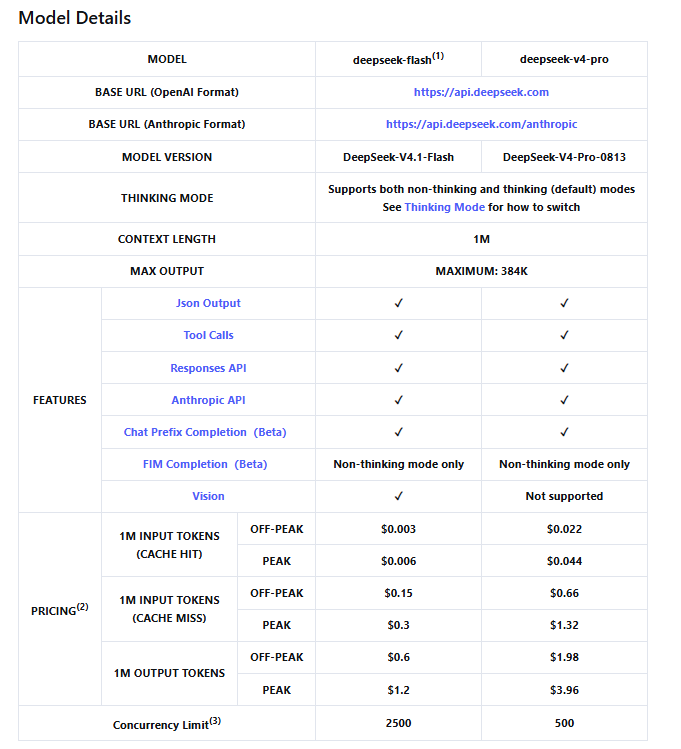
| Model and condition | Cached input per 1M | Uncached input per 1M | Output per 1M |
|---|---|---|---|
| DeepSeek Flash, off-peak | $0.003 | $0.15 | $0.60 |
| DeepSeek Flash, peak | $0.006 | $0.30 | $1.20 |
| DeepSeek Pro, off-peak | $0.022 | $0.66 | $1.98 |
| DeepSeek Pro, peak | $0.044 | $1.32 | $3.96 |
| Grok 4.7, global, prompt below 200K | $0.50 | $2.00 | $6.00 |
| Grok 4.7, global, prompt at or above 200K | $1.00 | $4.00 | $12.00 |
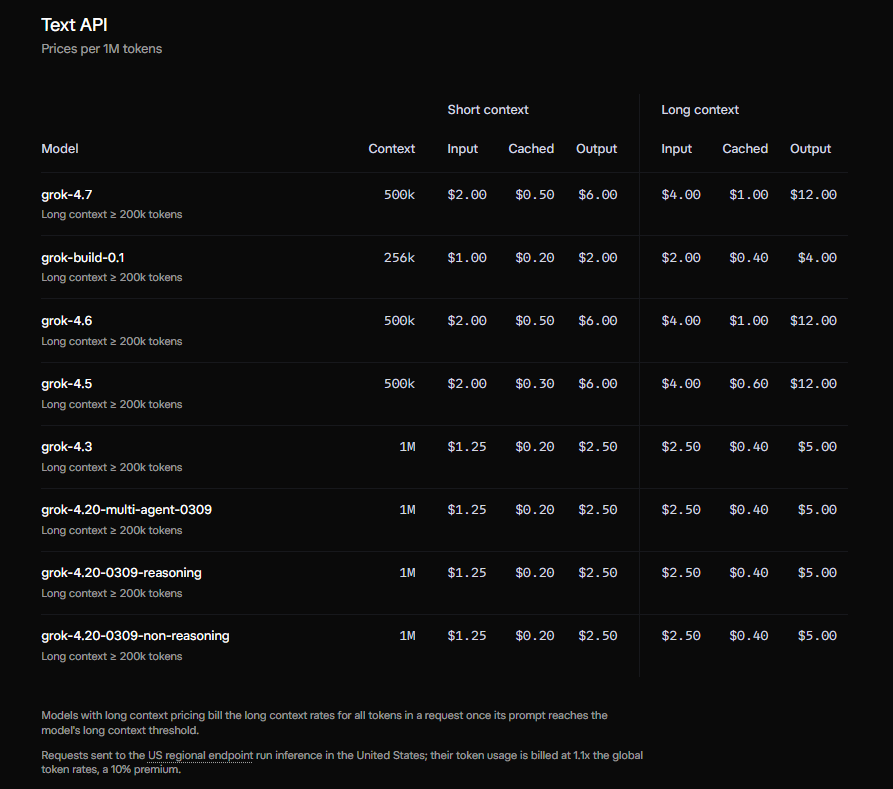
DeepSeek’s peak periods are 01:00–04:00 and 06:00–10:00 UTC from Monday through Friday, excluding Chinese public holidays; other times receive the off-peak rates. Grok applies its higher long-context tier to the whole request once the prompt reaches 200K tokens. Grok separately meters managed tools and media under its published API rate card. Its US regional endpoint adds 10% to the global token rates; priority processing is priced separately.
Worked API cost example
Consider a standard request using 100,000 uncached input tokens and 10,000 billable output tokens, including any reasoning billed as output. Assume Grok’s global endpoint, standard processing, and no paid tool or media use:
- DeepSeek Flash at peak:
(0.1 × $0.30) + (0.01 × $1.20) = $0.042 - DeepSeek Flash off-peak:
(0.1 × $0.15) + (0.01 × $0.60) = $0.021 - Grok 4.7 short-context rate:
(0.1 × $2.00) + (0.01 × $6.00) = $0.26
At those published token rates, the Grok 4.7 estimate is about 6.2 times the DeepSeek Flash peak estimate and 12.4 times the Flash off-peak estimate. These ratios describe the stated API workload before applicable API credits or account-specific adjustments; the subscription pool does not cover Grok API consumption. The example does not calculate Pro’s cost or measure model quality. Caching, output length, long-context pricing, paid tools, retries, and engineering overhead can change the cost of completing a task.
DeepSeek is therefore the stronger starting point for high-volume text generation, long-document processing, or an existing agent stack where the team supplies its own tools. Grok can justify the higher rate when its managed search, code execution, files, media, or MCP capabilities replace infrastructure you would otherwise have to build.
Open weights and local deployment
DeepSeek wins the current open-weight comparison. DeepSeek publishes V4.1-Flash weights under the MIT license and provides examples for serving the model with frameworks such as vLLM and SGLang. The checkpoint is extremely large, so availability of the weights does not mean that the full model will run comfortably on an ordinary laptop or single consumer GPU.
Grok has released historical open weights for Grok-1 under Apache 2.0. That model has 314 billion parameters and an 8,192-token context window. Its license applies specifically to Grok-1 code and weights; it does not make the current Grok 4.7 flagship open-weight or self-hostable.
Self-hosting can give an organization more control over model versions, network boundaries, logs, and retention. It also transfers responsibility for hardware, model serving, access controls, monitoring, patches, backups, and the privacy behavior of every surrounding application and tool. A locally hosted model is private only when the complete workflow remains under appropriate control.
Which is better for privacy?
Neither consumer assistant can be declared universally “more private.” The answer changes according to whether you use the public chat, an API, a business plan, Grok on X, or a self-hosted model.
| Privacy question | DeepSeek | Grok |
|---|---|---|
| Can consumer inputs be used to improve or train models? | Its policy says personal data may be used to train and improve technology; users may have a training opt-out right | Consumer data may be used for training; signed-in users can disable Improve the Model, and Private Chat is excluded from training where available |
| Where is consumer data processed? | The policy says personal data is directly collected, processed, and stored in the People’s Republic of China | The consumer policy identifies a US-based operator but does not provide one universal storage-location promise for every service and mode |
| Can chats be deleted? | Users can manage or delete chat history and delete their accounts | Private Chat is excluded from history and normally deleted within 30 days; deleted chats and accounts are also normally removed within 30 days, subject to exceptions |
| Does one privacy policy cover every interface? | Check the policy and terms for the specific DeepSeek service or deployment | Grok.com and its mobile apps use the standalone Grok policy; Grok inside X is governed by X’s privacy policy |
| Does the API train on customer requests? | Review the current DeepSeek policy and contractual terms for your account before sending business data | The provider states that API inputs and outputs are not used for training without explicit permission |
| Default API retention | No equally specific universal API-retention statement was identified in the public documentation reviewed | Requests and responses are stored for 30 days by default for abuse auditing; qualifying teams can review zero-data-retention options |
DeepSeek’s Privacy Policy covers prompts, uploaded files, photos, chat history, account information, and technical data. It states that the company may use personal data to improve and train its technology, provides a right to opt out of model training, and says personal data is directly processed and stored in the People’s Republic of China.
Grok’s consumer Privacy Policy covers Grok.com and the Grok mobile applications and permits data use for service improvement and model training. Its consumer FAQ says signed-in users can disable Improve the Model for new conversations, and Private Chat is excluded from training where available. Voluntary feedback may still be used after opting out. Grok used inside X follows X’s privacy rules and separate controls; some unauthenticated access has different opt-out availability.
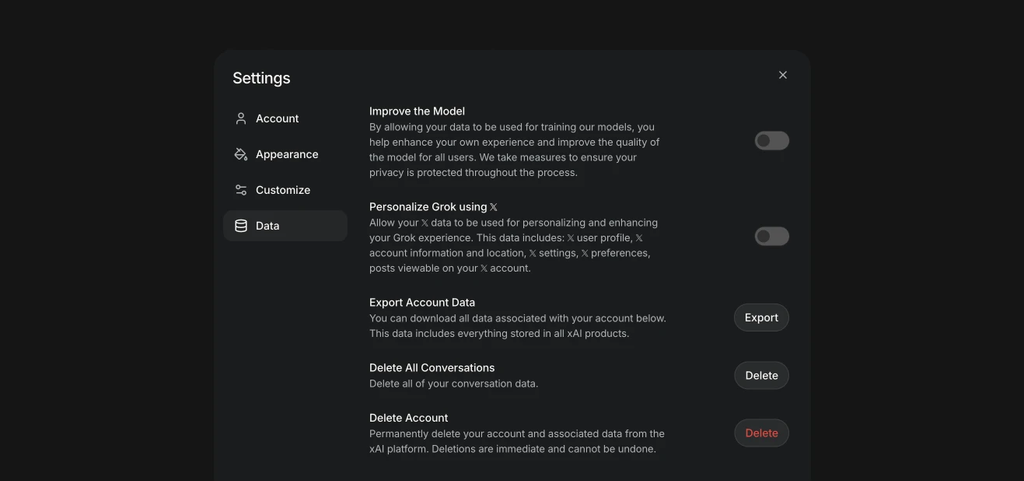
For the Grok API, the published security documentation states that customer inputs and outputs are not used for training without explicit permission. Requests and responses are retained for 30 days by default for abuse auditing. Zero Data Retention is available in supported team environments, but it disables features that require storage, including stateful Responses, Files, Collections, and Batch API. Check which features your workflow needs before choosing retention settings.
Practical privacy rule: do not place passwords, API keys, confidential source code, customer records, identity documents, private contracts, health data, or other sensitive information into either consumer assistant without an approved workflow. For organizational use, compare the exact API or business agreement—not only the public chat privacy policy.
Which is better for business and enterprise use?
Grok publishes the clearer packaged business and enterprise offering. Its plan comparison includes organization-oriented options such as seat management, consolidated billing, role-based access control, domain verification, no-training commitments, custom retention, SSO, SCIM, audit controls, customer-managed encryption options, dedicated infrastructure, and support tiers. Availability differs by plan, so a buyer should confirm the exact contract rather than assume every feature is included.
DeepSeek offers a hosted API and current open weights, which can be valuable for teams that prefer to build their own governance and deployment layer. Its public consumer and pricing pages do not present the same detailed organization-plan matrix. This does not prove that private commercial arrangements are unavailable; it means a buyer should obtain written answers about retention, training, support, data location, service levels, and incident handling.
Verdict: Grok is easier to evaluate when a company wants a packaged managed service with published administrative controls. DeepSeek is more compelling when low API cost or a controlled open-weight deployment matters more than an off-the-shelf enterprise workspace.
Choose DeepSeek if…
- You want a free general-purpose web or mobile assistant without purchasing a consumer plan.
- You need a low-cost API for high-volume text, code, vision, or long-document workloads.
- A one-million-token documented API context window is important.
- You already operate your own search, RAG, code-execution, or agent tools.
- You need an Anthropic-compatible endpoint as well as OpenAI-style access.
- You want current open weights for inspection, modification, research, or controlled self-hosting.
- You can manage the substantial infrastructure required by the full V4.1-Flash checkpoint, or select a separately documented smaller DeepSeek checkpoint with suitable licensing and hardware requirements.
Choose Grok if…
- You regularly research breaking news, public discussion, or events developing on X.
- You want live web and X search with source links built into the consumer product.
- You need image generation, image editing, video generation, or voice in the same ecosystem.
- You want managed web search, X search, code execution, file search, RAG collections, or remote MCP tools through an API.
- You prefer a packaged business or enterprise plan with published administrative and retention controls.
- The included usage, tool convenience, and any additional charges make economic sense for your workload.
Use both if…
A combined workflow can be sensible when the tasks are clearly separated. For example, Grok can collect current web and X sources, while DeepSeek handles lower-cost processing, classification, summarization, or long-context analysis. A media team might use Grok for images and video but use DeepSeek for bulk text or code work.
Do not pass information between services automatically without reviewing privacy, licensing, and data-minimization requirements. Remove irrelevant personal or confidential data, preserve source links, and make sure the second model does not turn an unverified first-model output into an apparently authoritative conclusion.
When neither product should be the sole tool
- Medical, legal, financial, employment, or safety-critical decisions: verify the information with current authoritative sources and an appropriately qualified professional.
- Confidential organizational data: use only an approved deployment with documented retention, training, security, access, and contractual controls.
- Claims requiring guaranteed factual accuracy: neither provider guarantees that every output is correct.
- Exact reproducibility: generative outputs may vary across runs, model updates, modes, and tool configurations.
- Current research without source checking: search-enabled answers can still misread, omit, or cite weak evidence.
DeepSeek vs Grok FAQ
Is DeepSeek or Grok better overall?
Grok is a strong consumer-product choice for live web and X research, voice, images, and video. Its developer platform also provides managed tools; API consumption is billed separately from the subscription pool at standard model rates, subject to applicable API credits and account-specific terms. DeepSeek is a strong choice for low-cost API usage, a larger documented context than Grok 4.7, current open weights, and control over deployment. Neither wins every category.
Which is better for coding, DeepSeek or Grok?
Grok provides a broader managed agent stack with code execution, search, files, MCP, Grok Build, and Grok Bot. DeepSeek provides lower-cost inference, a longer documented API context than Grok 4.7, OpenAI and Anthropic compatibility, and open weights. Test both against your repository and acceptance tests before choosing based on model claims.
Which is better for current news?
Grok is convenient for current news, especially when direct X search matters. DeepSeek also offers managed web search through Responses with deepseek-v4-pro, while deepseek-flash ignores that built-in tool. With either provider, enable a supported search route and verify its sources; model memory alone is not live information.
Is DeepSeek cheaper than Grok?
DeepSeek-V4.1-Flash has lower published text-token rates in this comparison. For the worked example, Grok 4.7’s standard global token-rate estimate is about 6.2 times the Flash peak estimate and 12.4 times the Flash off-peak estimate. These ratios exclude applicable API credits or account-specific adjustments. Grok API usage does not draw from the subscription pool. Actual API spending also depends on caching, paid tools, output length, and the attempts needed to complete the task.
Can DeepSeek generate images and video like Grok?
DeepSeek-V4.1-Flash can understand visual inputs, but the current DeepSeek API documentation does not list a comparable first-party image- and video-generation suite. Grok offers dedicated image generation, editing, video generation, and related APIs.
Can DeepSeek or Grok run locally?
DeepSeek publishes current V4.1-Flash weights under MIT, although the full model requires substantial infrastructure. Grok released historical Grok-1 weights under Apache 2.0, but the current Grok 4.7 flagship is not presented as an open-weight download in the current official model documentation.
Which is better for privacy?
Privacy depends on the product and deployment. Both consumer services document training controls; Grok also excludes Private Chat from training where available. DeepSeek’s consumer policy says data is processed and stored in China, while Grok’s API documents a no-training commitment without explicit permission and default 30-day retention. Self-hosting DeepSeek can give you more control, but the surrounding applications, tools, and logs still matter. Choose an approved deployment for sensitive information.
Can I use Grok without an X account?
Yes. Grok is available through Grok.com and its iOS and Android applications. The official product information says users can sign in through the options presented by the service, while Grok used inside X remains a separate access path with X-specific terms and privacy rules.
Is Grok open source?
Do not apply one label to the entire Grok family. The historical Grok-1 code and weights were released under Apache 2.0, but that license applies specifically to Grok-1. The current Grok 4.7 flagship is offered through hosted products and APIs rather than as a current open-weight release.
Official sources checked
- DeepSeek official app and download page
- DeepSeek API models and pricing
- DeepSeek-V4.1-Flash announcement
- DeepSeek-V4.1-Flash model card and license
- DeepSeek Privacy Policy
- Grok official product page
- Grok consumer, business, and enterprise plans
- Grok API models
- Grok API, tool, media, and voice pricing
- Grok consumer Privacy Policy
- Grok API data and retention information
- Historical Grok-1 open-weight repository and license
- DeepSeek API change log: continuation of V4 Pro service
- DeepSeek thinking-mode controls
- Grok 4.7 model specifications and reasoning controls
- Grok legacy and deprecated API compatibility
- Grok consumer training controls and Private Chat
- The X Subscription: current plans, shared usage, and existing subscribers
- The X Subscription: individual and team plan prices
Next step: try the free consumer versions with one ordinary task, then run a small API pilot using your real input size, tool requirements, and acceptance tests. Choose Grok when live search and built-in media or agent tools create more value than their added cost; choose DeepSeek when inference economics, long context, or control over deployment matters most.