

Last reviewed: October 11, 2026
Quick answer: DeepSeek Coder is the original family of DeepSeek code language models, released in multiple sizes and built for code generation, completion, infilling, and project-level coding tasks. DeepSeek-Coder-V2 is the later Mixture-of-Experts coding model family that expanded language support, increased context length, and improved coding and math capabilities compared with the original DeepSeek-Coder release.
Use DeepSeek-Coder if you want a smaller, simpler, older coding model family with well-known Base and Instruct variants. Use DeepSeek-Coder-V2 if you want the stronger 2024 coding-focused release with MoE architecture, 128K context, Lite and full variants, and better long-context code work. But do not assume Coder V2 is the newest DeepSeek model overall. Treat it as a specific coding model release and compare it with newer DeepSeek models and current coding alternatives before using it in production.
This article is based on official DeepSeek repositories, Hugging Face model cards, arXiv papers, and public documentation. No private benchmark or hands-on production test was performed for this article, so benchmark claims are presented as documented historical results, not as a current universal ranking.
DeepSeek Coder and Coder V2 at a glance
| Feature | DeepSeek-Coder | DeepSeek-Coder-V2 |
|---|---|---|
| Best understood as | Original DeepSeek coding model family | Later MoE coding model family based on DeepSeek-V2 continued pretraining |
| Main release period | Models available in 2023; technical report submitted January 25, 2024 | 2024 technical report and model release |
| Architecture | Dense code language models | Mixture-of-Experts code language models |
| Model sizes | Released in sizes such as 1.3B, 5.7B, 6.7B, and 33B | Lite 16B total / 2.4B active and full 236B total / 21B active |
| Context length | 16K window in the official release materials | 128K context length in the official model table |
| Training focus | Project-level code corpus, code completion, and fill-in-the-middle | Continued pretraining from DeepSeek-V2 with additional code and reasoning data |
| Programming languages | More than 80 programming languages in official materials | Expanded from 86 to 338 programming languages according to the official repository |
| Variants | Base and Instruct | Lite Base, Lite Instruct, full Base, full Instruct |
| Good fit | Smaller local coding experiments, code completion, classic FIM workflows | Longer-context coding, stronger code/math reasoning, larger-scale local or hosted testing |
| Main caution | Older generation; benchmark claims are time-bound | Large full model is hardware-heavy; not automatically the latest DeepSeek model today |
What is DeepSeek Coder?
DeepSeek-Coder is DeepSeek’s original coding-focused language model family. The official DeepSeek Coder website describes it as a series of code language models trained from scratch on 2 trillion tokens, with 87% code and 13% natural language in English and Chinese.
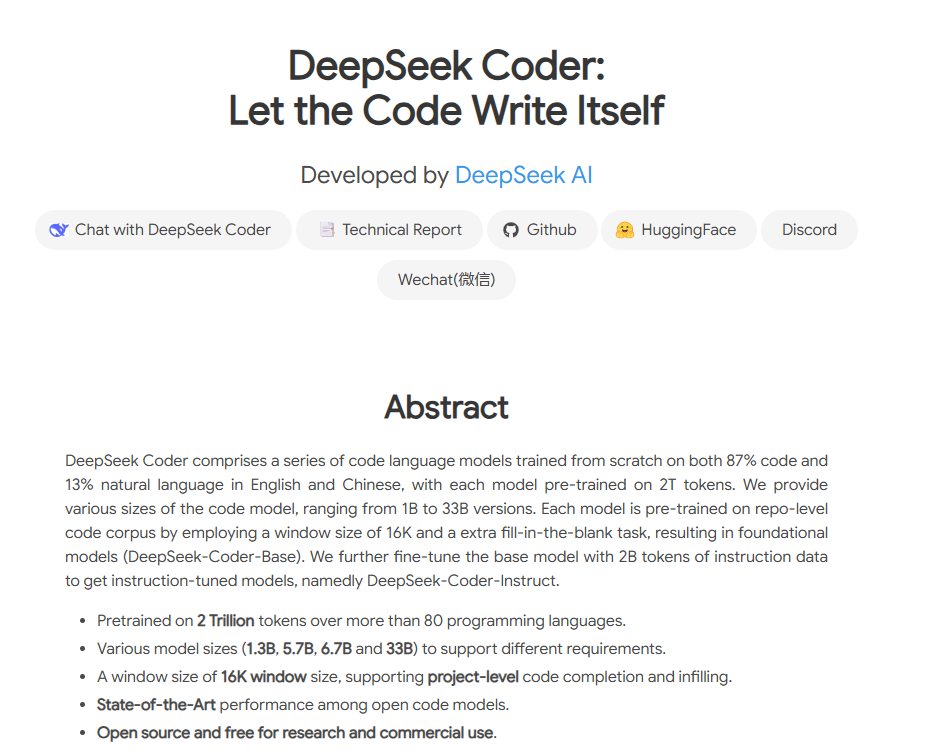
The model family was designed for code generation, code completion, code infilling, and repository-level coding tasks. The official materials describe a 16K window and a fill-in-the-blank training task, which is why DeepSeek-Coder is often mentioned in the same context as fill-in-the-middle completion.
DeepSeek-Coder was released in multiple model sizes, including 1.3B, 5.7B, 6.7B, and 33B variants. The smaller models are easier to experiment with locally, while the 33B models were the stronger options in the original family.
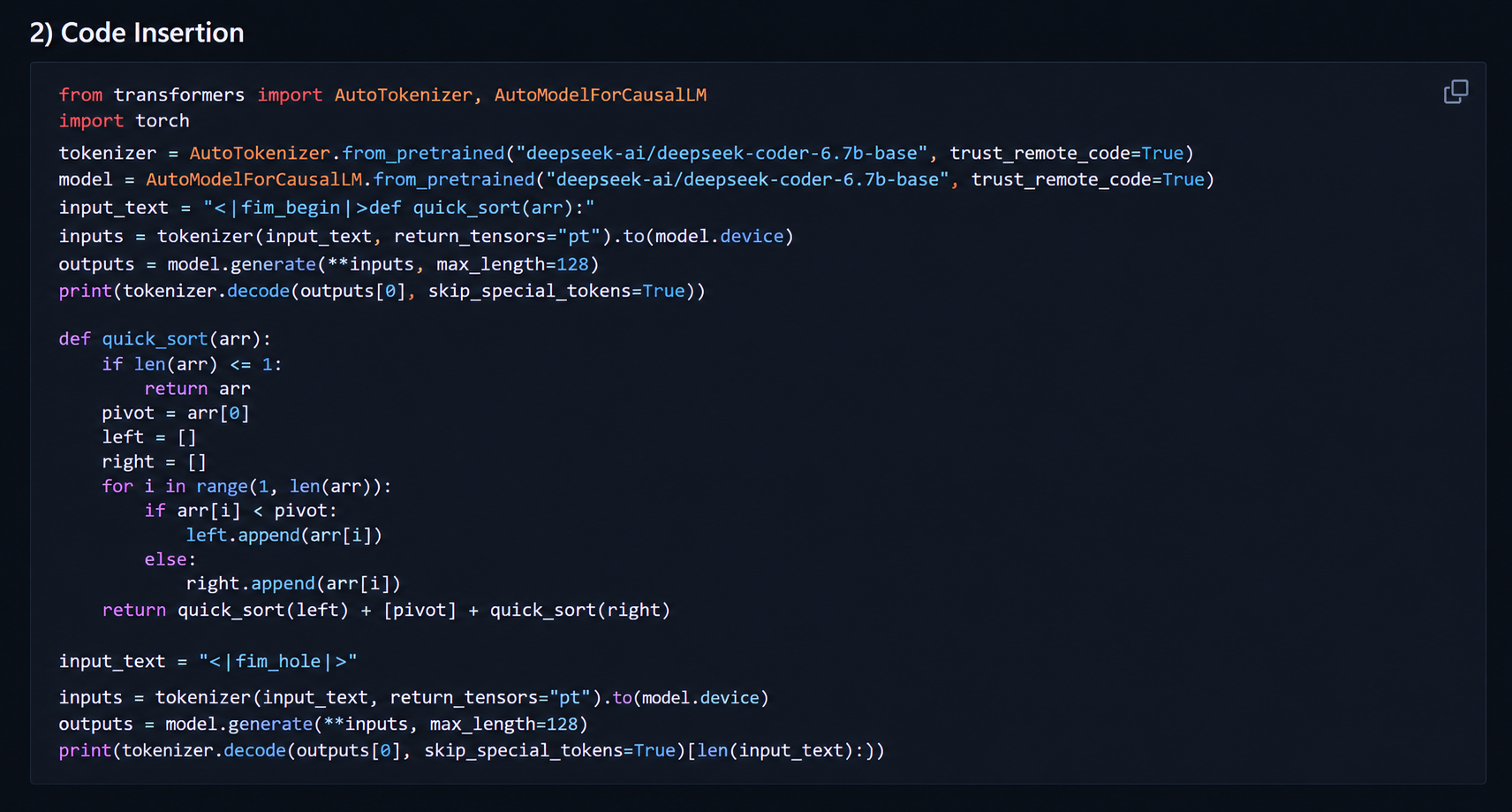
The official DeepSeek-Coder GitHub repository includes examples for code completion, code insertion, chat-style inference, and repository-level code completion. The model cards on Hugging Face also describe the model license and commercial-use support for the DeepSeek-Coder family.
What is DeepSeek-Coder-V2?
DeepSeek-Coder-V2 is the second major coding-focused release in this line. The official DeepSeek-Coder-V2 GitHub repository describes it as an open-source Mixture-of-Experts code language model further pretrained from an intermediate checkpoint of DeepSeek-V2 with an additional 6 trillion tokens.
Compared with the original DeepSeek-Coder family, DeepSeek-Coder-V2 expanded programming language support from 86 to 338 languages and extended context length from 16K to 128K. It was also released in Lite and full variants, with both Base and Instruct versions.
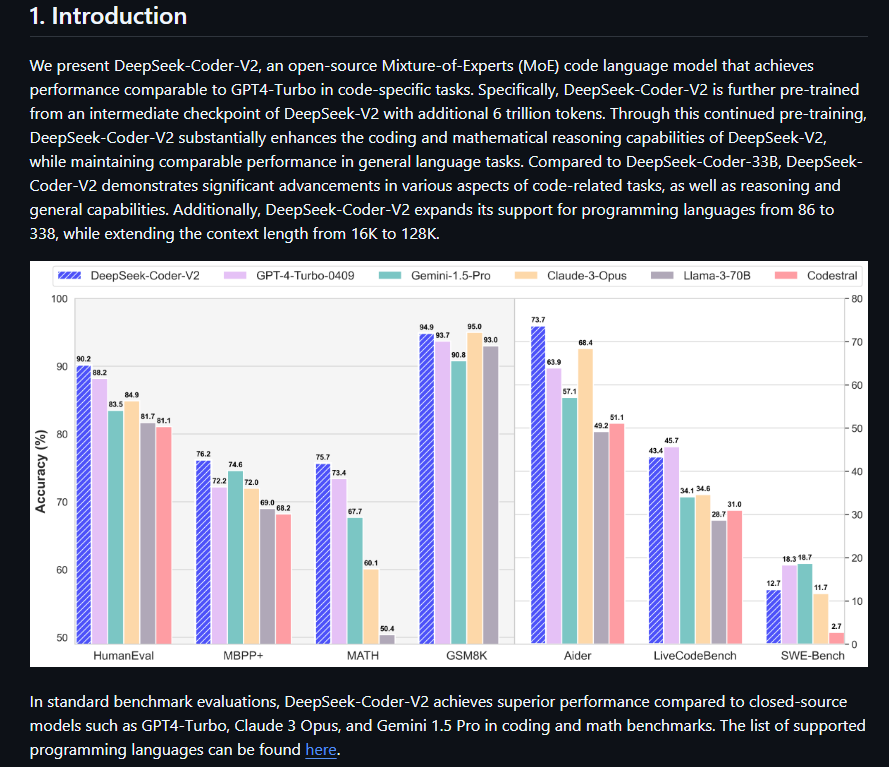
The important point is that DeepSeek-Coder-V2 is not just “DeepSeek-Coder with a new name.” It is a different generation built on DeepSeek-V2 and DeepSeekMoE ideas. It is better framed as a larger, more capable code-and-reasoning model family, especially for long-context and multi-language coding tasks.
DeepSeek Coder vs Coder V2: what changed?
The biggest changes are architecture, scale, context length, language coverage, and the way users should think about deployment.
| Area | What changed in Coder V2 | Why it matters |
|---|---|---|
| Architecture | DeepSeek-Coder-V2 moved to a Mixture-of-Experts design | MoE models can have many total parameters while activating only part of the model per token |
| Training path | Coder V2 was further pretrained from an intermediate DeepSeek-V2 checkpoint | It is connected to DeepSeek’s broader general-model architecture, not only a standalone code model |
| Data scale | The official paper/repository describes 6T additional tokens for Coder V2 | This helped improve coding and mathematical reasoning capabilities |
| Programming languages | Support expanded from 86 to 338 languages | Better fit for multilingual and less common programming-language tasks |
| Context length | Context increased from 16K to 128K | More useful for longer files, multi-file prompts, and repository-aware workflows |
| Variants | Coder V2 introduced Lite and full model options | Users can choose between a more practical smaller model and a much larger full model |
These changes make DeepSeek-Coder-V2 a real upgrade in many coding scenarios. However, “upgrade” does not mean it is automatically the best choice for every user. A smaller original DeepSeek-Coder model may still be easier to run, while a newer general DeepSeek model or another modern coding assistant may be a better fit for current hosted workflows.
Model variants: Base, Instruct, Lite, and full
The most common confusion around DeepSeek Coder and Coder V2 comes from the model names. The important words are Base, Instruct, Lite, and the full Coder V2 model.
Base models
Base models are the foundation models. They are usually better suited for raw code completion, fill-in-the-middle tasks, and further fine-tuning. If you are building a coding autocomplete or experimenting with model behavior, a Base model may be the better starting point.
Instruct models
Instruct models are tuned to follow user instructions. They are usually better for chat-style coding help, debugging requests, explanations, code rewriting, and “write a function that…” prompts.
Lite Coder V2 models
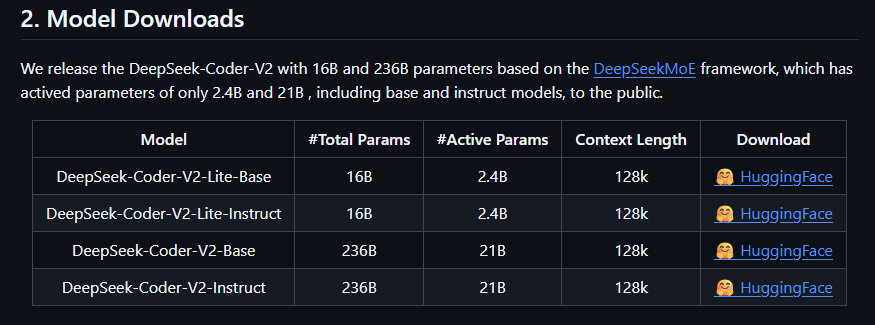
DeepSeek-Coder-V2-Lite is the more practical Coder V2 branch for many local users. The official model table lists Lite Base and Lite Instruct at 16B total parameters with 2.4B active parameters and 128K context.
Full Coder V2 models
The full DeepSeek-Coder-V2 models are much larger. The official model table lists the full Base and Instruct variants at 236B total parameters with 21B active parameters and 128K context. The official repository also notes that using the full DeepSeek-Coder-V2 in BF16 format for inference requires 8 × 80GB GPUs, so most individual users should not treat the full model as a casual local download.
| Model | Total parameters | Active parameters | Context length | Best for |
|---|---|---|---|---|
| DeepSeek-Coder Base | Varies by size | Dense model | 16K | Code completion, infilling, research, fine-tuning |
| DeepSeek-Coder Instruct | Varies by size | Dense model | 16K | Chat-style coding help and instruction following |
| DeepSeek-Coder-V2-Lite-Base | 16B | 2.4B | 128K | Long-context code completion and local experimentation |
| DeepSeek-Coder-V2-Lite-Instruct | 16B | 2.4B | 128K | Chat-style coding help with a more practical Coder V2 model |
| DeepSeek-Coder-V2-Base | 236B | 21B | 128K | Large-scale code completion and research setups |
| DeepSeek-Coder-V2-Instruct | 236B | 21B | 128K | Stronger instruction-following coding and reasoning tasks, if hardware is available |
What does Mixture-of-Experts mean in Coder V2?
A Mixture-of-Experts model has many total parameters, but it does not use all of them for every token. Instead, it activates a subset of “experts” during inference. That is why DeepSeek-Coder-V2 can have 236B total parameters while the official model table lists 21B active parameters for the full model.
This matters because users often compare total parameter counts incorrectly. A 236B MoE model is not the same deployment experience as a dense 236B model, but it is also not as lightweight as a 21B dense model. You still need to check real memory, serving framework, quantization, throughput, and context length before choosing it.
What can DeepSeek Coder and Coder V2 do?
Both generations are designed for coding tasks, but Coder V2 is the stronger and more flexible family for longer and more complex prompts.
| Task | DeepSeek-Coder | DeepSeek-Coder-V2 |
|---|---|---|
| Generate code from a prompt | Good, especially with Instruct models | Usually stronger, especially with Instruct variants |
| Complete code inside a file | Strong original use case | Also supported; V2 adds longer context |
| Fill in missing code | Core feature through fill-in-the-middle style training | Supported in Base examples and long-context workflows |
| Explain code | Better with Instruct models | Better with Instruct models, especially for longer snippets |
| Debug code | Useful for smaller tasks | Better fit for larger context and more reasoning-heavy debugging |
| Repository-level assistance | Possible within 16K context | More practical because of 128K context, but still needs retrieval and testing |
| Mathematical reasoning | Not the main advantage of the original family | Official Coder V2 materials emphasize improved coding and math reasoning |
Can you run DeepSeek Coder and Coder V2 locally?
Yes, but “locally” means different things depending on the model size and serving method. The original DeepSeek-Coder repository includes Transformers examples. The Coder V2 repository and Hugging Face model cards include examples for Transformers and vLLM, while Hugging Face also surfaces local-app and quantization paths for tools such as llama.cpp, Ollama, and LM Studio through compatible community formats.
The safest rule is simple: start with a smaller or Lite model unless you have the hardware and engineering resources for the full model. For the full DeepSeek-Coder-V2 BF16 model, the official GitHub repository states that 8 × 80GB GPUs are required for inference. Quantized community builds can reduce hardware needs, but those are separate from the official BF16 requirement and should be evaluated carefully.
Example: original DeepSeek-Coder with Transformers
The official DeepSeek-Coder repository shows Transformers usage for code completion and chat-style inference. A simplified pattern looks like this:
from transformers import AutoTokenizer, AutoModelForCausalLM
import torch

model_name = "deepseek-ai/deepseek-coder-6.7b-instruct"

tokenizer = AutoTokenizer.from_pretrained(model_name, trust_remote_code=True)
model = AutoModelForCausalLM.from_pretrained(
    model_name,
    trust_remote_code=True,
    torch_dtype=torch.bfloat16
).cuda()

messages = [
    {"role": "user", "content": "Write a Python function that checks whether a number is prime."}
]

inputs = tokenizer.apply_chat_template(
    messages,
    add_generation_prompt=True,
    return_tensors="pt"
).to(model.device)

outputs = model.generate(inputs, max_new_tokens=256)
print(tokenizer.decode(outputs[0][len(inputs[0]):], skip_special_tokens=True))
Example: DeepSeek-Coder-V2 Lite with Transformers
The Coder V2 Lite Instruct model card shows usage with Transformers. A simplified pattern looks like this:
from transformers import AutoTokenizer, AutoModelForCausalLM

model_name = "deepseek-ai/DeepSeek-Coder-V2-Lite-Instruct"

tokenizer = AutoTokenizer.from_pretrained(model_name, trust_remote_code=True)
model = AutoModelForCausalLM.from_pretrained(
    model_name,
    trust_remote_code=True,
    device_map="auto"
)

messages = [
    {"role": "user", "content": "Refactor this JavaScript function and explain the changes."}
]

inputs = tokenizer.apply_chat_template(
    messages,
    add_generation_prompt=True,
    tokenize=True,
    return_dict=True,
    return_tensors="pt"
).to(model.device)

outputs = model.generate(**inputs, max_new_tokens=512)
print(tokenizer.decode(outputs[0][inputs["input_ids"].shape[-1]:], skip_special_tokens=True))
These examples are starting points, not production setups. For a real application, you need dependency pinning, memory testing, input sanitization, timeout handling, logging, and evaluation against your own codebase.
Can you use them through the DeepSeek API?
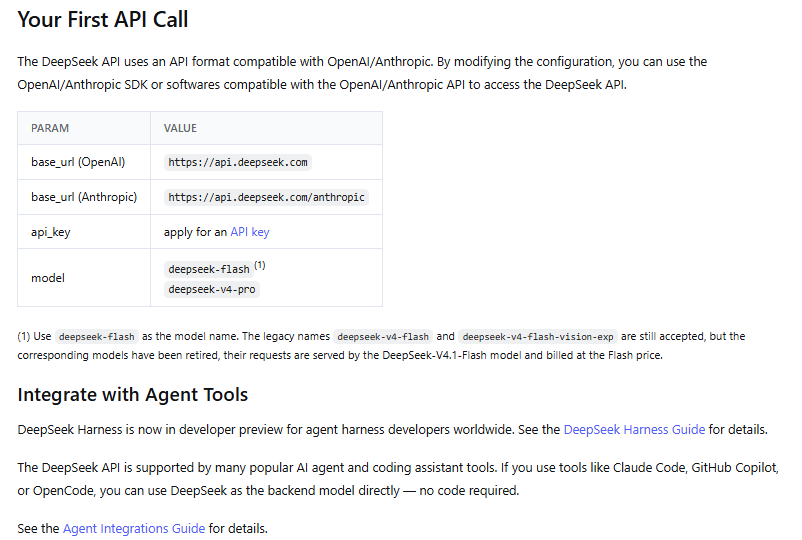
Do not assume that every local DeepSeek model has a matching hosted API model ID. DeepSeek’s current hosted API and chat products may use newer general-purpose DeepSeek models rather than exposing the old DeepSeek-Coder or DeepSeek-Coder-V2 names directly.
If API access matters, check the current DeepSeek API documentation before writing code or publishing model-specific instructions. For this article, the safest distinction is: DeepSeek-Coder and DeepSeek-Coder-V2 are public model families with weights and documentation, while the hosted DeepSeek API may have its own current model IDs and pricing.
Benchmarks: how to read the old claims correctly
The original DeepSeek-Coder models were available in 2023, with a technical report submitted in January 2024; DeepSeek-Coder-V2 followed in 2024. Their benchmark claims should be read in that historical context. The original DeepSeek-Coder materials compare the 33B model against open code models on benchmarks such as HumanEval, MBPP, DS-1000, APPS, and MultiPL-E. The Coder V2 repository includes benchmark tables for code generation, code completion, code fixing, mathematical reasoning, and general capabilities.
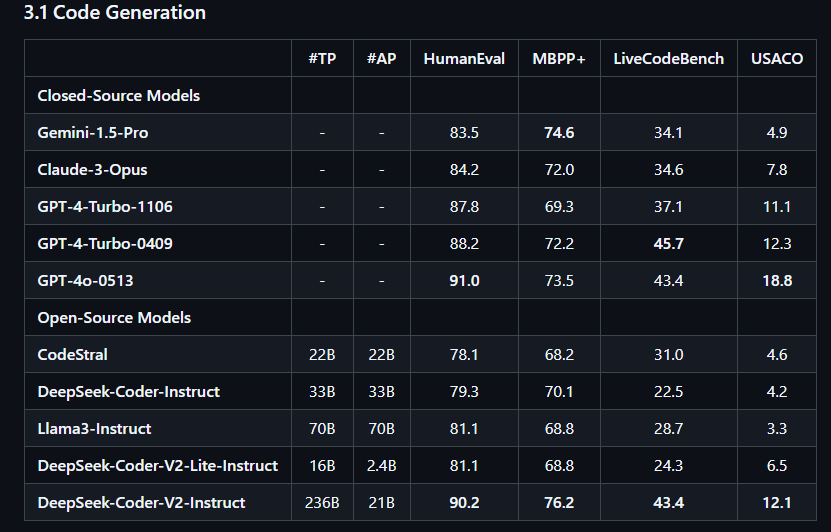
Those results are useful, but they should not be read as a current 2026 leaderboard. Coding model quality changes quickly. Benchmarks also vary by prompt format, decoding settings, test contamination controls, tool use, benchmark version, and whether the task resembles your real codebase.
For a practical decision, run your own evaluation. Give the model real tasks from your repository: bug fixes, unit test generation, function refactoring, SQL correction, API integration, code review, and documentation updates. Measure accepted outputs, compile/test pass rate, security issues, hallucinated APIs, latency, memory cost, and human review time.
Is DeepSeek-Coder-V2 still worth using today?
Yes, but mainly for the right audience. DeepSeek-Coder-V2 is still worth testing if you want a coding-focused open model family, local or self-hosted inference, long-context code prompts, and a model with documented Base and Instruct variants. It is especially relevant if you want to evaluate a 128K-context coding model outside a closed hosted assistant.
It is less attractive if you simply want the newest DeepSeek capability through a hosted chat interface, the easiest coding agent workflow, or a managed production service. In those cases, you should compare Coder V2 with current DeepSeek hosted models, Claude Code, OpenAI coding models, Qwen Coder, Codestral, or whatever current coding systems are available at the time you publish or deploy.
| Your goal | Best starting point | Why |
|---|---|---|
| Small local coding experiments | DeepSeek-Coder 1.3B or 6.7B, or community quantized variants | Easier to run and test |
| Instruction-following coding help | DeepSeek-Coder Instruct or Coder V2 Lite Instruct | Better fit for chat-style prompts |
| Long-context code prompts | DeepSeek-Coder-V2 Lite or full V2 if hardware allows | 128K context is the main advantage |
| Code completion and infilling | Base models | Base models are more natural for completion-style use cases |
| Production coding assistant | Run an evaluation first | Needs security review, test pass rate, latency, monitoring, and human review |
| Newest DeepSeek hosted experience | Check DeepSeek’s current chat/API products | Coder V2 is not automatically the current hosted model |
Licensing and commercial use
The official Hugging Face model card for DeepSeek-Coder-33B-Instruct says the code repository is licensed under MIT, model use is subject to the model license, and DeepSeek Coder supports commercial use. The official Hugging Face model card for DeepSeek-Coder-V2-Lite-Instruct similarly states that the code repository is MIT licensed, model use is subject to the model license, and the DeepSeek-Coder-V2 series supports commercial use.
Before commercial deployment, still read the current license files for the exact model you plan to use. Do not assume that a community quantization, fine-tune, hosted endpoint, or third-party wrapper has the same terms as the official model card.
Privacy and private code
Running a model locally can help keep private code inside your own environment, but local inference is not automatically secure. You still need to control who can access the machine, where prompts and outputs are logged, how model servers are exposed, and whether generated code is reviewed before merging.
Hosted use is different. If you use a hosted API, third-party gateway, public demo, cloud notebook, or hosted inference provider, review its data-retention and logging terms before sending private source code. For sensitive codebases, secrets, credentials, customer data, or regulated systems, use a formal security review and avoid pasting confidential material into unapproved tools.
Production readiness checklist
DeepSeek Coder and Coder V2 can be useful, but production coding assistants need more than a good model. Use this checklist before depending on either model for real development work.
- Build a test set from your real codebase. Include bugs, refactors, tests, documentation tasks, and multi-file changes.
- Measure correctness with tests. Do not judge only by whether the answer looks good.
- Track hallucinated APIs. Coding models often invent functions, package options, or framework behavior.
- Check security output. Look for injection risks, unsafe deserialization, weak authentication, exposed secrets, and insecure defaults.
- Measure latency and hardware cost. Long context and large models can be expensive even when the weights are available.
- Review license terms. Check the official model license and any third-party quantization license.
- Separate local and hosted privacy risks. Local inference, cloud notebooks, and hosted APIs have different data flows.
- Use human code review. Do not merge model-generated code without review, tests, and security checks.
- Keep alternatives in the evaluation. Compare with newer coding models before standardizing.
Common mistakes to avoid
- Calling Coder V2 the latest DeepSeek model. It is a major coding release, but not automatically the newest DeepSeek model overall.
- Mixing up DeepSeek-Coder and DeepSeek-Coder-V2. They are related but different model families.
- Ignoring Base vs Instruct. Base is better for completion-style workflows; Instruct is better for chat-style coding help.
- Confusing total and active parameters. Coder V2 is MoE, so both numbers matter.
- Assuming the full 236B model is easy to run locally. The official BF16 requirement is heavy.
- Treating benchmark claims as current rankings. The 2024 results need current evaluation against your workload.
- Assuming API availability from model-card availability. Model weights and hosted API model IDs are not the same thing.
- Uploading private code to unverified demos. Local inference and hosted tools have different privacy implications.
Final recommendation
Choose DeepSeek-Coder if you want a simpler, older, coding-focused model family for completion, infilling, and local experiments. It is especially useful if you want smaller model sizes or want to understand DeepSeek’s first major code model release.
Choose DeepSeek-Coder-V2 if you want a stronger coding-focused model with 128K context, MoE architecture, Lite and full variants, and better documented performance on coding and math tasks in its original release context.
Choose a newer hosted coding assistant or model if your priority is the easiest production workflow, current managed API support, tool integration, agentic coding, or the best present-day benchmark performance. DeepSeek-Coder-V2 is important, but it should be evaluated against today’s options rather than treated as the final answer.
FAQ
What is DeepSeek Coder?
DeepSeek Coder usually refers to DeepSeek-Coder, the original DeepSeek code language model family. It was trained on a code-heavy dataset and released in multiple sizes for code generation, completion, infilling, and instruction-following coding tasks.
What is DeepSeek Coder V2?
DeepSeek Coder V2 usually refers to DeepSeek-Coder-V2, a later Mixture-of-Experts coding model family based on continued pretraining from DeepSeek-V2. It expanded programming language support and increased context length to 128K.
What is the difference between DeepSeek Coder and Coder V2?
DeepSeek-Coder is the original dense coding model family with a 16K window. DeepSeek-Coder-V2 is the later MoE family with 128K context, Lite and full variants, expanded language support, and stronger documented coding and reasoning results in its 2024 release materials.
Is DeepSeek-Coder-V2 better than DeepSeek-Coder?
For many coding and long-context tasks, yes, Coder V2 is the stronger release. However, DeepSeek-Coder may still be easier to run in smaller configurations, and Coder V2 should still be compared with current models before production use.
What is DeepSeek-Coder-V2 Lite?
DeepSeek-Coder-V2 Lite is the smaller Coder V2 branch. The official model table lists it at 16B total parameters and 2.4B active parameters, with Base and Instruct variants and 128K context.
What is the difference between Base and Instruct models?
Base models are better suited for code completion, fill-in-the-middle, research, and fine-tuning. Instruct models are tuned to follow user instructions and are better for chat-style coding help, explanations, debugging, and refactoring prompts.
Can I run DeepSeek Coder V2 locally?
Yes, especially the Lite models if your hardware supports them. The official materials include Transformers and vLLM examples. The full Coder V2 BF16 model is much heavier, and the official repository states that 8 × 80GB GPUs are required for full BF16 inference.
Is DeepSeek Coder V2 open source?
The official repository and model cards make the code and model weights publicly available, with code under MIT and model use governed by the model license. The official model card states that the Coder V2 series supports commercial use. Always check the current license for the exact model or quantization you use.
Is DeepSeek Coder V2 available through the DeepSeek API?
Do not assume it is available under a Coder V2-specific API model ID. Check the current DeepSeek API documentation. Public model weights and hosted API model names are separate things.
Is DeepSeek Coder V2 still worth using today?
Yes, if you want a coding-focused open model with 128K context and local or self-hosted options. It is less ideal if you want the easiest managed coding agent or the newest hosted model. In that case, compare it with current alternatives.
Is it safe to use DeepSeek Coder with private code?
Local inference can reduce exposure to third-party services, but safety still depends on your infrastructure, logs, access controls, and review process. Hosted demos, cloud notebooks, and third-party APIs should be reviewed before sending private code.
Sources checked
- DeepSeek Coder official website
- DeepSeek-Coder official GitHub repository
- DeepSeek-Coder-V2 official GitHub repository
- DeepSeek-Coder technical report on arXiv
- DeepSeek-Coder-V2 paper on arXiv
- DeepSeek-Coder-33B-Instruct Hugging Face model card
- DeepSeek-Coder-V2-Lite-Instruct Hugging Face model card
- DeepSeek API documentation