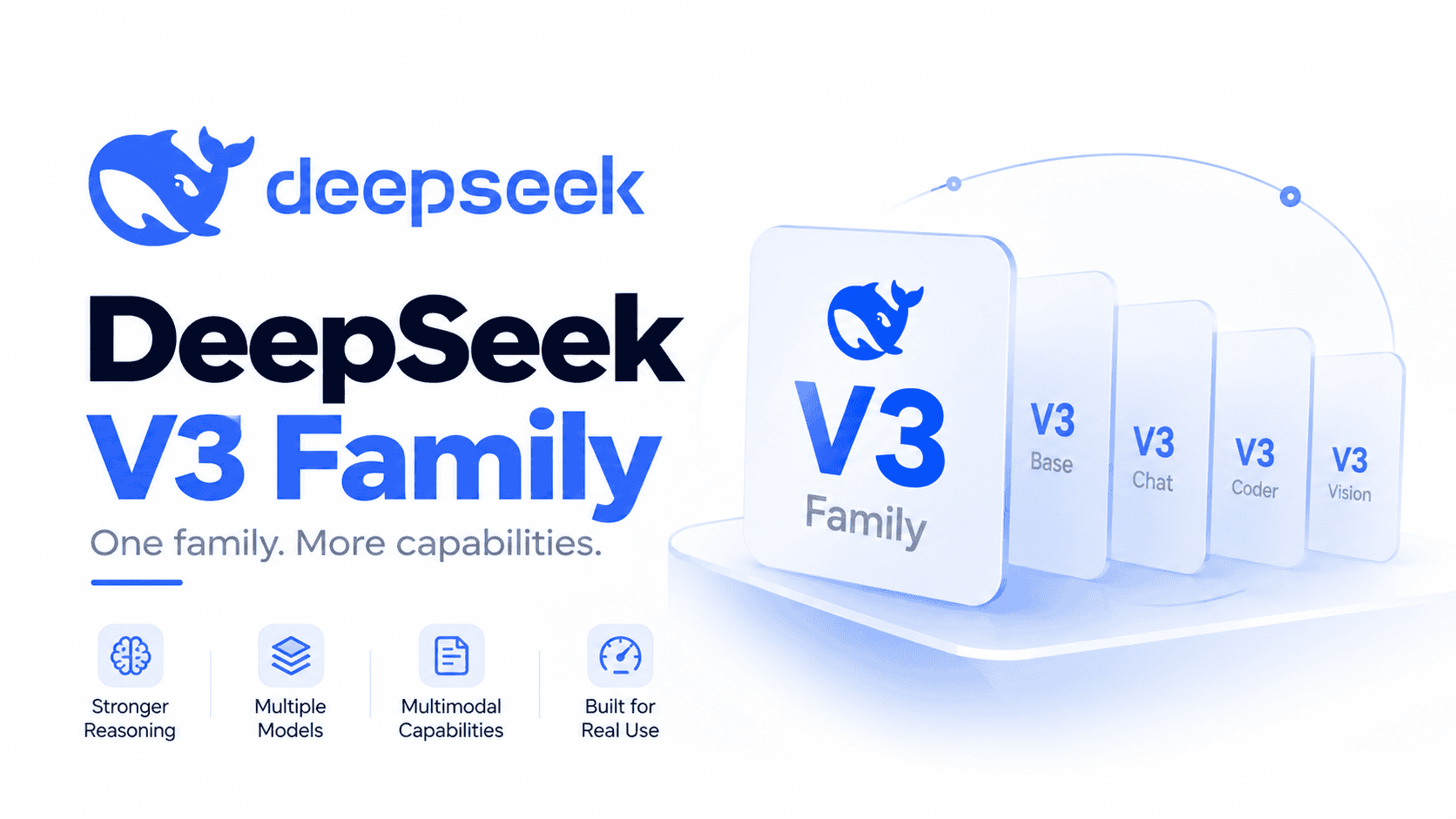

DeepSeek V3 Family refers to the sequence of DeepSeek V3-series models released from late 2024 through 2025, including DeepSeek-V3, V3-0324, V3.1, V3.1-Terminus, V3.2-Exp, V3.2, and V3.2-Speciale. The family was important because it pushed open Mixture-of-Experts models, API-compatible deployment, reasoning improvements, agent workflows, long-context work, and later sparse-attention experiments.
It is also old by current DeepSeek API standards. The current DeepSeek Models & Pricing page lists newer hosted API models such as deepseek-flash and deepseek-v4-pro. It does not present the V3 family as the default current API path. Treat V3 as a historically important model family and open-weight lineage, not as the first model line to choose for a new hosted API integration.
Documentation checked: October 4, 2026. This article is based on official DeepSeek release pages, current DeepSeek API documentation, and official model cards. No live API request, local deployment, or benchmark test was performed.
DeepSeek V3 Family quick map
| Model or release | Release context | What it added | How to treat it now |
|---|---|---|---|
| DeepSeek-V3 | December 2024 | 671B-parameter MoE model with 37B activated parameters, 14.8T training tokens, API compatibility, and open models/papers. | Historical baseline and open-weight lineage. |
| DeepSeek-V3-0324 | March 2025 | Improved reasoning, front-end development, writing, search, and function calling. | Important V3 update; not a current default hosted API recommendation. |
| DeepSeek-V3.1 | August 2025 | Hybrid Think and Non-Think behavior, stronger agents, 128K context, Anthropic API format, and open weights. | Key transition toward agent workflows and thinking modes. |
| DeepSeek-V3.1-Terminus | September 2025 | Improved language consistency and Code Agent/Search Agent performance. | Stabilization/refinement of V3.1. |
| DeepSeek-V3.2-Exp | September 2025 | Experimental DeepSeek Sparse Attention for long-context efficiency. | Research/intermediate efficiency step, not a stable current API default. |
| DeepSeek-V3.2 | December 2025 | Later V3-family model with thinking in tool-use and stronger agent training pipeline. | Late V3-family open model; current hosted API users should still check the current model table. |
| DeepSeek-V3.2-Speciale | December 2025 | Special reasoning-focused variant, API-only at release, with limited tool support. | Historical/special evaluation route; not the same as a general current API default. |
Why the DeepSeek V3 Family mattered
The original DeepSeek-V3 release described a major step over DeepSeek-V2: 671B MoE parameters, 37B activated parameters, training on 14.8T high-quality tokens, and API compatibility kept intact. It also linked to open-source models and papers.
The DeepSeek-V3 model card frames V3 as a strong Mixture-of-Experts language model using Multi-head Latent Attention and DeepSeekMoE architectures. It also notes that V3 was pretrained on 14.8 trillion tokens and then went through supervised fine-tuning and reinforcement learning.
That made V3 more than a single model announcement. It became the base of a model family that later explored stronger reasoning, hybrid thinking behavior, agent workflows, long-context efficiency, and open-weight deployment. But the historical importance of V3 should not be confused with current hosted API status.
DeepSeek V3 timeline
The family is easiest to understand as a timeline.
| Date | Release | What happened |
|---|---|---|
| December 2024 | DeepSeek-V3 | Original V3 release with a 671B-parameter MoE design, 37B activated parameters, 14.8T training tokens, API compatibility, and open models/papers. |
| March 2025 | DeepSeek-V3-0324 | Update focused on reasoning, front-end development, writing, search, and smarter tool use. DeepSeek said API usage remained unchanged at the time. |
| August 2025 | DeepSeek-V3.1 | Introduced one model with Think and Non-Think modes, stronger agent skills, 128K context, Anthropic API format support, and open weights. |
| September 2025 | DeepSeek-V3.1-Terminus | Refined V3.1 by improving language consistency and Code Agent/Search Agent performance. |
| September 2025 | DeepSeek-V3.2-Exp | Experimental model built on V3.1-Terminus, introducing DeepSeek Sparse Attention for long-context efficiency. |
| December 2025 | DeepSeek-V3.2 | Later V3-family release described as the official successor to V3.2-Exp, with thinking in tool-use and an expanded agent training pipeline. |
| December 2025 | DeepSeek-V3.2-Speciale | Special reasoning variant launched with V3.2, described as API-only at release and not supporting tool calls. |
| Current API docs | Current model table | Current hosted API users should check the latest model table, which currently lists newer model IDs such as deepseek-flash and deepseek-v4-pro. |
DeepSeek-V3: the original release
DeepSeek-V3 was the starting point for the family. DeepSeek described it as its “biggest leap forward yet,” with faster generation than V2, improved capabilities, intact API compatibility, and fully open-source models and papers.
The model-card view is more technical. V3 was a large MoE model with 671B total parameters and 37B activated for each token. It used MLA and DeepSeekMoE, and introduced further training strategies such as an auxiliary-loss-free load-balancing approach and multi-token prediction training objective.
For present-day readers, the most practical point is not that V3 should be used as the first hosted API option now. The point is that V3 established the architecture and open-weight line that later V3-family models built on.
DeepSeek-V3-0324: the first major update
DeepSeek-V3-0324 was released in March 2025. DeepSeek highlighted three practical improvements: a major boost in reasoning performance, stronger front-end development skills, and smarter tool-use capabilities.
The V3-0324 model card gives more detail. It lists improvements in reasoning benchmarks, front-end web development, Chinese writing quality, Chinese search capabilities, and function calling.
DeepSeek said API usage remained unchanged at that time and that the model was released under the MIT License, like R1. That statement belongs to the March 2025 release context. It should not be read as a permanent instruction that V3-0324 is still the current hosted API default.
DeepSeek-V3.1: Think and Non-Think in one model
DeepSeek-V3.1 was the family’s major agent-era transition. DeepSeek described it as “our first step toward the agent era,” with one model supporting both Think and Non-Think inference modes.
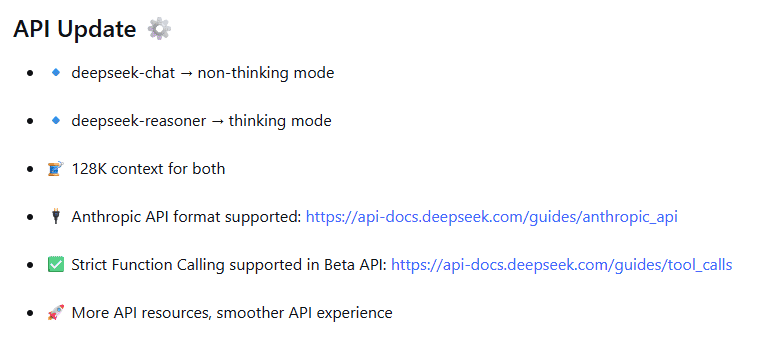
At that release point, the hosted API aliases had specific meanings:
deepseek-chatpointed to the non-thinking mode.deepseek-reasonerpointed to the thinking mode.- Both had 128K context at the time.
- Anthropic API format was supported.
- Strict Function Calling was supported in Beta API.
This historical detail is important because old tutorials may still use deepseek-chat or deepseek-reasoner with V3.1-era meanings. Current integrations should not assume those aliases still mean the same thing. The latest DeepSeek API change log and current model table should decide what model names are valid now.
The DeepSeek-V3.1 model card also describes V3.1 as a hybrid model with thinking and non-thinking modes, improved tool calling, stronger agent tasks, and 128K context. It lists V3.1-Base and V3.1 as 671B total parameter models with 37B activated parameters.
DeepSeek-V3.1-Terminus: a stabilization release
DeepSeek-V3.1-Terminus refined V3.1. DeepSeek said it improved language consistency, reduced Chinese/English mix-ups, reduced occasional abnormal characters, and upgraded Code Agent and Search Agent performance.
The V3.1-Terminus model card presents it as an update that maintains V3.1’s original capabilities while addressing user-reported issues. It also says the model structure is the same as DeepSeek-V3 and points readers to V3 resources for running it locally.
Terminus should be read as a refinement of V3.1, not as proof that V3.1-Terminus is the current hosted API default now.
DeepSeek-V3.2-Exp: the sparse-attention experiment
DeepSeek-V3.2-Exp was an experimental release built on V3.1-Terminus. Its main purpose was to introduce and validate DeepSeek Sparse Attention, a sparse-attention mechanism aimed at improving long-context training and inference efficiency.
The model card says V3.2-Exp was deliberately aligned with V3.1-Terminus training configurations so DeepSeek could evaluate the effect of sparse attention. It reports that public benchmark performance was broadly on par with V3.1-Terminus while focusing on efficiency in long-context scenarios.
That makes V3.2-Exp important technically, but it also means it should be treated as an experiment or intermediate step. It is not the same thing as a stable current hosted API recommendation.
DeepSeek-V3.2 and V3.2-Speciale
DeepSeek-V3.2 was announced in December 2025 as the official successor to V3.2-Exp. DeepSeek described it as a reasoning-first open model built for agents and said it was live on app, web, and API at release.
DeepSeek also announced DeepSeek-V3.2-Speciale, a special reasoning variant. The release page described Speciale as API-only at launch and noted that it did not support tool use. That distinction matters: V3.2-Speciale should not be treated as a general replacement for V3.2 in ordinary tool-using applications.
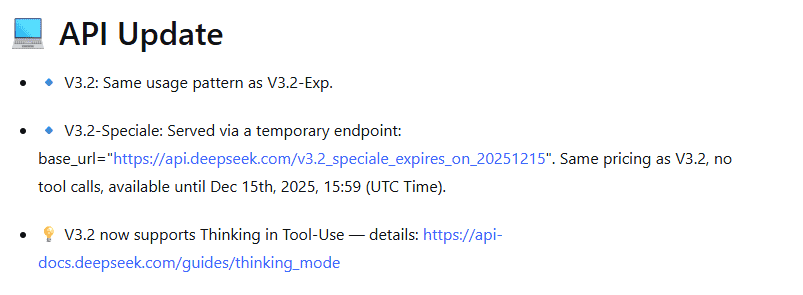
The DeepSeek-V3.2 model card says V3.2 introduced significant chat-template changes, including a revised format for tool calling and “thinking with tools.” It also warns that its output parsing function handles well-formatted strings only and is not suitable for production without robust error handling.
These details are valuable if you use the open weights or study V3.2. They should not be copied blindly into current hosted API code without checking current API documentation.
What happened to deepseek-chat and deepseek-reasoner?
The names deepseek-chat and deepseek-reasoner changed meaning over time. During the V3.1 release, DeepSeek mapped deepseek-chat to V3.1 non-thinking mode and deepseek-reasoner to V3.1 thinking mode. Later model transitions changed those old assumptions.
If you have old code like this:
{
  "model": "deepseek-chat"
}
or this:
{
  "model": "deepseek-reasoner"
}
treat it as legacy code. Check the current API change log and Models & Pricing page before assuming what those names do today. For new hosted API projects, use current official model IDs rather than old aliases.
V3.1 Think/Non-Think vs current Thinking Mode
DeepSeek-V3.1 introduced a model-level Think and Non-Think split in its release context. Current Thinking Mode is a broader API behavior/control used by supported current DeepSeek models.
Those ideas are related historically, but they are not identical:
- V3.1 Think/Non-Think was specific to the V3.1 release and its API aliases at that time.
- Current Thinking Mode can exist on newer models that are not V3.1.
- Enabling Thinking Mode today does not recreate the V3.1 model.
- Old
deepseek-reasonertutorials may describe historical behavior, not current API behavior.
Are V3-family weights open?
Several V3-family checkpoints are available through official DeepSeek organization pages on Hugging Face and GitHub, including DeepSeek-V3, DeepSeek-V3-0324, DeepSeek-V3.1, DeepSeek-V3.1-Terminus, DeepSeek-V3.2-Exp, and DeepSeek-V3.2.
Many of these model cards list the license as MIT. Check the license for the exact checkpoint you plan to use. Do not assume every V3-family checkpoint, derivative, quantization, or provider-hosted version has identical terms.
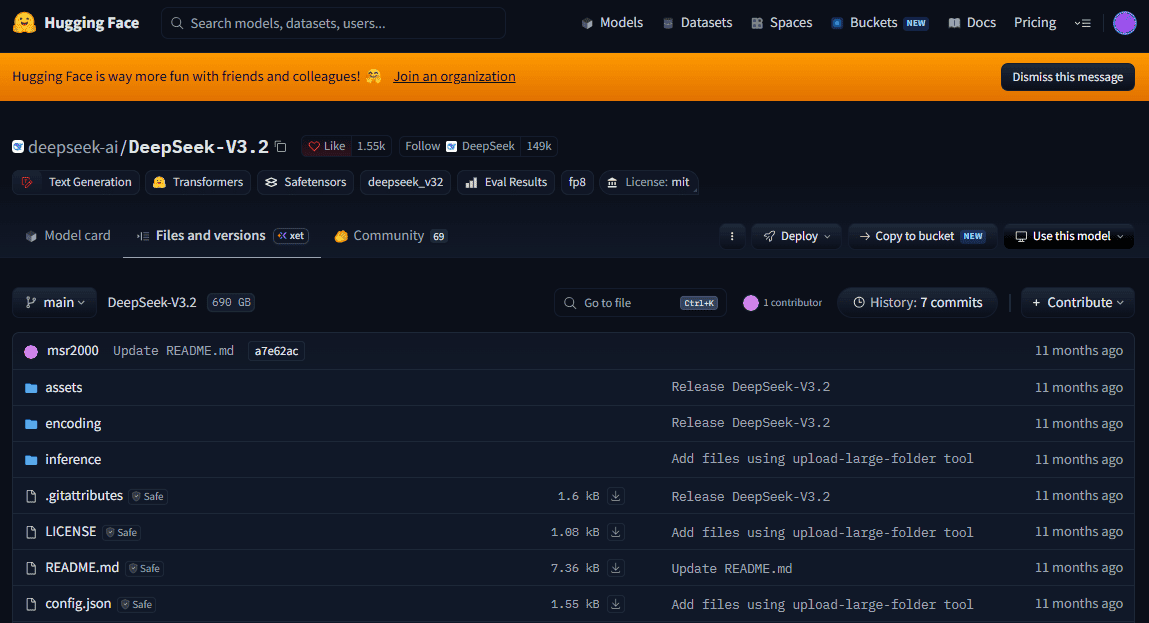
Open weights do not automatically mean that training data is open, that the original training run can be fully reproduced, or that local deployment will be easy or cheap.
Can you run DeepSeek V3 locally?
You can run some V3-family checkpoints using the resources provided in the official model cards, but the word “locally” needs context. Full V3-family models are extremely large. The DeepSeek-V3 model card includes routes such as SGLang, LMDeploy, TRT-LLM, vLLM, and hardware-specific inference guidance; later cards mention tools such as vLLM, SGLang, Docker Model Runner, llama.cpp-compatible quantizations, Ollama, and LM Studio depending on the checkpoint.
Do not assume a consumer laptop can run a full V3 or V3.2 checkpoint. Third-party quantizations or local-app routes may be more accessible, but they have their own trade-offs, licenses, performance, and correctness considerations. Local deployment behavior is not the same as official hosted API behavior.
Should developers use V3 today?
For new hosted API work, developers should start from the current DeepSeek model table. As of this documentation check, the current API model table focuses on newer hosted models such as deepseek-flash and deepseek-v4-pro.
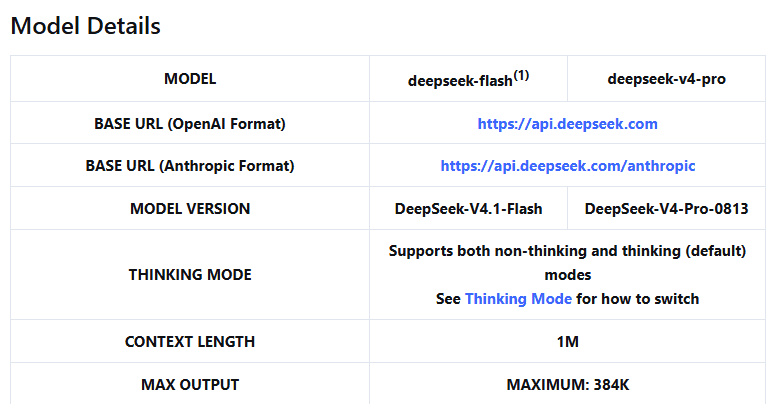
V3-family models can still be useful when you specifically need:
- a historical checkpoint for research or comparison;
- open weights from a specific V3 release;
- local or self-hosted experiments based on official model cards;
- compatibility with an evaluation setup built around a V3-family model;
- analysis of DeepSeek’s architectural evolution from V3 toward V4 and V4.1.
Use current API models when you need current hosted API features, current pricing, current model IDs, and current support behavior. Use V3-family resources when your goal is historical study, open-weight experimentation, or a provider that explicitly serves that exact checkpoint.
Migration checklist for old V3-era code
If you maintain old V3-family code, examples, or tutorials, check these items before using them today:
- Do not assume
deepseek-chatstill means the same thing it meant during V3.1. - Do not assume
deepseek-reasonerstill means V3.1 thinking mode. - Use the current DeepSeek model table for new hosted API model IDs.
- Use the current Thinking Mode documentation for reasoning behavior on supported current models.
- Do not copy old V3 API pricing into current budgets.
- Do not copy V3.2 local chat-template parsing into production without robust error handling.
- If you need a specific V3 checkpoint, use its exact Hugging Face/GitHub model-card resources or a provider that explicitly serves that checkpoint.
- Keep official hosted API behavior separate from local open-weight inference behavior.
Common DeepSeek V3 Family misunderstandings
| Misunderstanding | Safer current interpretation |
|---|---|
| “DeepSeek V3 Family is one model.” | It is a sequence of V3-series releases, from V3 through V3.2 and related variants. |
| “V3 is still the default hosted DeepSeek model.” | Current hosted API users should check the current model table. V3 is now a legacy family by API standards. |
“deepseek-chat always means V3.” | It had V3.1-era meaning, but old aliases changed across later releases. |
“deepseek-reasoner is the same as V3.1 thinking mode today.” | That was true in the V3.1 release context, not a safe current assumption. |
| “V3.2-Exp and V3.2 are the same.” | V3.2-Exp was the experimental DSA step; V3.2 was the later official successor. |
| “Open weights mean easy local deployment.” | Open weights still require hardware, engineering, inference setup, and license review. |
| “Old benchmark claims prove V3 is still best today.” | Old benchmarks are historical. Compare against current models and your workload before deciding. |
Official resources
- DeepSeek-V3 release page
- DeepSeek-V3-0324 release page
- DeepSeek-V3.1 release page
- DeepSeek-V3.1-Terminus release page
- DeepSeek-V3.2-Exp model card
- DeepSeek-V3.2 release page
- DeepSeek API change log
- Current DeepSeek Models & Pricing
- Current DeepSeek Thinking Mode guide
- DeepSeek-V3 GitHub repository
FAQ
What is the DeepSeek V3 Family?
DeepSeek V3 Family is the group of V3-series DeepSeek models released from late 2024 through 2025, including DeepSeek-V3, V3-0324, V3.1, V3.1-Terminus, V3.2-Exp, V3.2, and V3.2-Speciale.
Is DeepSeek V3 old?
Yes. DeepSeek V3 is now old by current DeepSeek API standards. It remains important historically and as an open-weight lineage, but it should not be treated as the default current hosted API model.
Is DeepSeek V3 still available in the official API?
Current developers should check the live DeepSeek model table. As of this documentation check, the current hosted API table focuses on newer model IDs such as deepseek-flash and deepseek-v4-pro, not the V3 family as a default path.
What happened to deepseek-chat and deepseek-reasoner?
During V3.1, deepseek-chat referred to non-thinking mode and deepseek-reasoner referred to thinking mode. Those aliases later changed through model transitions, so old tutorials should not be treated as current without checking the latest API change log.
Is V3.1 the same as current Thinking Mode?
No. V3.1 had a release-specific Think/Non-Think split. Current Thinking Mode is a broader API behavior for supported newer models. Enabling Thinking Mode today does not recreate V3.1.
Are DeepSeek V3 weights open?
Several V3-family checkpoints are available on official DeepSeek Hugging Face and GitHub pages, and many model cards list MIT licensing. Check the exact checkpoint and license before commercial use or redistribution.
Should I use V3 or a current DeepSeek model?
Use current DeepSeek API models for new hosted API work unless you specifically need a V3 open-weight checkpoint or a provider that explicitly serves that model. Use V3-family resources for research, historical comparison, self-hosting experiments, or compatibility with an existing V3 evaluation setup.