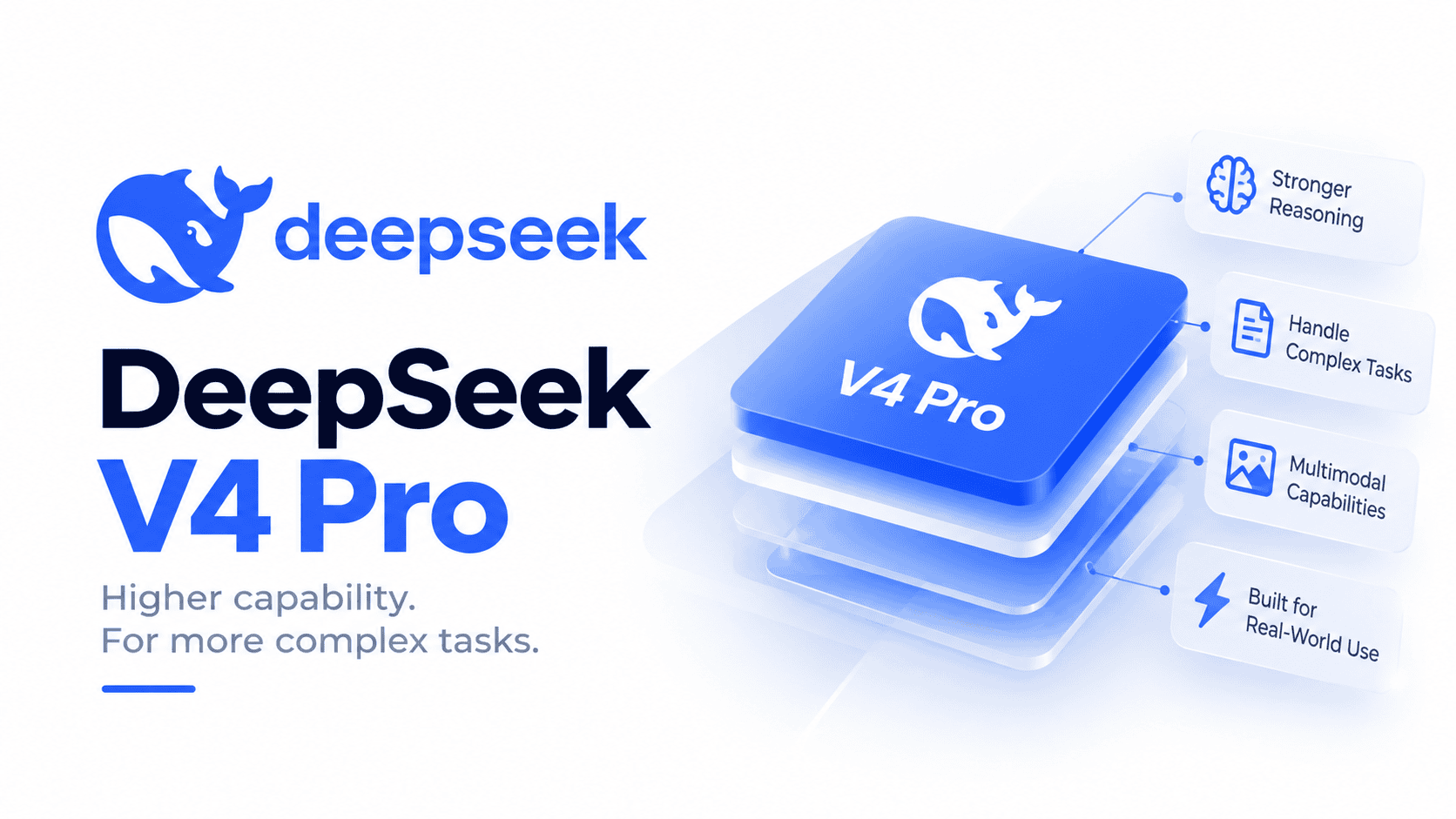

DeepSeek V4 Pro is DeepSeek’s Pro model line for higher-end text, reasoning, coding, and agent workflows. In the official DeepSeek API, the current model is called deepseek-v4-pro, and the current model version shown in the official model table is DeepSeek-V4-Pro-0813.
The most important current update is that V4 Pro is still listed as an available API model. DeepSeek’s V4.1 Flash announcement created some confusion because it discussed routing V4 Pro requests to Flash, but the current Models & Pricing page says DeepSeek decided to continue providing V4 Pro API service after September 14, 2026, with billing unchanged.
Documentation checked: October 4, 2026. This article is based on official DeepSeek documentation, the DeepSeek V4 Pro model card, and the DeepSeek V4 paper. No live API request, local deployment, benchmark test, or private evaluation was performed.
DeepSeek V4 Pro quick facts
| Item | Current information |
|---|---|
| Model / product name | DeepSeek V4 Pro |
| API model ID | deepseek-v4-pro |
| Current model version | DeepSeek-V4-Pro-0813 |
| GA release | August 13, 2026, according to the DeepSeek-V4-Pro GA release page |
| Official API status | Still listed as available in the current Models & Pricing page |
| Context length | 1M tokens |
| Maximum output | 384K tokens |
| Vision support | Not supported in the current official model table |
| Core API features | Thinking Mode, JSON Output, Tool Calls, Responses API, Anthropic API, Chat Prefix Completion Beta, and FIM Completion Beta in non-thinking mode |
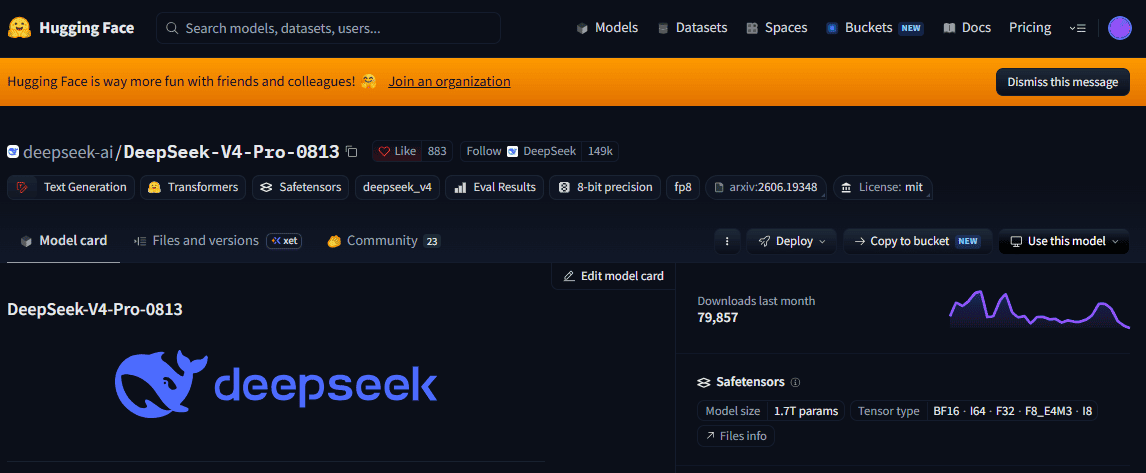
| Open weights | Available as deepseek-ai/DeepSeek-V4-Pro-0813 on Hugging Face |
| License | The Hugging Face model card lists the repository and model weights under the MIT License |
Is DeepSeek V4 Pro still available after V4.1 Flash?
Yes, according to the current API model table. The timeline matters because older pages can make the status look confusing.
- August 13, 2026: DeepSeek announced the GA release of DeepSeek-V4-Pro, available in app/web through “Expert Mode” and through the API.
- September 10, 2026: DeepSeek announced DeepSeek V4.1 Flash, including language about routing V4 Pro requests to the new Flash model.
- Current model table: the official Models & Pricing page now says DeepSeek decided to continue providing DeepSeek V4 Pro API service after September 14, 2026, with the billing method unchanged.
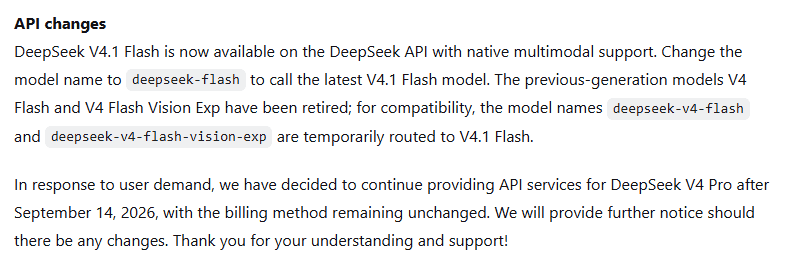
For implementation, treat the current Models & Pricing page and current change log as the source of truth. Older release pages are useful historical context, but they should not override the current model table when you are deciding what model ID to use today.
Model naming: what should you put in API code?
Use deepseek-v4-pro in the official hosted API. Do not use the Hugging Face repository name as the hosted API model string unless DeepSeek’s API documentation later says to do that.
| Name | What it means | Use it in hosted API code? |
|---|---|---|
| DeepSeek V4 Pro | Product or model-family name used in articles, announcements, and comparisons. | No; use the API model ID. |
deepseek-v4-pro | Current official API model ID. | Yes. |
| DeepSeek-V4-Pro-0813 | Current model version shown in the official model table. | No, unless the API docs later expose it as an accepted hosted model ID. |
deepseek-ai/DeepSeek-V4-Pro-0813 | Hugging Face repository name for the open-weight model card. | No for the official hosted API; use it for model-card or self-hosting contexts. |
Here is a minimal hosted API example. It uses the OpenAI-compatible DeepSeek base URL and the API model ID deepseek-v4-pro. Running it sends a real API request and can consume DeepSeek API balance.
curl https://api.deepseek.com/chat/completions \
  -H "Authorization: Bearer ${DEEPSEEK_API_KEY:?Set DEEPSEEK_API_KEY first}" \
  -H "Content-Type: application/json" \
  --data '{
    "model": "deepseek-v4-pro",
    "messages": [
      {
        "role": "user",
        "content": "Explain when a developer should consider DeepSeek V4 Pro instead of Flash."
      }
    ],
    "max_tokens": 512,
    "stream": false
  }'
The SDK base URL is https://api.deepseek.com. The full /chat/completions path belongs in raw HTTP requests, not in an SDK base_url field.
What is DeepSeek V4 Pro for?
DeepSeek positions V4 Pro as the higher-end member of the V4 model family for demanding reasoning, coding, and agentic workloads. The GA announcement highlights improved agent performance and availability through app/web Expert Mode as well as the API. The Hugging Face model card describes DeepSeek-V4-Pro-0813 as the official release that supersedes the preview version, with stronger agentic capabilities and DSpark speculative decoding attached.
That does not mean V4 Pro is automatically the best model for every task. It is more expensive than Flash, has a lower public account-level concurrency limit, and currently does not support Vision. It is a model to evaluate when your text, coding, or agent workload can justify those trade-offs.
Current API capabilities
The current official model table lists deepseek-v4-pro with these API capabilities:
| Capability | Current status for deepseek-v4-pro | Practical note |
|---|---|---|
| Text generation | Supported | Use Chat Completions or Responses API depending on your integration. |
| Thinking Mode | Supported | Use the Thinking Mode guide for effort controls and response fields. |
| JSON Output | Supported | Use JSON Output when you need valid JSON from Chat Completions. |
| Tool Calls | Supported | Your application executes the function; validate arguments before execution. |
| Responses API | Supported | Do not parse Responses output as if it were Chat Completions output. |
| Anthropic API | Supported | Use the Anthropic-compatible base URL only for Anthropic-format clients. |
| Chat Prefix Completion | Beta | Use only when your application needs that beta feature and you follow the current docs. |
| FIM Completion | Beta; non-thinking mode only | Use for fill-in-the-middle workflows where the current docs support it. |
| Vision | Not supported | Use deepseek-flash for image understanding. |
Do not assume every OpenAI or Anthropic feature works identically through DeepSeek’s compatibility layers. The SDK or client can express a field, but DeepSeek’s documentation determines whether the provider supports it.
Does DeepSeek V4 Pro support Vision?
No, not in the current official model table. DeepSeek lists Vision support for deepseek-flash, while deepseek-v4-pro is marked as not supporting Vision.
This is one of the most important differences between V4 Pro and V4.1 Flash. If your application needs screenshot analysis, chart interpretation, OCR-like extraction, or image-question answering, start with deepseek-flash and the official Vision guide.
Vision non-support does not make V4 Pro useless. It simply means V4 Pro is a text and reasoning model in the hosted API table, while Flash is the current route for image understanding.
Context length, output limit, and reasoning effort
The current model table lists deepseek-v4-pro with a 1M-token context length and a 384K-token maximum output. These are not the same thing.
- Context length is how much input the model can consider in a request.
- Maximum output is the upper bound on generated output.
- Reasoning effort controls how much deliberation the model spends before answering when Thinking Mode is enabled.
- Concurrency limit controls how many requests can be active at once under an account.
A 1M context window does not mean the model remembers previous sessions. If you use a stateless API format, your application still needs to send the relevant conversation or document context in the current request.
The V4-Pro-0813 model card says reasoning_effort supports low, high, and max. It also recommends specific sampling settings for local deployment scenarios. Those model-card notes are useful for self-hosting or open-weight inference, but hosted API behavior should still be checked in the official API documentation.
DeepSeek V4 Pro pricing and concurrency
DeepSeek’s API pricing separates cached input, uncached input, and output tokens. The following deepseek-v4-pro rates are listed on the official Models & Pricing page as of this documentation check:
Token category for deepseek-v4-pro | Off-peak | Peak |
|---|---|---|
| Cached input | $0.022 per 1M tokens | $0.044 per 1M tokens |
| Uncached input | $0.66 per 1M tokens | $1.32 per 1M tokens |
| Output | $1.98 per 1M tokens | $3.96 per 1M tokens |
Peak periods are currently 01:00–04:00 UTC and 06:00–10:00 UTC, Monday through Friday, excluding Chinese public holidays. All other times are off-peak, including weekends and Chinese public holidays.
The current public concurrency limit for deepseek-v4-pro is 500 concurrent connections per account. This is an account-level concurrency limit, not a separate pool for every API key.
Do not convert these rates into a universal cost per request. The real cost depends on input tokens, cache hits and misses, output tokens, reasoning behavior, tool loops, and whether traffic happens during peak or off-peak periods.
DeepSeek V4 Pro vs DeepSeek V4.1 Flash
V4 Pro and V4.1 Flash overlap in several API features, but they are not interchangeable. Use the comparison below as a practical starting point, then test your own workload.
| Item | deepseek-v4-pro | deepseek-flash |
|---|---|---|
| Current model version | DeepSeek-V4-Pro-0813 | DeepSeek-V4.1-Flash-1017 |
| Context length | 1M | 1M |
| Maximum output | 384K | 384K |
| Vision support | Not supported | Supported |
| Thinking Mode | Supported | Supported |
| Tool Calls | Supported | Supported |
| Responses API | Supported | Supported |
| Anthropic API | Supported | Supported |
| Off-peak cached input | $0.022 per 1M tokens | $0.003 per 1M tokens |
| Off-peak uncached input | $0.66 per 1M tokens | $0.15 per 1M tokens |
| Off-peak output | $1.98 per 1M tokens | $0.60 per 1M tokens |
| Public concurrency limit | 500 concurrent connections per account | 2,500 concurrent connections per account |
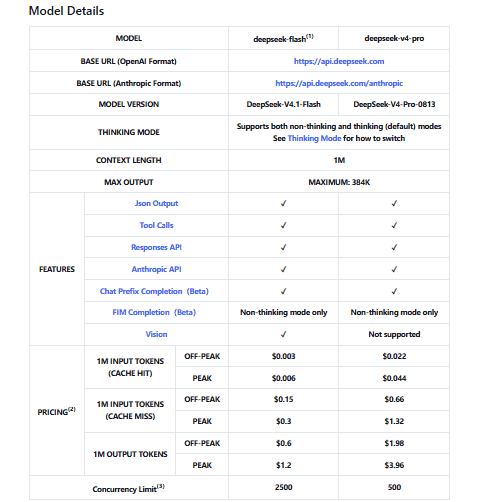
Use deepseek-flash if you need Vision, lower per-token pricing, or higher public account-level concurrency. Evaluate deepseek-v4-pro when you need its Pro model behavior for higher-end text, coding, reasoning, or agent workloads and the higher cost and lower concurrency limit are acceptable.
Open weights, MIT license, and self-hosting
The DeepSeek-V4-Pro-0813 model card lists the model on Hugging Face with a model size of 1.7T parameters and a MIT License. It says the repository and model weights are licensed under the MIT License.
Open weights do not automatically mean that the training data, the complete training infrastructure, or every detail required to reproduce training is available. They also do not make deployment easy. Running a very large Mixture-of-Experts model requires substantial hardware, storage, inference engineering, monitoring, and security planning.
The model card includes examples and notes for Transformers, vLLM, SGLang, Docker Model Runner, quantized local apps, and DSpark speculative decoding. Treat those as model-card deployment resources, not as proof that the official hosted API behaves like a local server or that self-hosting will be cheaper for your workload.
Architecture and benchmarks: how to read them
The DeepSeek V4 paper describes the preview V4 series as Mixture-of-Experts models supporting a one-million-token context, with DeepSeek-V4-Pro preview described as a 1.6T-parameter model with 49B activated parameters. The paper also discusses architecture and optimization upgrades such as Compressed Sparse Attention, Heavily Compressed Attention, Manifold-Constrained Hyper-Connections, and the Muon optimizer.
The GA model card for DeepSeek-V4-Pro-0813 should not be collapsed into the preview paper without context. The model card lists V4-Pro-0813 as a 1.7T-parameter release that supersedes the preview version and adds DSpark speculative decoding. Use the paper for the V4-series architecture background, and use the current model card for the released V4-Pro-0813 details.
The model card reports benchmark results such as Terminal Bench 2.1, DeepSWE, Toolathlon-Verified, Agents’ Last Exam, AutomationBench, and DSBench. Those numbers are useful signals, especially for agentic and coding workloads, but they are model-card reported and come with evaluation context. For example, the model card notes that several code-agent tasks were evaluated with DeepSeek Harness minimal mode using max reasoning effort with temperature = 1.0 and top_p = 0.95.
Do not turn one benchmark into a universal claim. Your own workload may depend on prompts, tools, latency constraints, context length, API format, and whether you use the hosted API or local weights.
Who should use DeepSeek V4 Pro?
DeepSeek V4 Pro is worth evaluating when your workload is primarily text-based and may benefit from a stronger Pro model for reasoning, coding, and agentic tasks.
- Consider V4 Pro for: coding agents, long-context repository analysis, complex reasoning, tool-using agents, Responses API workflows, Anthropic-compatible workflows, and production agent tasks where Pro performance justifies the higher price.
- Consider Flash instead for: image understanding, lower-cost general API usage, workloads requiring higher public account-level concurrency, simple extraction, short routine responses, or tasks where Pro’s cost is not justified.
For app or web users, DeepSeek’s GA announcement described V4 Pro as available through Expert Mode. For API users, the important choice is the model ID and the current model table.
Migration checklist for developers
If you are updating code from V4 preview, old documentation, or a V4.1 Flash migration note, check the following before shipping:
- Use
deepseek-v4-proas the hosted API model ID. - Do not use
DeepSeek-V4-Pro-0813as the API model string unless the current API docs explicitly accept it. - Confirm V4 Pro is still listed in the current Models & Pricing page.
- Do not treat the old V4.1 Flash routing note as the final current status without checking the current model table.
- Use
deepseek-flashfor image input unless V4 Pro Vision support appears in a future official update. - Recheck cost using cached input, uncached input, output, and peak/off-peak pricing.
- Apply the 500-concurrent-connection account-level limit when planning production traffic.
- Keep Chat Completions, Responses API, and Anthropic API request shapes separate.
- Validate Tool Call arguments and JSON Output before using them in application logic.
Common mistakes and fixes
| Symptom or assumption | Likely issue | What to do |
|---|---|---|
DeepSeek-V4-Pro-0813 fails as a hosted API model name | The model-card name was used instead of the API model ID. | Use deepseek-v4-pro in the official hosted API. |
| The article or code says V4 Pro was discontinued | It may be relying on older V4.1 Flash phase-out wording. | Check the current Models & Pricing page, which currently lists continued V4 Pro API service. |
| Image input fails with V4 Pro | V4 Pro is not currently listed as Vision-capable. | Use deepseek-flash for image understanding. |
| The app expects image generation | Vision and image generation were confused. | Do not claim image generation unless a current official source supports it for that service. |
| Costs are higher than expected | V4 Pro is priced above Flash and uses peak/off-peak token rates. | Estimate using cached input, uncached input, output, and current pricing periods. |
| 429 errors appear under load | The app may be exceeding the public 500 concurrent-connection account-level limit. | Use queues, worker pools, and per-model concurrency caps. |
| A third-party route behaves differently | The model may be hosted by another provider with its own wrappers and limits. | Check that provider’s docs; do not transfer official DeepSeek API facts automatically. |
| Self-hosting is harder than expected | Open weights do not remove infrastructure requirements. | Review the model card, inference recipes, hardware needs, and operational costs before planning local deployment. |
Official resources
Use official sources for current implementation decisions, because model availability, pricing, and API behavior can change.
- DeepSeek-V4-Pro GA release
- DeepSeek API change log
- DeepSeek Models & Pricing
- DeepSeek V4.1 Flash release page
- DeepSeek Thinking Mode guide
- DeepSeek Tool Calls guide
- DeepSeek JSON Output guide
- DeepSeek Responses API guide
- DeepSeek Anthropic API guide
- DeepSeek Vision guide for Flash vision support and Pro non-support comparison
- DeepSeek-V4-Pro-0813 model card on Hugging Face
- DeepSeek V4 paper on arXiv
FAQ
Is DeepSeek V4 Pro still available?
Yes. The current official Models & Pricing page lists deepseek-v4-pro and says DeepSeek decided to continue providing V4 Pro API service after September 14, 2026, with billing unchanged.
What model name should I use in the API?
Use deepseek-v4-pro. DeepSeek-V4-Pro-0813 is the model version and Hugging Face model-card name, not the hosted API model ID shown in the official model table.
Was DeepSeek V4 Pro replaced by V4.1 Flash?
DeepSeek’s V4.1 Flash announcement included phase-out or routing language for V4 Pro, but the current Models & Pricing page says V4 Pro API service continues after September 14, 2026. Use current docs for implementation decisions.
Does DeepSeek V4 Pro support Vision?
No, not according to the current official model table. Use deepseek-flash for image understanding.
Does DeepSeek V4 Pro support Tool Calls and JSON Output?
Yes. The current model table lists Tool Calls, JSON Output, Responses API, and Anthropic API support for deepseek-v4-pro.
Are DeepSeek V4 Pro weights available?
Yes. The DeepSeek-V4-Pro-0813 model card is available on Hugging Face and lists the repository and model weights under the MIT License. Open weights do not automatically mean training data is open or that self-hosting is simple.
Is DeepSeek V4 Pro better than V4.1 Flash?
Not universally. V4 Pro is the higher-priced Pro route for text, reasoning, coding, and agent workloads. V4.1 Flash is cheaper, supports Vision, and has a higher public concurrency limit. Choose based on the task, feature needs, and measured performance for your workload.