

DeepSeek Engram is a research and architecture module from DeepSeek, not a consumer product, chatbot, browser extension, or standalone API model. It introduces conditional memory via scalable lookup: instead of making Transformer layers reconstruct static knowledge only through computation, Engram retrieves N-gram-based memory vectors from large learned tables and fuses them into hidden states.
In simple terms, Engram adds a memory sparsity axis alongside the computation sparsity used by Mixture-of-Experts models. MoE routes tokens through selected experts; Engram looks up selected memory rows. The official deepseek-ai/Engram repository describes it as the official implementation of the paper Conditional Memory via Scalable Lookup: A New Axis of Sparsity for Large Language Models.
Documentation checked: October 11, 2026. DeepSeek Engram is a technical research topic. Model cards, serving frameworks, repository code, and API behavior can change, so verify the official repository, model cards, and serving documentation before making engineering decisions.
DeepSeek Engram in one minute
DeepSeek Engram is an architectural idea and implementation for adding learned static memory to Transformer models. It is designed to help a model retrieve common or static patterns through scalable lookup rather than repeatedly rebuilding those patterns through ordinary neural computation.
The official README says Transformers lack a native primitive for knowledge lookup, while MoE scales capacity through conditional computation. Engram explores conditional memory as a complementary sparsity axis, using modernized N-gram embeddings for approximately O(1) lookup.
That makes Engram important for researchers and infrastructure engineers, but it does not mean ordinary users can “turn on Engram” in DeepSeek Chat or call a model named deepseek-engram through the API. When Engram appears in practical systems, it usually appears as part of a model checkpoint or serving runtime, not as a separate end-user feature.
What DeepSeek Engram is—and what it is not
| Term | Is it DeepSeek Engram? | What it means | Best source | Main caution |
|---|---|---|---|---|
| DeepSeek Engram | Yes | A conditional memory module that retrieves learned N-gram memory and fuses it into Transformer hidden states. | Official repository | It is a research/architecture module, not a consumer app. |
deepseek-ai/Engram | Yes | The official GitHub repository containing the README, paper PDF, demo code, and license file. | GitHub | The demo code is illustrative, not a full production stack. |
| Engram paper | Yes | The paper titled “Conditional Memory via Scalable Lookup: A New Axis of Sparsity for Large Language Models.” | Paper PDF | Paper-reported results are not the same as your own production benchmark. |
| Engram demo code | Partly | A standalone demonstration of the core logic and data flow. | Demo script | It mocks standard components and requires further optimization for real production use. |
| DeepSeek-V4.1-Flash Engram layers | Serving context | A model checkpoint can declare Engram layers, which a serving runtime may load and manage. | Model card and vLLM docs | This is not a user-facing Chat setting. |
| vLLM Engram support | Serving support | vLLM can enable Engram automatically when a checkpoint declares Engram layers. | vLLM Engram documentation | vLLM behavior does not automatically apply to every serving stack. |
| DeepSeek Harness | No | An agent harness/workspace for files, tools, plugins, and automation. | DeepSeek Harness | Harness is an agent/workspace product; Engram is a model-architecture module. |
| RAG or vector search | No | External document retrieval or semantic search outside the model’s learned parameters. | RAG/vector DB documentation | Engram is learned/static parametric memory, not a document retrieval pipeline. |
| KV cache | No | Runtime attention-state storage for the current generation/session. | Serving-system docs | KV cache stores current-session attention state; Engram stores learned memory rows. |
| Agent memory | No | Application-level remembered notes, tasks, or user history. | Agent framework docs | Engram does not mean DeepSeek remembers your chats. |
| Unrelated Engram tools | No | Other tools named Engram, including memory systems for AI coding agents. | Project-specific docs | Do not confuse name overlap with DeepSeek’s research module. |
What problem does Engram try to solve?
Transformer models spend a lot of computation transforming hidden states layer by layer. Some of that computation is dynamic and context-dependent, but some of it may effectively reconstruct common static patterns: frequent phrases, fixed associations, repeated lexical structures, or stable knowledge-like signals.
Mixture-of-Experts models address scaling by adding more conditional computation. Instead of activating all parameters for every token, the model routes a token through selected experts. That increases capacity without computing over the entire model on every step.
Engram asks a different question: can some capacity be stored as conditional memory rather than conditional computation? Instead of routing to an expert that performs computation, Engram retrieves a learned memory vector through a scalable N-gram lookup and lets the model decide how much of that memory to use.
The official repository frames this as a new axis of sparsity: MoE scales through conditional computation; Engram scales through conditional memory. This does not replace Transformers or MoE. It is meant to complement them.
How Engram works at a high level
The details are technical, but the core idea can be understood in two phases: retrieval and fusion.
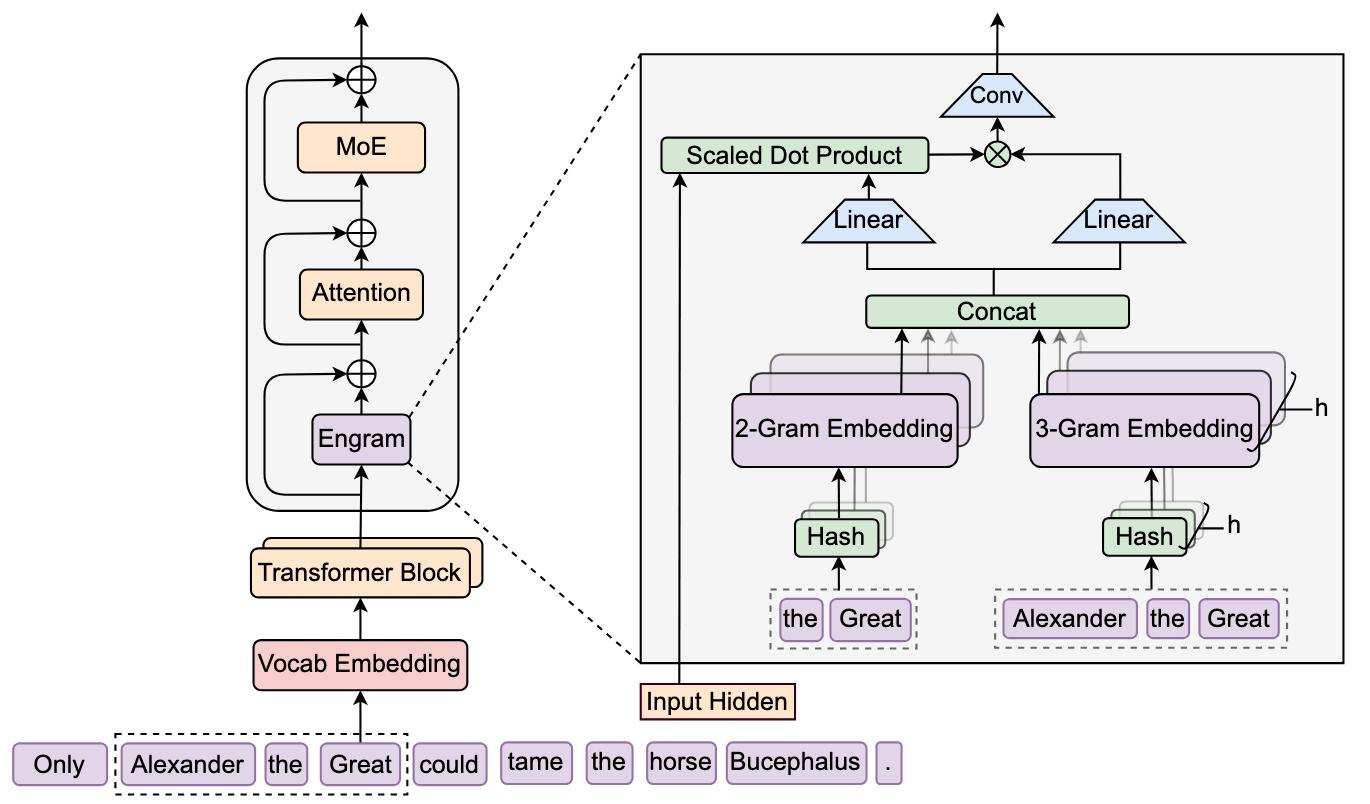
1. Retrieval: mapping local context to memory rows
Engram uses recent token context to form N-gram-style keys. Those keys are hashed into large learned memory tables. Instead of computing over every possible memory row, the model retrieves specific rows associated with the current local token pattern.
Serving documentation from vLLM describes a practical implementation in which token text can be canonicalized or compressed so normalized forms such as casing and whitespace variants map into a smaller space. Then multi-head hashing maps local suffix N-grams into table rows. This is where the “scalable lookup” part comes in.
2. Fusion: deciding whether the retrieved memory matters
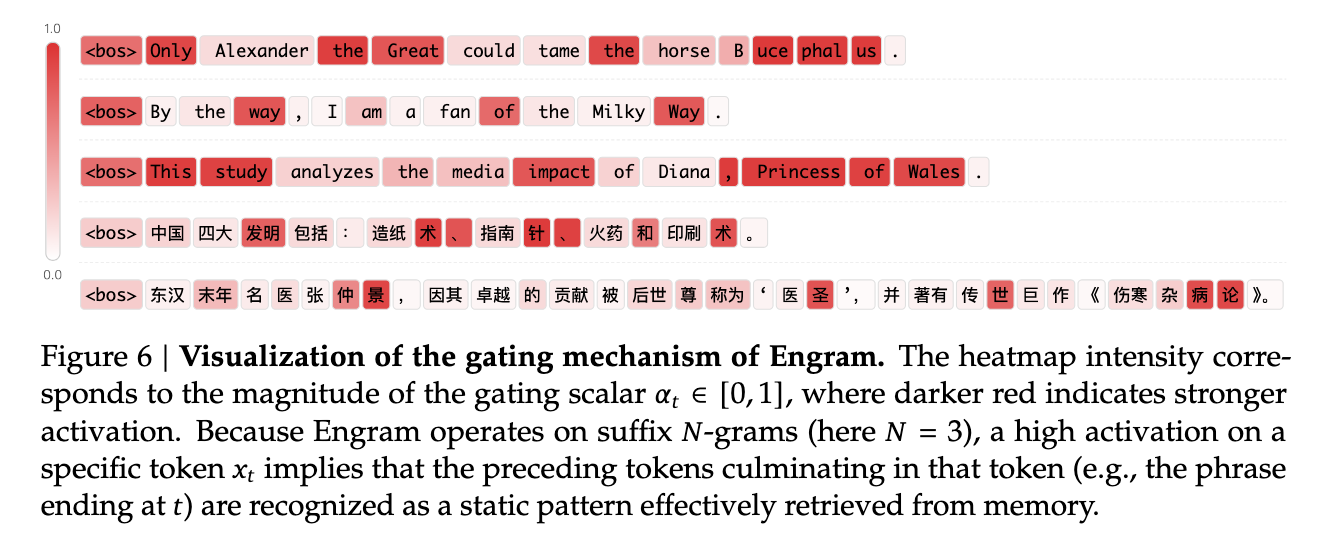
The retrieved memory is not automatically trusted. It is a context-independent prior and can be noisy because of hash collisions or ambiguous N-grams. Engram therefore uses a context-aware gating step: the model compares retrieved memory with the current hidden state and decides how strongly to fuse that memory into the representation.
This matters because the same short phrase can mean different things in different contexts. The fusion step gives the model a way to suppress memory that does not fit the current sequence.
3. Placement: Engram is not everywhere
Engram layers are inserted at specific positions in a model architecture or declared by a checkpoint. In the vLLM documentation, Engram layers are not chosen at serve time by the user; they are declared by the checkpoint configuration. That is why Engram should be understood as part of a model architecture, not as an ordinary runtime toggle.
Why O(1) lookup matters
O(1) lookup means that the system can retrieve memory by addressing a table entry directly rather than scanning over a growing collection of documents or computing over every parameter. In Engram’s design, N-gram hashing points to specific memory rows, so the lookup cost is roughly constant with respect to the total memory-table size.
This is important because it offers a different way to scale capacity. With more learned memory rows, the model can potentially store more static patterns without turning every token into a bigger dense computation. That is the architectural motivation. It does not mean inference becomes free, and it does not mean the system has no memory or bandwidth constraints.
The systems question becomes: where are these large tables stored, how are they prefetched, and how does serving software move them efficiently enough that lookup does not become the new bottleneck?
Engram vs MoE, RAG, KV cache, context window, and agent memory
| Concept | What it stores or retrieves | Where it lives | What it helps with | What it does not replace |
|---|---|---|---|---|
| Engram | Learned static memory rows addressed through N-gram-style lookup. | Inside the model architecture or checkpoint-defined serving path. | Static pattern lookup and memory/computation trade-offs. | It does not replace RAG, KV cache, or application memory. |
| MoE | Selected expert computation for each token. | Model layers. | Scaling compute capacity conditionally. | It does not provide direct static lookup memory. |
| RAG | External documents or chunks retrieved at prompt time. | Search index, vector database, or retrieval system outside the model. | Using fresh or private documents. | It does not change the model’s learned internal architecture. |
| KV cache | Attention key/value states for the current generation/session. | Serving runtime memory. | Efficient autoregressive generation within a request/session. | It does not store learned long-term knowledge. |
| Context window | Tokens provided to the model at inference time. | The current prompt/session. | Letting the model attend to recent or supplied information. | It is not persistent learned memory. |
| Context caching | Reused computation or cached prompt state for repeated context. | Provider or serving infrastructure. | Reducing repeated processing cost for repeated prompts. | It is not the same as Engram’s learned memory tables. |
| Vector database | External embeddings for semantic document search. | Application infrastructure. | Finding relevant documents or records. | It does not become part of model parameters. |
| Agent memory | Notes, histories, preferences, tasks, or summaries retained by an app. | Agent/application layer. | Personalization and multi-session task continuity. | It does not mean the underlying model architecture has Engram. |
| LoRA or adapters | Additional fine-tuned parameters. | Model adaptation layer. | Task/domain adaptation. | They are not scalable N-gram memory lookup tables. |
What the Engram paper claims
The official repository summarizes the paper’s main contributions around four ideas: sparsity allocation, empirical verification, mechanistic analysis, and system efficiency.
- Sparsity allocation: the paper formulates a trade-off between neural computation through MoE and static memory through Engram.
- Empirical verification: the repository summary reports that the Engram-27B model shows consistent improvements over MoE baselines under strict iso-parameter and iso-FLOPs constraints across knowledge, reasoning, code, and math domains.
- Mechanistic analysis: the repository summary says Engram appears to relieve early layers from static pattern reconstruction, potentially preserving effective depth for complex reasoning.
- System efficiency: deterministic addressing can allow massive embedding tables to be offloaded to host memory with minimal inference overhead, according to the repository summary.
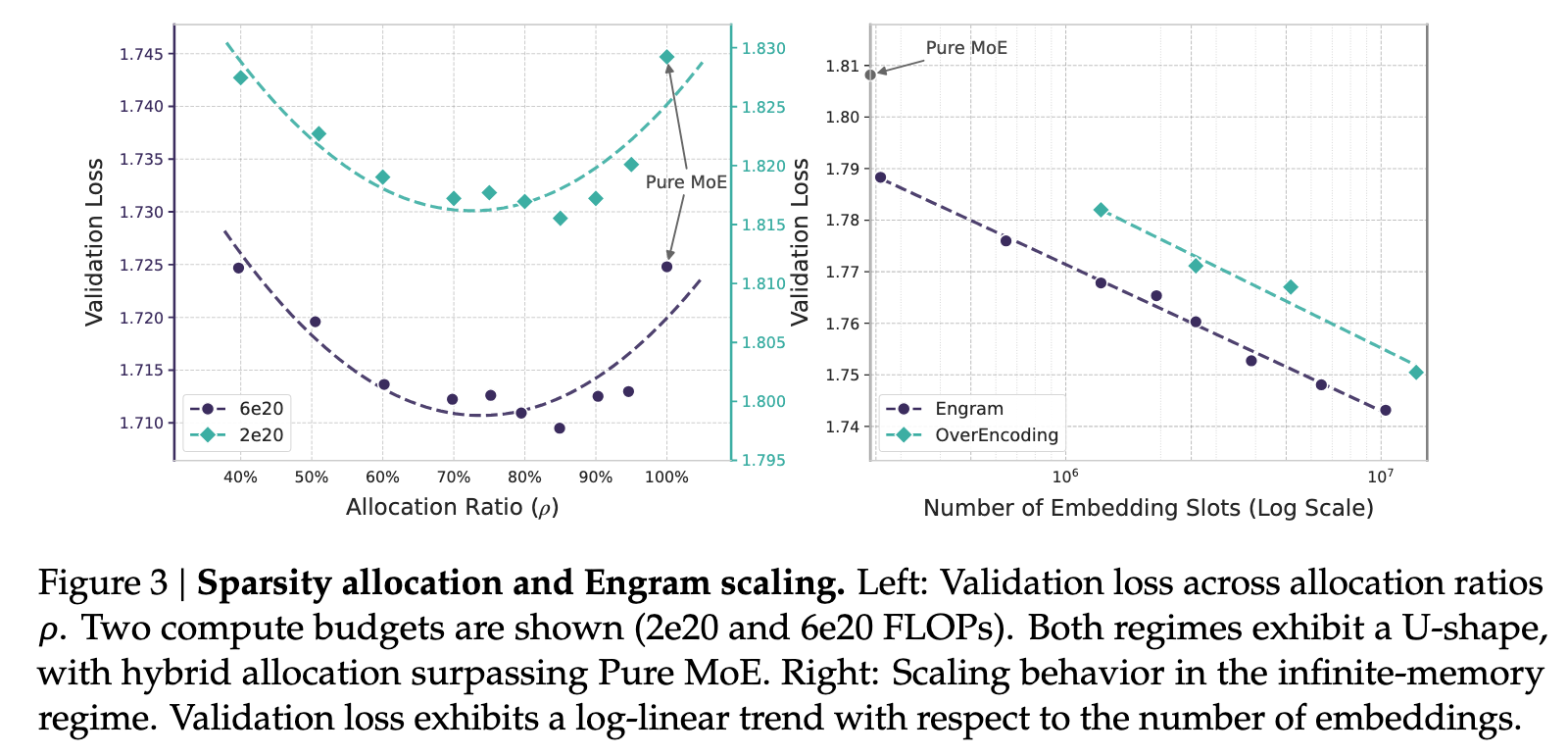
These are paper-reported and repository-reported claims. They are not a guarantee that every model, serving stack, workload, or hardware environment will see the same improvement. If you need production evidence, you still need your own benchmark on your own workload.
What Engram does not prove
Engram is important research, but it should not be inflated into a universal answer to all model-memory problems.
| Overclaim | More accurate reading |
|---|---|
| “Every LLM should use Engram.” | The paper explores a promising architecture direction; it does not prove every model or workload benefits. |
| “Engram replaces MoE.” | The paper frames Engram as complementary to MoE, not a replacement for conditional computation. |
| “Engram makes RAG obsolete.” | RAG retrieves external documents. Engram is learned/static memory inside the model architecture. They solve different problems. |
| “Engram solves HBM pressure completely.” | vLLM discusses host-memory offload for Engram tables, but serving still has hardware, bandwidth, topology, and runtime constraints. |
| “Small models automatically match larger frontier models.” | The paper reports controlled experimental gains; it does not give a universal replacement rule. |
| “DeepSeek API users can toggle Engram.” | Current public information treats Engram as an architecture/checkpoint/serving feature, not a generic API parameter. |
| “The GitHub demo is production-ready.” | The demo states that it illustrates core logic, requires further optimization, and mocks major components to focus on Engram data flow. |
How Engram relates to DeepSeek-V4.1-Flash and vLLM
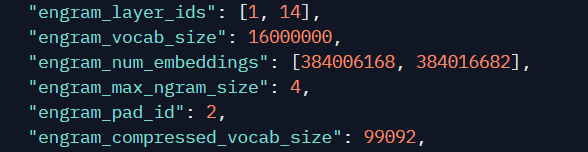
DeepSeek Engram becomes practically visible when model checkpoints and serving runtimes expose it. The vLLM Engram documentation says vLLM enables Engram automatically whenever the checkpoint declares Engram layers. It also lists deepseek-ai/DeepSeek-V4.1-Flash as an example architecture using the engram_layer_ids configuration field.
The DeepSeek-V4.1-Flash model card describes V4.1 Flash as a multimodal MoE model with 552B backbone parameters, a 1M-token context window, image-and-text processing, and text generation. Its Hugging Face page also shows local/serving routes such as Transformers, vLLM, SGLang, Docker Model Runner, and quantization browsing.
In serving terms, this means Engram is not something the user adds to a random model at runtime. A checkpoint declares Engram layers, and a compatible runtime such as vLLM can load and manage them.
Why CPU or host-memory offload matters
vLLM’s documentation says Engram tables can be very large. For DeepSeek-V4.1-Flash, it describes two Engram layers with roughly 384 million table rows each and about 200 GB of table weights alone. Because the lookup indices are deterministic from token IDs, vLLM can store those tables in pinned host memory and prefetch them while preceding layers compute.
That is a serving-runtime optimization, not a general promise that all Engram models are easy to run. It also does not mean every system supports the same path: vLLM notes CUDA-alike platform requirements and other limitations.
Serving caveats from vLLM
vLLM lists several limitations for Engram serving. It says Engram support is for CUDA-alike platforms, DeepSeek V4.1 Engram does not support DBO or microbatching, and certain shared-memory table modes require CPU offload, data parallelism, and compatible process topology. Treat those as engineering constraints, not minor footnotes.
What the GitHub demo is—and is not
The official repository includes engram_demo_v1.py. It is useful if you want to understand the core data flow, but it is not a full training or production inference stack.
The demo file itself says it is a demonstration version intended to illustrate the core logic and data flow of the Engram module. It also says the implementation requires further optimization for production use, such as custom CUDA kernels and distributed training support, and that standard components such as normalization, attention, MoE, and complex Hyper-connection mechanisms are omitted or mocked.
Use the demo to learn the idea. Do not use it as evidence that you can deploy a full Engram-powered model by running one script.
Who should care about DeepSeek Engram?
| Reader | Why Engram matters | What to do next |
|---|---|---|
| LLM architecture researchers | Engram proposes conditional memory as a second sparsity axis beside MoE. | Read the paper and compare the method with MoE, RETRO-style retrieval, RAG, and learned memory variants. |
| Infrastructure engineers | Large lookup tables, deterministic addressing, host-memory offload, and serving topology affect runtime design. | Study the vLLM Engram docs and model-card serving notes before deployment. |
| Developers using DeepSeek API | Engram may explain model architecture choices, but it is not a normal API switch. | Use current DeepSeek API docs for implementation. Do not invent an Engram parameter. |
| Local model users | Engram layers can affect serving memory, runtime requirements, and vLLM configuration. | Check the exact checkpoint, model card, runtime version, and hardware/runtime support. |
| General DeepSeek users | Engram is mostly background architecture, not a chat feature. | Use DeepSeek Chat/API normally unless you are studying model internals or serving open weights. |
| Editors and writers | The term is easy to confuse with agent memory, RAG, or DeepSeek Harness. | Define it precisely before writing about it. |
Should you “use” DeepSeek Engram?
Use DeepSeek Engram resources if you are studying model architecture, reading the DeepSeek-V4.1-Flash model card, evaluating serving support in vLLM, or researching the memory/computation trade-off in large language models.
You probably do not need Engram directly if you only want normal DeepSeek Chat, a basic API integration, a RAG pipeline, a vector database, or an AI coding-agent memory tool. For those tasks, the right resource is DeepSeek Chat, DeepSeek API, DeepSeek Harness, a retrieval system, or an agent framework—not the Engram research module.
For local or self-hosted models that include Engram layers, the answer changes: then Engram becomes part of the serving problem. You need to check model-card instructions, runtime support, CPU/GPU memory behavior, and known limitations before planning deployment.
Common misconceptions about DeepSeek Engram
| Myth | More accurate answer | What to check |
|---|---|---|
| “DeepSeek Engram is a new chatbot.” | No. It is a research and architecture module for conditional memory. | Official Engram repository. |
| “Engram is the same as DeepSeek Harness.” | No. Harness is an agent workspace; Engram is a model-architecture module. | DeepSeek Harness page vs Engram repository. |
| “Engram is a memory plugin for coding agents.” | No. Other projects may use the name Engram, but DeepSeek Engram is about learned N-gram memory inside model architecture. | Project owner and repository. |
| “Engram is just RAG.” | No. RAG retrieves external documents; Engram retrieves learned/static memory rows inside the model architecture. | Engram paper and RAG system docs. |
| “Engram replaces MoE.” | No. It is described as complementary to MoE’s conditional computation. | Official repository abstract and paper. |
| “Engram replaces KV cache.” | No. KV cache stores current-session attention state; Engram is learned memory lookup. | Serving docs and architecture docs. |
| “Engram means DeepSeek remembers my chats.” | No. Engram is not user chat memory or personalization. | DeepSeek product docs and privacy docs. |
| “Engram is an API model ID.” | No. Do not call deepseek-engram unless official API docs ever expose such a model ID. | Current DeepSeek API model table. |
| “Engram makes inference free.” | No. It may shift memory/computation trade-offs, but inference still has model, runtime, hardware, and bandwidth costs. | Model card and serving runtime docs. |
| “The GitHub demo is a full implementation.” | No. It is an educational demonstration of core logic and data flow. | Demo file disclaimer. |
| “Every DeepSeek model uses Engram.” | No. Engram layers must be declared by the checkpoint or architecture. | Model card and runtime config. |
| “vLLM support means every serving stack supports Engram.” | No. vLLM documents its own support and limitations. Other serving stacks need separate verification. | Runtime documentation. |
Implementation and deployment caveats
- Engram is checkpoint-defined. You cannot safely assume that any model can use Engram unless its architecture/config declares Engram or equivalent layers.
- Serving support is runtime-specific. vLLM documents Engram support, but other frameworks may differ or not support the same path.
- Memory tables can be large. vLLM’s DeepSeek-V4.1-Flash documentation describes Engram table weights at a scale that requires careful host/GPU memory planning.
- Offload is not magic. CPU/host-memory offload can help GPU memory, but it depends on unified virtual addressing, data-parallel layout, shared memory, and bandwidth.
- The demo is not production proof. The official demo intentionally mocks major model components to focus on the Engram module.
- Licensing must be checked per artifact. The repository displays an Apache-2.0 license, but model checkpoints and downstream releases should be checked through their own model cards and license files before deployment.
- Benchmarks need context. Paper-reported improvements are valuable, but production workloads still require your own evaluation.
Official resources for DeepSeek Engram
Use these primary resources before relying on secondary summaries:
- DeepSeek Engram official GitHub repository
- DeepSeek Engram README
- Engram paper PDF
- Engram demo implementation
- Engram repository license file
- DeepSeek-V4.1-Flash model card
- vLLM Engram serving documentation
- DeepSeek official GitHub organization
- DeepSeek official Hugging Face organization
Final takeaway
DeepSeek Engram is best understood as a model-architecture research module that introduces conditional memory through scalable N-gram lookup. It is not a chatbot, not DeepSeek Harness, not RAG, not KV cache, and not a standalone API model.
Its core idea is simple but important: MoE gives models conditional computation; Engram gives them conditional memory. That distinction matters for architecture research and model serving, especially when checkpoints such as DeepSeek-V4.1-Flash declare Engram layers and runtimes such as vLLM support them.
For ordinary DeepSeek users, Engram is mostly background architecture. For researchers and infrastructure engineers, it is a serious idea to study because it changes the memory-versus-computation design space for large language models.
FAQ
What is DeepSeek Engram?
DeepSeek Engram is a conditional memory module introduced by DeepSeek. It retrieves learned N-gram-based memory vectors from large tables and fuses them into Transformer hidden states. It is an architecture module, not a consumer product.
Is Engram a DeepSeek model?
No. Engram is not a standalone model or API model ID. It can be part of a model architecture or checkpoint, but it is not itself a chatbot or hosted model route.
Is DeepSeek Engram the same as DeepSeek Harness?
No. DeepSeek Harness is an agent harness/workspace for files, plugins, tools, and automation. DeepSeek Engram is a conditional memory module inside a model architecture.
Is Engram the same as RAG?
No. RAG retrieves external documents or chunks at inference time. Engram retrieves learned/static memory rows inside the model architecture. They can both relate to “memory,” but they work at different layers of the system.
How does Engram differ from MoE?
MoE scales capacity through conditional computation: tokens are routed to selected experts. Engram scales capacity through conditional memory: tokens address learned memory rows through scalable lookup and fuse the result into hidden states.
How does Engram differ from KV cache?
KV cache stores attention state for the current generation or session. Engram stores learned memory rows as part of model architecture. KV cache helps generation efficiency; Engram changes how learned static memory can be retrieved.
Does DeepSeek-V4.1-Flash use Engram?
Serving documentation from vLLM lists DeepSeek-V4.1-Flash as an example checkpoint that declares Engram layers through engram_layer_ids. Check the current model card and serving docs before deployment, because support depends on the checkpoint and runtime.
Can I turn Engram on in the DeepSeek API?
Current public documentation does not present Engram as a normal API parameter that users toggle. It is an architecture/checkpoint/serving feature, not a generic API option.
Can I run Engram locally?
You can study the official demo repository, and you may serve checkpoints that include Engram layers through a compatible runtime such as vLLM where supported. Running an Engram-equipped full model is an infrastructure task, not a one-command beginner setup.
Is the GitHub demo production-ready?
No. The demo file says it is intended to illustrate the core logic and data flow of the Engram module. It also says production use would require further optimization and that standard components are omitted or mocked.
Does Engram make RAG obsolete?
No. RAG remains useful for external, fresh, private, or document-specific information. Engram is a learned internal memory mechanism, not a replacement for search or retrieval pipelines.
What should developers verify before serving an Engram model?
Verify the exact checkpoint, model card, license, serving runtime, Engram layer declarations, CPU/GPU memory behavior, host-memory offload settings, platform support, and runtime limitations. Do not generalize from one vLLM example to every serving system.